
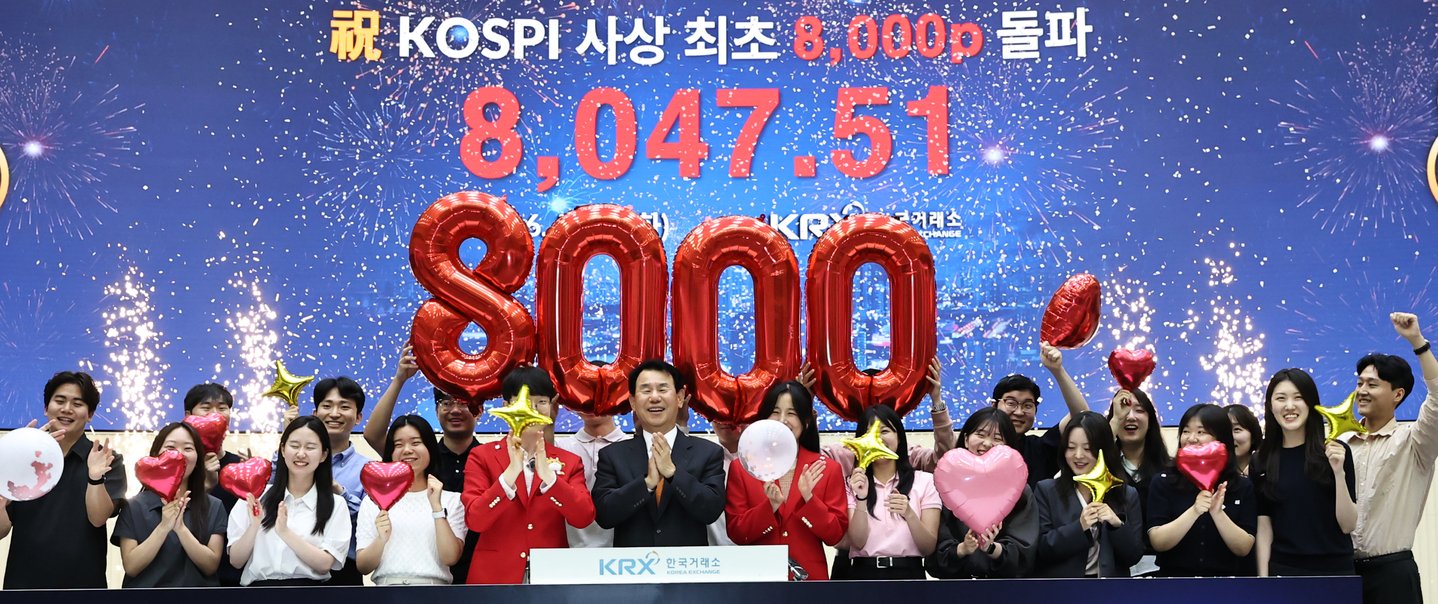
![Korea Exchange Chairman Jeong Eun-bo, center, celebrates Kospi closing past 8,000 points in a ceremony held at its office in western Seoul on May 26. The Kospi on the day rose 2.55 percent to close at a record 8,047.51. [YONHAP]](https://fundfocusnews.co.uk/wp-content/uploads/2026/05/d87b53d2-ea69-4ec8-a684-086f910c629e.jpg)
Korea Exchange Chairman Jeong Eun-bo, center, celebrates Kospi closing past 8,000 points in a ceremony held at its office in western Seoul on May 26. The Kospi on the day rose 2.55 percent to close at a record 8,047.51. [YONHAP]
Exchange-traded funds (ETF) tracking Samsung Electronics and SK hynix shares at twice their daily movement are set to debut on Korea’s stock market on Wednesday, raising concerns that the government may be prioritizing market stimulus over financial stability.
The products include 16 leveraged ETFs designed to deliver gains or losses equal to two times the daily movement of the underlying shares, along with two inverse ETFs that move in the opposite direction. The combined value of the planned listings amounts to 4.32 trillion won ($2.88 billion).
More than 130,000 investors have already completed mandatory education courses required to purchase the products. Industry estimates suggest the launch could attract more than 5 trillion won in fresh investment funds.
These ETFs are considered extremely high-risk products because leverage magnifies both gains and losses. Given Korea’s daily stock price movement limit of 30 percent, investors could theoretically record gains or losses of up to 60 percent in a single day.
The risks become even greater when share prices move sideways over an extended period. In such cases, the so-called negative compounding effect can rapidly erode returns, potentially wiping out an investor’s principal entirely.
Because of those risks, financial authorities had previously refused to allow leveraged or inverse ETFs tied to individual stocks. The government’s position changed late last year after the sharp rise in the won-dollar exchange rate accelerated investment by retail investors into overseas markets.
Authorities appear to have approved the Samsung Electronics and SK hynix products partly to lure individual investors back into Korea’s domestic market. The concern, however, is that such products could pour fuel onto an already overheated market and sharply increase volatility.
The Kospi, which closed above the 8,000-point threshold for the first time on Tuesday, already ranks among the world’s most volatile major indexes. Samsung Electronics and SK hynix, the underlying assets of the ETFs, also experience frequent sharp swings in share prices.
Because the two companies together account for nearly half of the Kospi’s total market capitalization, concentrated inflows into the leveraged ETFs could destabilize not only the two stocks themselves but the broader Korean market.
Although the Kospi has surged enough to become the world’s seventh-largest stock market by capitalization, underlying conditions remain fragile.
Margin lending balances have also climbed to a record 36 trillion won. Despite mounting uncertainty surrounding the market, the government is considering additional measures to support stock prices, including increasing the National Pension Service’s allocation to domestic equities.
Stimulating the market cannot become the government’s sole priority. Authorities must also strengthen safeguards against the shocks that excessive volatility could bring.
삼전·하이닉스 레버리지 ETF 상장…증시 군불만 땔 건가
삼성전자와 SK하이닉스 주가를 2배로 추종하는 상장지수펀드(ETF)가 오늘 증시에 상장된다. 주가 변동 폭을 플러스 2배로 추종하는 레버리지(16개)와 마이너스 2배로 추종하는 인버스(2개) 상품 18개다. 예정된 상장 규모만 4조3227억원에 달한다. 해당 상품 투자를 위해 이수해야 하는 사전 교육 수료자만 13만 명을 넘었다. 업계는 상품 출시에 따른 자금 유입 효과를 5조원 이상으로 추산한다.
해당 상품은 ‘지렛대 효과’로 인해 이익과 손실이 증폭되는 초고위험 상품이다. 국내 주식의 가격 제한 폭(±30%)을 감안하면 하루 만에 최대 60%의 이익이나 손실을 볼 수 있다는 이야기다. 개별 종목의 주가가 횡보할 경우 ‘음의 복리 효과’로 해당 상품의 손실이 눈덩이처럼 커져 원금을 모두 날릴 수도 있다.
이런 위험으로 인해 금융 당국은 그동안 개별 종목 레버리지·인버스 ETF를 허용하지 않았다. 당국의 입장이 바뀐 건 지난해 말 환율 급등 사태 때문이다. 서학개미를 국내 증시로 끌어들이려 삼성전자와 하이닉스 2배 레버리지·인버스 ETF를 유인책으로 내놓은 것이다. 문제는 이들 상품이 과열 장세에 기름을 붓고 시장의 변동성을 과도하게 키울 수 있다는 데 있다.
어제 종가 기준으로 사상 처음 8000 고지를 밟은 코스피의 변동성은 세계 최고 수준이다. 이들 상품의 기초자산인 삼성전자와 하이닉스 주가도 널뛰기 일쑤다. 특히 두 종목의 시가총액이 코스피의 절반에 육박하는 상황에서 해당 상품으로의 자금 쏠림이 심화할 경우 이들 종목의 주가뿐 아니라 국내 증시 전체를 뒤흔들 수 있다.
코스피 시총이 세계 7위에 오를 만큼 강세지만 시장 상황은 만만치 않다. 글로벌 금리 인상 가능성이 커지며 지난주 외국인 투자자는 10조원이 넘는 순매도를 기록했다. 신용거래융자 잔고는 36조원대로 역대 최고 수준이다. 증시를 둘러싼 불확실성이 커지고 있지만 정부는 개별 종목 레버리지 ETF 출시에 이어 국민연금의 국내 주식 투자 비중을 높이는 카드도 만지작거리고 있다. 정부가 마냥 증시 부양을 위해 군불만 때는 건 옳지 않다. 시장의 변동성이 야기할 충격을 막을 수 있도록 리스크 관리에도 만전을 기해야 한다.
This article was originally written in Korean and translated by a bilingual reporter with the help of generative AI tools. It was then edited by a native English-speaking editor. All AI-assisted translations are reviewed and refined by our newsroom.