
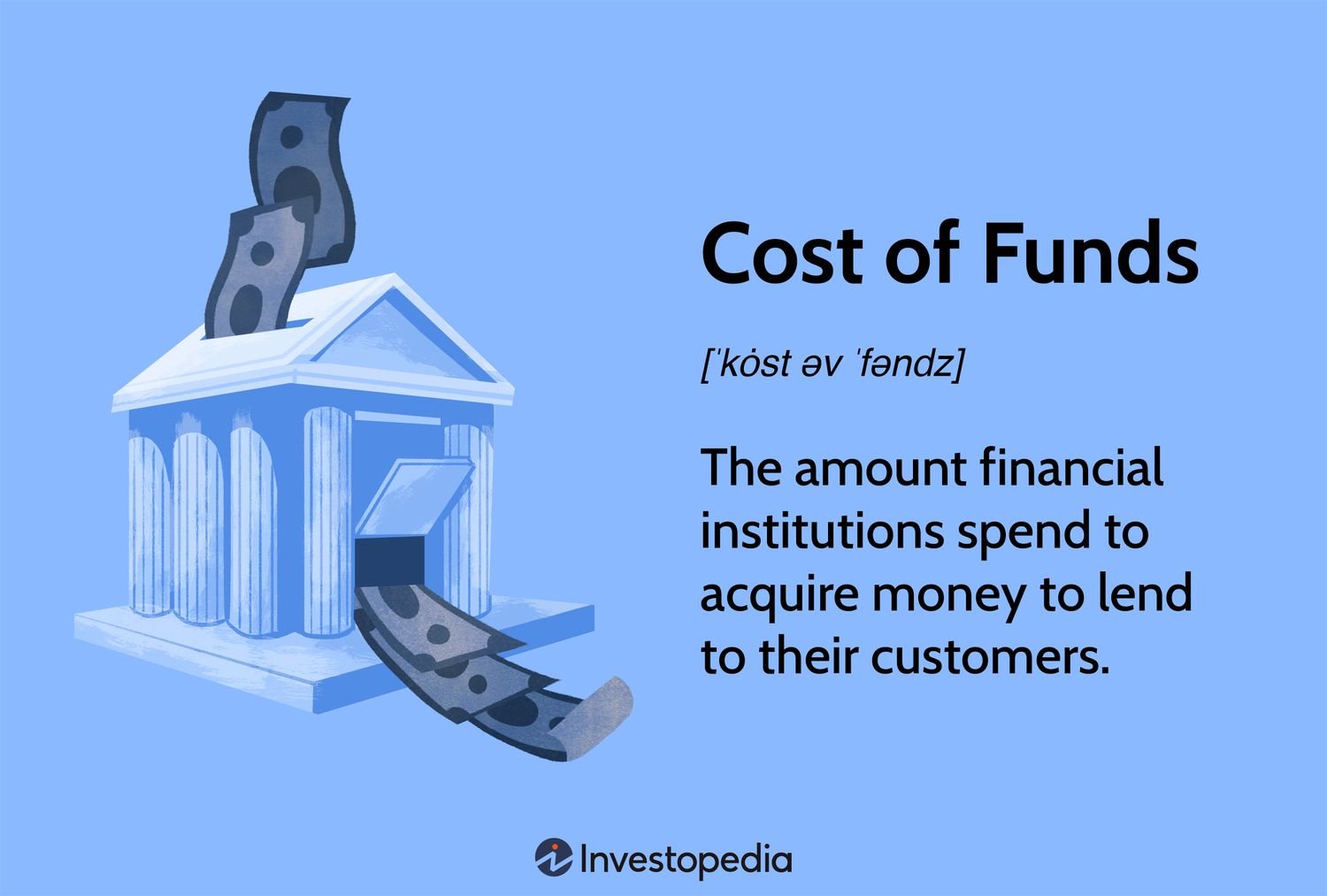
What Is the Cost of Funds?
Banks and financial institutions rely on the cost of funds to determine the interest rates they charge to borrowers. This cost represents the interest paid when borrowing from Federal Reserve banks. The margin between this cost and the lending rate is crucial for financial institutions’ profitability. Borrowers face higher interest rates when the cost is high, affecting credit accessibility.
Key Takeaways
- The cost of funds is the interest rate banks and financial institutions pay to acquire money for lending purposes.
- A lower cost of funds leads to greater profitability for banks, as it reduces expenses when issuing loans.
- The spread between the cost of funds and the interest rate charged to borrowers is a primary source of profit for banks.
- The Federal Reserve’s federal funds rate directly influences the cost of funds and thus, the interest rates banks offer to borrowers.
- While the cost of funds pertains to how banks acquire funds, the cost of capital refers to the total financial requirement for a business’s operations.
Get personalized, AI-powered answers built on 27+ years of trusted expertise.
Investopedia / Theresa Chiechi
Key Components and Implications of Cost of Funds
Borrowing money involves costs for both individuals taking a mortgage and banks providing it. For banks, the costs associated with borrowing are called the cost of funds.
In simpler terms, it’s how much in interest a bank has to pay in order to borrow money to lend to its consumers. The cost of funds is paid by banks and other financial institutions to a Federal Reserve bank.
For lenders, such as banks and credit unions, the cost of funds is determined by the interest rate paid to depositors on financial products, including savings accounts and time deposits. The term is often used and analyzed by the financial industry as a whole, so most corporations are also significantly affected by the cost of funds when borrowing.
Cost of funds and net interest spread are key ways in which many banks make money. Commercial banks charge interest rates on loans and other products that consumers, companies, and large-scale institutions need.
Note
The interest rate banks charge on such loans must be greater than the interest rate they pay to obtain the funds initially—the cost of funds.
The Significance of Cost of Funds in the Financial System
Understanding the link between the cost of funds and interest rates is crucial for grasping the U.S. economy. Interest rates are determined in a number of ways. While open market activities play a key role, so does the federal funds rate.
According to the Fed, the federal funds rate is “the interest rate at which depository institutions lend reserve balances to other depository institutions overnight.” This applies to the biggest, most credit-worthy institutions as they seek to maintain the mandated amount of reserves required. Reserve requirements are limits set by the Federal Reserve that outline how much banks must hold in their vaults or at the nearest Federal Reserve bank in line with their deposits.
The fed funds rate serves as a base for determining all other U.S. interest rates. It’s a crucial indicator of the U.S. economy’s health. The Federal Reserve’s Federal Open Market Committee (FOMC) issues the desired target rate in response to economic conditions as part of its monetary policy to maintain a healthy economy.
For instance, during a period of rampant inflation in the early 1980s, the Fed funds rate soared to 20%. In the wake of the Great Recession in 2007 and the ensuing global financial crisis (which led to the European sovereign debt crisis), the FOMC maintained a record low target interest rate of 0% to 0.25% to encourage growth.
Important
The Federal Reserve announced it would raise interest rates after its FOMC meeting in March 2022 amid persistent, rising inflation. The target range was increased 25 basis points to 0.25% to 0.50% from 0% to 0.25% to help fight inflation. This was the first time the central bank raised interest rates since 2018. Rates continued to rise until they reached 5.25% to 5.50% in July 2023. The Federal Reserve has maintained interest rates since then and the target range remains at 2023 levels as of July 2024.
Determining the Cost of Funds: Key Influences
Sources of funds that financial institutions can access for a cost can fall into several categories. The primary source of funds is bank deposits, which are also called core deposits. These usually come as checking or savings accounts, generally at low rates. Other categories include:
- Shareholder equity
- Debt issuance
- Wholesale money, or cash that is found in money markets and lent by banks
Banks issue a variety of loans, with consumer lending comprising the lion’s share in the U.S. Mortgages on property, home equity lending, student loans, car loans, and credit card lending can be offered at variable, adjustable, or fixed interest rates.
The net interest spread, or the difference between the interest earned on loans and paid on deposits, indicates a financial institution’s profit. Akin to a profit margin, the greater the spread, the more profit the bank realizes. Conversely, the lower the spread, the less profitable the bank.
Cost of Funds vs. Cost of Capital: Key Differences and Similarities
Although they may seem the same, the cost of funds isn’t the same as the cost of capital. Remember that the cost of funds refers to how much banks pay in order to acquire funds to lend to their customers. The cost of capital, though, is the total amount of money a business requires to get the money it needs for its operations.
When a business needs money (or its cost of capital), it can turn to one or more sources to raise the money. It can turn to a bank, from which it can lend capital. Some businesses also turn to their own equity to fund their operations and achieve their goals.
How Do You Calculate the Cost of Funds?
To calculate the cost of funds, multiply the borrowed amount by the interest rate, then multiply by the time period.
Who Pays the Cost of Funds?
Primarily, the cost of funds is paid by banks to the Federal Reserve when they borrow from the U.S. central bank. But most businesses and individuals that borrow also bear the burden of the cost of funds in the form of the interest rate spread they are required to cover for their lenders.
What Is the Fed Funds Rate and How Does It Affect the Cost of Funds?
The Federal Reserve Fed funds rate, also known as the “Fed funds rate,” is the interest rate at which depository institutions lend reserve balances to other depository institutions overnight. It is a base interest rate by which all other interest rates in the U.S. are determined, so the Fed funds rate shapes the interest rate banks charge on loans, as it must be greater than the interest rate they pay to obtain the funds initially, which is the cost of funds.
The Bottom Line
The cost of funds is the interest rate financial institutions pay to acquire capital, often from Federal Reserve banks, for lending and reserves. This cost directly impacts a bank’s profitability, as the spread between the cost of funds and the rates charged to borrowers constitutes a key revenue source. When the cost of funds is low, banks can offer loans at competitive rates, benefiting both the institutions and their customers. Conversely, higher costs of funds result in increased lending rates, thus affecting consumer loan affordability. Understanding this relationship is crucial, as it influences the broader economic environment and the financial decisions of individuals and businesses.