

Dedicated international funds have been among the better-performing diversification options for Indian investors, but many of them are not easy to access today. With industry-level overseas investment limits largely exhausted, several schemes have suspended or restricted fresh inflows. For investors still looking for global exposure, the workaround may lie within domestic equity-oriented schemes themselves.
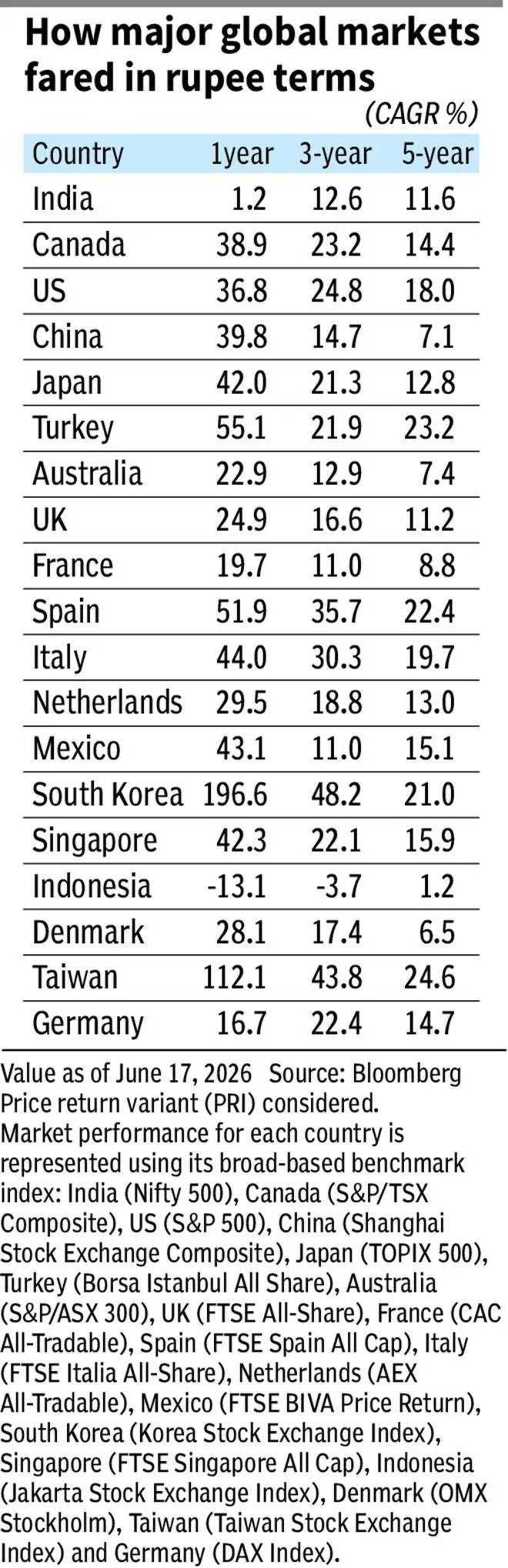
Over the past year, while the Nifty 100 Total Return Index delivered virtually flat returns, some international funds generated very attractive returns. Major global indices also posted strong gains in rupee terms, with the S&P 500 returning 25 per cent, the Shanghai Composite 21 per cent, the Nikkei-225 83 per cent and Brazil’s Ibovespa 21 per cent.
However, gaining exposure to overseas markets through dedicated international funds is not straightforward. The RBI has capped the mutual fund industry’s overseas investments at $7 billion, with an additional $1-billion limit for overseas ETFs. As these limits have largely been exhausted, many international funds have suspended or restricted fresh subscriptions. Consequently, among the 66 dedicated international funds available, only a handful remain open for investments at any given time. This makes it difficult for investors to access overseas opportunities.
Interestingly, several domestic equity schemes, which are required to maintain at least 65 per cent exposure to Indian equities, have quietly built meaningful allocations to overseas stocks.
Currently, 40 such schemes hold overseas exposure of up to 29 per cent of their portfolios. Together, the overseas allocation of these schemes stood at ₹35,941 crore, compared with ₹84,142 crore managed by dedicated international funds. They span categories such as flexi-cap, value, contra, multi-asset and aggressive hybrid funds, as well as sectoral and thematic strategies focussed on technology, healthcare, innovation and commodities.
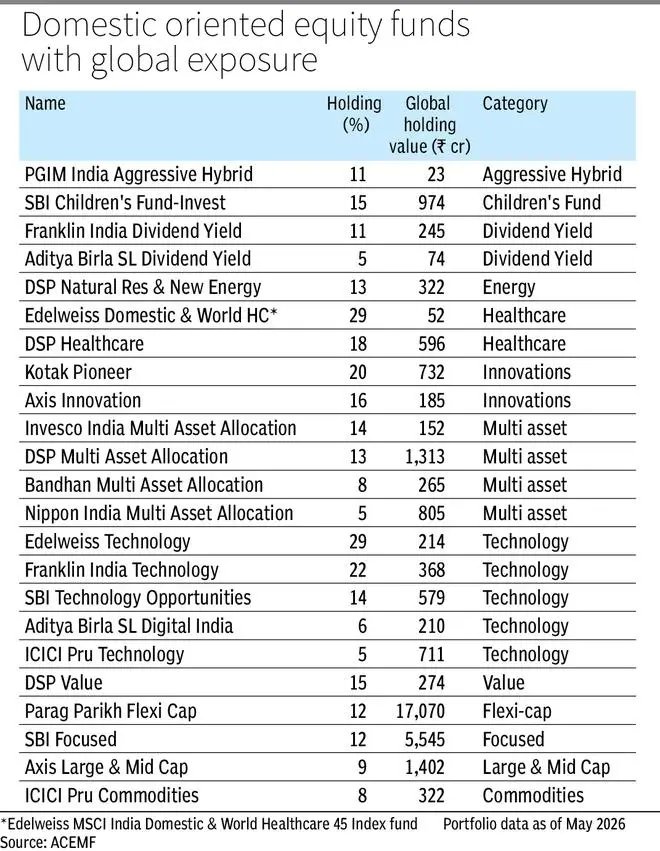
Here, we analysed the portfolio composition, performance and suitability of 24 domestic mutual fund schemes that allocate at least 5 per cent of their assets to overseas equities.
Flexi-cap funds
Among flexi-cap funds, Parag Parikh Flexi Cap had 12 per cent of its assets, or ₹17,070 crore, invested in overseas equities as of May 2026. It has been one of the category’s most consistent long-term performers. Its value-oriented investment approach, strategic international allocation and timely cash calls have helped it emerge as a category leader. Historically, the fund invested up to 30 per cent of its portfolio overseas, though the allocation varies based on market conditions and regulatory constraints. Over the past three years, its international allocation has declined from 30 per cent to 12 per cent. The overseas portfolio is primarily concentrated in leading US technology companies such as Alphabet, Amazon, Facebook and Microsoft. The fund’s five-year annualised return of 14 per cent is ahead of the category average of 12 per cent. However, the fund’s strong return cannot be attributed to overseas exposure alone.
Focused funds
SBI Focused Fund held 12 per cent of its assets, or ₹5,545 crore, in overseas equities. The fund has tactically maintained international exposure between 5 per cent and 15 per cent over the past five years. Its current overseas portfolio is concentrated in two holdings — Alphabet and EPAM Systems. The fund’s five-year annualised return of 13 per cent exceeds the category average of 12 per cent.
Value funds
DSP Value Fund held 15 per cent of its assets, or ₹274 crore, in overseas equities. Its international portfolio is diversified across sectors such as technology, healthcare, industrials and energy, and across regions including the US, Europe, China, Taiwan and Canada. Key overseas holdings include Amazon, Microsoft and NVIDIA. Over five years, it has delivered an annualised return of 14 per cent, in line with the category average.
Dividend yield funds
Two schemes, Franklin India Dividend Yield and Aditya Birla Sun Life Dividend Yield, held overseas allocations of 11 per cent and 5 per cent respectively.
Franklin India Dividend Yield Fund’s international allocation has ranged between 11 per cent and 19 per cent over the past five years. It primarily invests in dividend-yielding stocks in emerging markets such as China, South Korea and Taiwan. Aditya Birla Sun Life Dividend Yield Fund, on the other hand, favours the US and global companies such as Starbucks, L’Oréal and Microsoft. Over the past five years, these funds have delivered annualised returns of 14 per cent and 15 per cent respectively, compared with the category average of 15 per cent.
Children’s fund
SBI Children’s Fund-Investment is the only scheme in the children’s fund category with overseas exposure. It allocated 15 per cent of its assets, or ₹974 crore, to international equities. Its overseas portfolio includes Alphabet, ReNew Energy Global and EPAM Systems. Structured as a hybrid fund, it has delivered a strong five-year annualised return of 24 per cent. However, the fund’s strong return cannot be attributed to overseas exposure alone, given its broader hybrid portfolio.
Multi-asset funds
Of the 34 multi-asset allocation funds (MAA), four schemes held overseas exposure: Invesco India MAA (14 per cent), DSP MAA (13 per cent), Bandhan MAA (8 per cent) and Nippon India MAA (5 per cent).
Invesco India MAA gains overseas exposure through the Invesco US Value Equity Fund, while the other schemes invest globally through ETFs and direct equities. Their one-year returns stood at 15 per cent, 18 per cent, 16 per cent and 16 per cent respectively. The one-year return has been highlighted because most of these schemes do not yet have a five-year track record.
Technology funds
Five technology funds held overseas exposure: Edelweiss Technology (29 per cent), Franklin India Technology (22 per cent), SBI Technology Opportunities (14 per cent), ABSL (6 per cent) and ICICI Prudential Technology (5 per cent). These funds predominantly invest in the US technology leaders such as Microsoft, Adobe, Apple, Amazon, EPAM Systems and NVIDIA, providing investors access to global technology trends.
Healthcare funds
Two healthcare funds held meaningful international allocations: Edelweiss MSCI India Domestic & World Healthcare 45 Index Fund (29 per cent) and DSP Healthcare (18 per cent). Their overseas portfolios comprise global healthcare and pharmaceutical companies, including Illumina, Eli Lilly, Globus Medical, Johnson & Johnson and Intuitive Surgical.
Funds from other categories with international exposure include Kotak Pioneer (20 per cent), Axis Innovation (16 per cent), DSP Natural Resources & New Energy (13 per cent), Axis Large & Mid Cap (9 per cent) and ICICI Prudential Commodities (8 per cent).
Takeaways
With at least 65 per cent invested in domestic equities, these schemes continue to enjoy equity taxation while offering investors a gateway to overseas markets. International exposure not only provides geographical diversification, but also access to global leaders and niche sectors such as artificial intelligence and semiconductors that are difficult to access through Indian equities alone.
However, investors should choose funds based on their primary investment mandate rather than overseas exposure alone.
Flexi-cap, focused, value and dividend-yield funds can form part of a core equity allocation.
Multi-asset funds suit investors seeking diversification across asset classes and geographies.
Children’s funds can be considered for long-term goals.
Sectoral funds such as technology, healthcare and commodities are better used as satellite allocations, given their dependence on specific global themes and higher volatility.
Thematic and innovation-oriented strategies are best suited for investors with a higher risk appetite and a long investment horizon.
Overseas exposure should be viewed as a portfolio enhancer, not the sole reason for investing in a fund.
Published on June 20, 2026