

Series: “A Textbook for Learning Finance, Economics, and Investing from the Ground Up”
“Since I bought it at a bank counter, it must be as safe as a deposit.”
“If I combine multiple mutual funds, I should be well-diversified.”
When you begin choosing financial products, it is tempting to rely on such intuition.
That is because bank and brokerage screens are lined with countless names—deposits, stocks, bonds, mutual funds, ETFs, REITs, FX, and more—and trying to memorize them one by one is exhausting in itself.
However, before memorizing product names, there is just one key point you should examine: “what right does my money transform into?”
Is it the right to have a bank pay you back?
Is it an ownership stake in a company?
Or is it a “box” that bundles multiple assets together?
Once you grasp this underlying structure, why gains are generated and why losses occur will connect together in a single, clear line.
By the time you finish reading this article, you will acquire a perspective that prevents you from being misled by “names” when looking at news or materials from financial institutions, enabling you to break down the true nature and risks of products on your own.
*The amounts, interest rates, and foreign exchange rates in this article are hypothetical examples for educational purposes.
Descriptions regarding Japanese systems are based on publicly available materials as of November 3, 2026.
1. What You Will Learn in This Article
-
The “decisive differences in rights” held by deposits, stocks, and bonds
-
A perspective for viewing mutual funds and ETFs by separating their “underlying assets” from their “trading methods”
-
How gains and losses are generated in FX, commodities, REITs, and crypto assets
-
A practical framework for separating living funds from investment funds and verifying costs, liquidity, and potential losses
2. Organizing by “What You Hold” Rather Than Product Names
Financial products become much easier to organize when you categorize them first by “what your money turns into.”
Here, let us look at nine major products in order, starting from the core of how they work.
Deposits: The Right to Have the Bank Return Your Money
The essence of a deposit is holding “the right to have the bank refund your money according to the contract.”
In contrast to ordinary deposits, which are easy to use for receiving salary payments and making transactions, time deposits involve depositing funds for a predetermined period.
If you cancel a time deposit before maturity, specific product conditions apply, such as a change in the applicable interest rate.
Under Japan’s deposit insurance system, the scope and coverage of protection are defined as follows (verified on November 3, 2026). [Reference 1] [Reference 2]
-
General Deposits, etc.: Principal up to 10 million yen plus accrued interest up to the date of failure is protected per depositor across combined accounts at each financial institution.
-
Deposits for Payment and Settlement: Full protection is provided for deposits meeting specified conditions.
-
Foreign Currency Deposits: Not covered by deposit insurance
*This is a Japanese regulatory framework and is not a universal condition that applies to all countries or financial products.
The Intuitive Pitfall: Just Because It Is Called a “Deposit” Does Not Mean It Shares the Same Safety
Even if your yen deposit balance does not decrease, rising prices reduce the “amount of goods and services you can buy (purchasing power).”
Furthermore, with foreign currency deposits, quite apart from your foreign currency balance, the exchange rate and transaction fees when converting back to yen will determine your gains or losses.
Stocks: Becoming Part-Owner of a Company
The essence of a stock is that it is a fractional share of ownership in a company issued in exchange for raising business capital.
Those who hold shares become “shareholders” and part-owners of the company.
Shareholders primarily earn returns through two avenues:
-
Dividends: Receiving a share distributed from the company’s profits, etc.
-
Capital Gains: Earning a profit by selling at a price higher than what you paid as market expectations of the company’s future prospects change (selling for less results in a loss)
However, dividends are never guaranteed, and common stock comes with no promise to “return the principal at maturity.”
In situations where a company is liquidated, debt payments and other obligations generally take priority over distributions to shareholders.
As a result, if the remaining assets of the company are insufficient, shareholders may receive nothing back. [Document 3]
Bonds: Having Your Money Returned Under Agreed-Upon Terms
The essence of a bond is the right to lend money to a company or government and have it repaid under agreed-upon terms.
If the issuer is a corporation, it is called a “corporate bond”; if it is a government, it is called a “government bond.”
In typical coupon-bearing bonds, the interest terms and the date on which the principal will be repaid (maturity date) are determined in advance.
Now, let us look at how this mechanism works using a hypothetical example for study purposes (excluding taxes and fees).
-
Terms: Face value of 1 million yen, annual interest rate of 2%, redeemed (repaid) after 5 years
-
If Paid as Promised: You receive 20,000 yen in interest each year, and the principal of 1 million yen is returned at maturity after 5 years
*”Face value” refers to the baseline amount used to calculate interest and redemption payouts.
What is easy to overlook here is that “even if there is a promise that 1 million yen will be returned if you wait until maturity, the price when selling midway is not fixed at 1 million yen.”
Why Do Bond Prices Drop Along the Way?
Suppose a new bond with similar creditworthiness offering an annual interest rate of “3%” appears on the market.
If that happens, the existing “2% per year” bond in your hands looks less attractive at its original price.
As a result, its price may fall to a level where buyers are willing to purchase it.
Moreover, there is also the risk that the issuing corporation or government will become unable to pay as promised (credit risk).
One cannot definitively claim that “holding until maturity is always safe”; verifying the paying counterparty, the currency, and the terms of the contract is essential.
Investment Trusts (Mutual Funds): Managing Pooled Funds According to a Set Strategy
At its core, a mutual fund is a mechanism that pools money from many investors and invests it in stocks, bonds, and other assets according to a predetermined investment policy.
[Document 4]
Even if you want to diversify across multiple companies, selecting and buying each one individually takes time, effort, and significant capital.
Mutual funds serve to lower that barrier.
What investors receive is the right to the returns of these collectively managed assets, known as “beneficiary rights.”
The net asset value per designated unit—calculated by subtracting expenses and liabilities from the total value of the managed assets—is the “base price (NAV).”
There are broadly two investment management styles.
The key takeaway here is that even if the mutual fund vehicle is the same, price movements will be completely different if the underlying contents differ.
Their characteristics vary depending on whether they focus primarily on stocks, bonds, or a combination of both.
Simply holding a product concentrated in a single industry does not constitute broad diversification.
Furthermore, assumptions such as “active funds are guaranteed to perform well” or “index funds are guaranteed not to lose money” do not hold true.
ETFs: Mutual Funds Traded on Exchanges
At their core, ETFs (Exchange-Traded Funds) are investment funds listed on exchanges that can be bought and sold in real time just like stocks.
With standard unlisted mutual funds, application deadlines and the timing for determining the net asset value upon purchase or redemption are set for each product, meaning you cannot buy at the exact price the moment you place an order.
In contrast, ETFs allow you to place orders while monitoring live prices during market trading hours.
However, ETFs have the following two prices:
While mechanisms exist to bring these two prices close together, they do not always match perfectly.
For low-volume issues, the gap between the bid and ask prices (the spread) can also widen.
[Document 8]
There are diverse varieties of ETFs, including stock ETFs, bond ETFs, and those designed to track commodity prices.
Before deciding to buy an ETF, it is essential to first verify what the ETF actually invests in.
REITs: Participating in Real Estate Management
At its core, a REIT (Real Estate Investment Trust) is a structure that pools funds from multiple investors to own real estate and distribute rental income and other earnings.
Even without the substantial capital required to purchase an entire building, investors can participate in real estate management with small sums.
The assets managed span a wide range, including office buildings, residential properties, commercial facilities, logistics centers, and hotels.
Factors such as higher occupancy rates, rent increases, and profitable property sales boost returns.
[Document 9]
Conversely, if vacancies rise, repair costs climb, or interest on borrowings increases, the funds available for distributions may decline.
Moreover, because the prices of listed REITs fluctuate daily on the market, it is dangerous to assume that prices are stable simply because they are backed by rental income.
Forex (FX): Trading the Exchange Ratio Between Two Currencies
The essence of FX is trading fluctuations in the exchange ratio (exchange rate) between two currencies.
For example, as a hypothetical scenario, if you buy 1 US dollar at 150 yen and sell it at 155 yen, you make a profit of 5 yen per dollar; if you sell it at 145 yen, you suffer a loss of 5 yen.
The major difference between retail FX and foreign currency deposits is that it is a “margin transaction” where money is deposited as collateral, allowing the use of “leverage” to trade amounts larger than the deposited funds.
The Reality of Leverage: Even If the Market Moves Just 1%, Your Funds Move 10%
Suppose you are trading 1.5 million yen worth of currency using 150,000 yen of your own funds as collateral.
If the price moves against you by just 1%, your simplified loss is 15,000 yen.
This is equivalent to 10% of your own funds (in reality, costs such as the bid-ask spread also apply).
While holding positions, you incur debits and credits of “swap points” based on interest rate differentials, but it is not uncommon for losses from market fluctuations to exceed the amounts received.
There is a “stop-out” mechanism that forces the liquidation of positions to curb expanding losses when margin falls below certain criteria.
Even so, if the market moves drastically, losses exceeding your deposited margin can occur.
[Reference Material 5]
Commodities: Investing in Gold, Crude Oil, Wheat, and More
In financial markets, “commodities” refer to metals, energy, agricultural products, and the like.
Real-economy factors such as industrial demand, mining and production volume, inventories, and weather drive their prices.
For example, physical gold is not an asset that generates profits and pays dividends like a corporation does.
Beyond expectations of price appreciation, it is sometimes included in portfolios because its price movements may differ from those of other assets, but you also need to account for storage costs and bid-ask spreads.
Furthermore, financial products investing in assets like crude oil often use “futures promising future purchases or sales” instead of storing the physical commodity.
Because the terms for rolling futures over to the next contract cycle also affect performance, the price movements of investment products may not match the spot prices you see in the news.
Crypto Assets: Trading the Value of Digital Mechanisms
Crypto assets such as Bitcoin are assets that are electronically transferred and recorded.
Even though their prices are displayed in the same manner as the yen or the US dollar, they are completely different from statutory legal tender issued by nations or bank deposits.
Most of them are not products that confer rights to receive corporate profits or claims for repayment against a specific counterparty.
Prices and ease of liquidation depend not only on supply and demand, but also on network utilization, technology, concentration of holdings, regulations, and exchange conditions.
There are also mechanisms to receive rewards by participating in network operations, but it is necessary to consider the following point separately.
“Earning Rewards” and “Increasing Assets in Yen Terms” Are Separate Matters
You must evaluate risks including depreciation of the reward currency itself, lockup periods where assets cannot be moved, and operational glitches.
Checking whether an operator is registered with the Financial Services Agency is a starting point, but registration does not guarantee price appreciation or principal preservation.
Managing private keys and authentication credentials, as well as risks of service outages and leaks, are also involved.
[Reference Material 6]
3. Why Different Products React Differently to the Same News
Once you understand the “rights and mechanisms” of financial products, you will be able to logically interpret differences in how they react to economic news.
What Happens When “Interest Rates Rise”
Even with a single piece of news like an interest rate hike, the direction of the impact varies from product to product.
-
Future bank deposits: The interest received may increase
-
Previously held fixed-rate bonds: They may look less attractive compared to new higher-yielding products, causing their market price to decline
-
Highly indebted companies and REITs: Interest payments may rise upon refinancing, potentially squeezing earnings (however, if financed at fixed rates, the impact during the contract term may be limited)
-
Mutual funds and ETFs: Because they are affected through the underlying stocks, bonds, real estate, and other holdings inside them, you cannot generalize that “if interest rates rise, mutual funds will drop”
“When you will use the money” changes which products are suitable
The risks you should prioritize change not only depending on the nature of the product, but also based on “when you plan to use that money.”
For example, if you put funds needed for tuition in six months into a product with large price fluctuations, you may be forced to sell even if prices have dropped by the payment due date.
Even if a product holds promise for long-term growth, there is no guarantee that it will preserve the required amount six months down the line.
Conversely, if you leave all funds that you have no plans to use for years as cash, their purchasing power could be eroded by inflation.
Time horizon and purpose serve as the foundation for choosing the right product.
4. Looking separately at the “box” and the “contents”
Here, let us visually organize the often-confused concepts of “investment targets” and “product structures.”
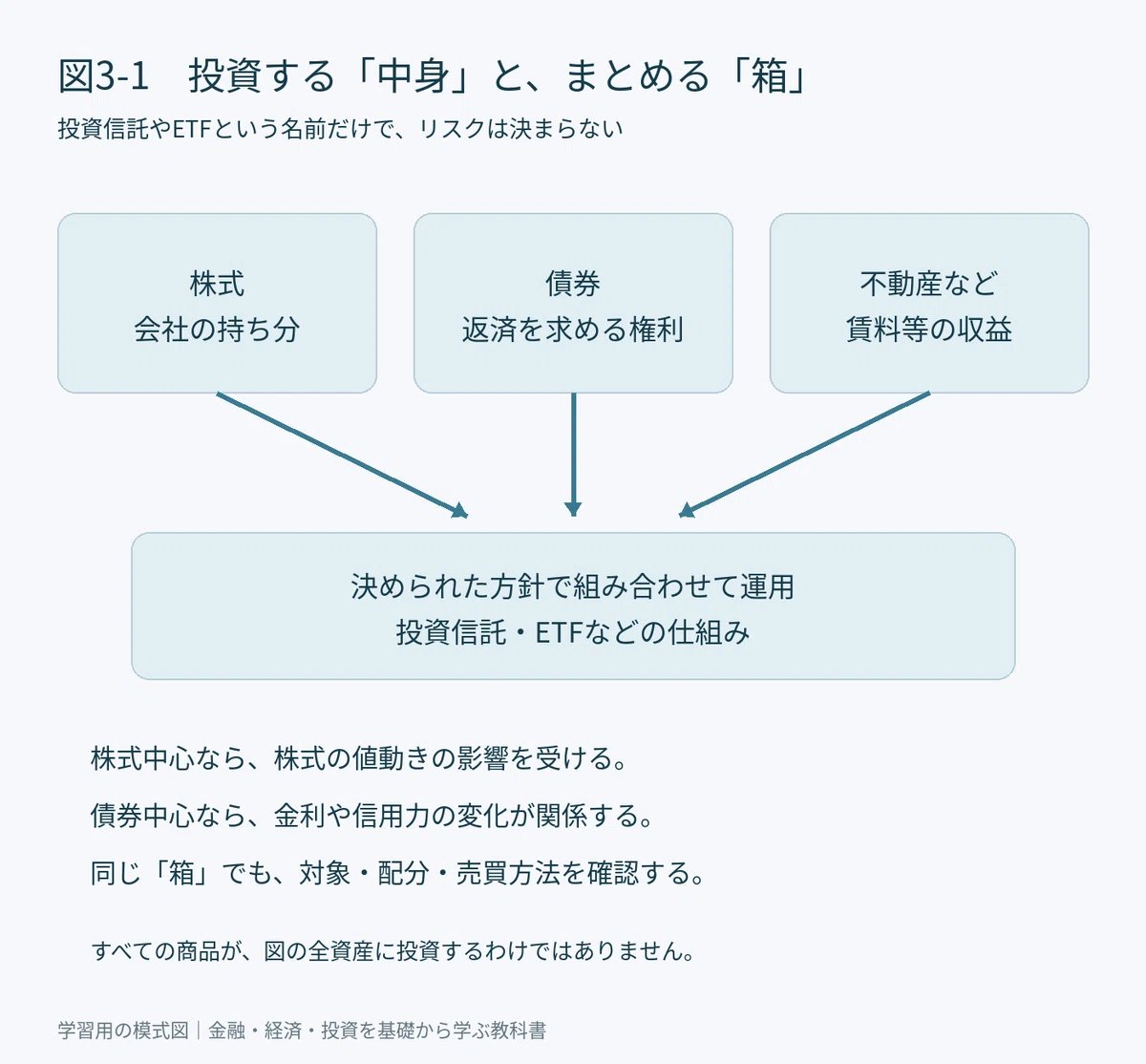
Stocks, bonds, and real estate are differences in the “contents (investment targets).”
On the other hand, mutual funds and ETFs refer to the “boxes (structures)” used to hold multiple assets together.
Even within the same category of “equity mutual funds,” their characteristics will differ substantially depending on whether the contents are concentrated in a single country or diversified globally.
When evaluating a product, make it a habit to always verify the following set of three elements:
-
Name of the box (Is it a mutual fund, an ETF, or direct ownership?)
-
Contents (Which assets in which countries is it investing in?)
-
Trading and redemption rules (When and at what price can it be traded, and what costs are incurred?)
5. Tracing an actual ETF from its name to its contents
Let us practice separating the “box” from the “contents” using a real-world product.
Based on official information verified on November 3, 2026, we will look at Nomura Asset Management’s “NEXT FUNDS TOPIX Exchange Traded Fund (1306).”
[Document 7]
Looking at the official page, it clearly states that the investment target is “stocks” and the region is “Japan.”
What we can glean from this is the fact that this product is not safe simply “because it is an ETF,” but rather that it is “an ETF designed for investing in Japanese equities.”
Even if it is diversified across multiple holdings, it remains susceptible during periods when the overall Japanese stock market declines.
The official page also publishes information regarding the market trading price, net asset value (NAV), fees, and distributions.
To properly understand a product, it is essential not merely to look at past performance charts, but to thoroughly review its investment policy and fees as well.
(*This discussion does not assess the merits or determine the purchase timing of any specific product.)
6. Four Common Misconceptions
Here, we organize four representative misconceptions that tend to hinder an understanding of financial products.
1. “If it’s a product bought at a bank, it’s the same as a deposit.”
The sales counter and the nature of the product are completely different things.
Even if an investment trust is sold by a bank, it is not a deposit, and the principal can decrease.
Whether something is covered by deposit insurance depends on the specific product, not the sales counter.
2. “If it’s a bond, it won’t drop in value.”
A promise to pay at maturity and the price if sold beforehand are two different matters.
Depending on the credit standing of the issuer, market interest rates, and currency fluctuations, the price when sold midway and the value converted into yen will fluctuate.
3. “If you buy many investment trusts, you’ll be diversified.”
You cannot judge diversification solely by the number of funds you hold.
Even if product names differ, when you look inside, there are cases where they hold large stakes in the same companies.
If the underlying holdings overlap, they become prone to declining simultaneously for the same reasons.
4. “The higher the distributions, the better the investment product.”
As a rule, assets within a fund decrease by the exact amount distributed.
In unlisted investment trusts and the like, distributions may effectively amount to a return of principal.
Rather than just looking at the payout amount, you must evaluate performance in total, taking into account changes in the net asset value.
7. Three Steps When Reading News About “Popular Products”
When you come across “currently popular products” in the news or on social media, instead of acting on momentum, try asking yourself the following three questions in order.
Step 1: Break down why it is popular
-
Distinguish whether it is because the price recently rose, because costs went down, or because it became eligible under an official system.
The fact that “more people are buying it” does not provide grounds for explaining future returns.
Step 2: Check for discrepancies in holdings, currency, and structure
-
Check the investment targets, currency, presence of leverage, and redemption structure.
-
For example, even if it is described as “investing in gold,” between “a product holding physical gold” and “a product investing in gold mining company stocks,” there is a decisive difference in whether corporate management risk is added.
Step 3: Lay out the full picture of fees
-
Check not only purchase fees, but also ongoing trust fees, costs upon sale, and the difference between buying and selling prices (the spread).
“Zero purchase fee” is not the same as “everything is free.”
8. Four Checks to Connect Your Money with Products
When applying your knowledge to real-life asset management, start by sorting out your own finances before choosing products.
-
Sorting your funds: First, separate your living expenses, reserves for unexpected costs, and money you plan to spend in the near future.
There is no need to put everything into investments.
Then, check how long you can manage the remaining funds. -
Loss tolerance: Determine an amount you can lose without disrupting your lifestyle or plans.
For example, if you cannot tolerate a 300,000 yen loss, you should be cautious about holding 1,000,000 yen in highly volatile products.
You also cannot set a future loss ceiling based solely on past rates of decline. -
Grasping the key vulnerabilities of each product: For stocks and mutual funds, check the investment destinations, purchase prices, and fees; for FX, check not only the currency outlook but also the actual total trading value and margin buffer.
-
Passing on what you do not understand: If you cannot explain how a mechanism works, passing on it without buying and continuing to learn is a perfectly valid option.
Criteria genuinely useful in practice
Rather than memorizing many product names, being able to explain in your own words the “reasons it generates profit” and “reasons it incurs losses” for the products you hold serves as the core of your judgment.
9. Key Takeaways from This Chapter
-
Difference in rights: Deposits and bonds give you the right to demand payment, whereas stocks represent an ownership stake in a company.
-
Containers and contents: Mutual funds and ETFs vary in character depending on the underlying assets they hold.
-
REIT fluctuation factors: In addition to real estate earnings, they are influenced by borrowing interest rates and market prices.
-
Understanding mechanisms: For FX, commodities, and crypto assets, examine the specific trading structures of each.
-
Multifaceted evaluation: Consider not just returns, but also principal loss, fees, liquidity timing, and foreign exchange rates together.
-
Prioritizing objectives: Separate living funds from investment capital, prioritizing compatibility with your goals over product names.
Thank you very much for reading this far.
This article was organized and written by Wanpachi using AI as part of my personal study and memo-taking. It may contain errors or outdated information, so I would greatly appreciate it if you could point out anything you notice. I will review the content and make revisions as necessary.
This is not a recommendation to buy or sell specific financial products, nor does it guarantee the accuracy of information or future outcomes. Investing involves the risk of loss. Please check the latest information, product mechanics, fees, and risks, and make decisions at your own discretion and responsibility.
For our detailed AI usage policy and disclaimers, please see the self-introduction article.
Sources and Reference Materials
Verification date: November 3, 2026.
Examples of amounts, interest rates, and foreign exchange rates are hypothetical scenarios for learning purposes.
Institutional rules are based on currently published Japanese materials and will be reconfirmed upon publication.
-
Financial Services Agency, “Deposit Insurance System.” Protection of general deposits and settlement deposits. Text
-
The Ashikaga Bank, “About the Deposit Insurance System.” Covered and non-covered products. Text
-
U.S. Securities and Exchange Commission, Investor.gov, “Stocks – FAQs.”
Stockholder rights and status during liquidation. Text -
Financial Services Agency, “Basics of Asset Building.” Basics of financial products and investment methods. Text
-
Financial Services Agency, “About Foreign Exchange Margin Trading.” Mechanics and risks of FX. Text
-
Financial Services Agency, “Crypto-Assets and Electronic Payment Instruments.” User information and business operator information.
Text -
Nomura Asset Management, “NEXT FUNDS TOPIX Exchange Traded Fund (1306).” Product classification, operational information, and fees. Text
-
Japan Exchange Group, “Indicative NAV / PCF Information (ETF).” Differences among net asset value, estimated value, and market price. Text
-
Japan Exchange Group, “Overview (REIT).” Real estate income and price/dividend risks. Text