
“Despite wider market uncertainty, demand for well-priced prime assets remains strong” – Chrissie Clancy-Crofts, Lismore
Scotland’s property investment market remains “relatively subdued” in historical terms, despite a £200 million-plus pipeline of deals amid strong demand for hotels and student accommodation, a new study reveals.
Releasing its latest review of the market, Lismore Real Estate Advisors noted that investment transaction volumes topped £358m during the second quarter of 2026, up 21 per cent on the same period last year but still 7 per cent below the five-year quarterly average.
The report points to “well in excess of” £200m of deals currently under offer in the Scottish market.


Among the quarter’s headline transactions was the sale of the DWS PBSA portfolio to La Caisse and Vita, which included two assets in Glasgow and Edinburgh.
The hotel sector also saw one of Scotland’s largest-ever investment deals, with the luxury five-star Cameron House Resort on Loch Lomond sold by KSL Capital Partners to London-based investment firm Victory Group. The transaction is understood to have been worth some £100m.
In Edinburgh, key transactions included the £20.2m sale of a prime mixed-use asset at 81/85 George Street to a private investor, alongside Hines’ circa £20m acquisition of Straiton Retail Park.

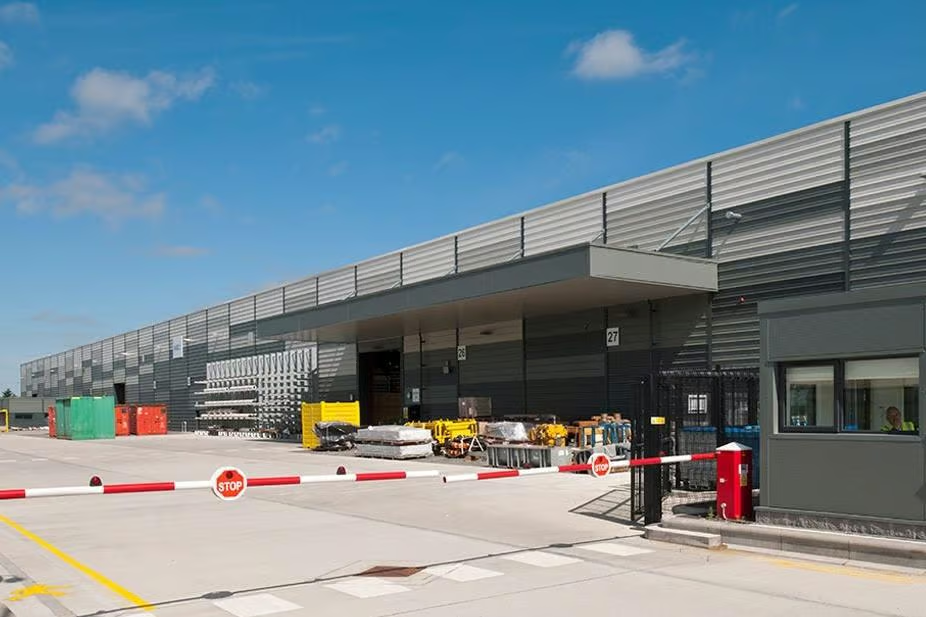
In Aberdeen, the circa £19.5m sale of BP’s modern logistics facility at D2 Business Park to a US real estate investment trust (REIT) completed, while in the west of Scotland, Cable Properties & Investments Limited purchased 55 Fullarton Drive, Cambuslang for just under £10.9m.
Chrissie Clancy-Crofts, senior surveyor at Lismore, said: “Whilst the quarter has been characterised by relatively limited transactions and, with a few exceptions, smaller lot sizes, opportunities remain for vendors looking to capitalise on more captive buyer pools.
“We estimate that there is well in excess of £200m of deals currently under offer in the Scottish market. Although the summer holiday period may push completion of some transactions into late Q3 or early Q4, the strength of the pipeline provides encouraging evidence of underlying investor demand.
“A shortage of core investment opportunities has suppressed Q2 volumes, yet investor appetite remains healthy,” she added. “UK institutional fund activity is relatively sporadic, allowing for private [equity] buyers to see the opportunity but the traditional debt backed buyers continue to contend with a fluctuating debt market. This period of volatility seems set to continue, making the underwrite for core plus assets more challenging.”
Clancy-Crofts said the Edinburgh office market remained “compelling”, with rental growth taking city centre Grade A space to just under £50 per square foot. Recent core-plus sales have attracted a good depth of competition, she noted.
“Despite wider market uncertainty, demand for well-priced prime assets remains strong, particularly in logistics, retail warehousing and high-quality PBSA,” Clancy-Crofts added.
“Private investors are capitalising on opportunities as debt-backed buyers face tighter lending conditions, while scarcity continues to drive competitive interest. We expect development activity to remain focused on sectors where viability and long-term fundamentals are strongest.”