
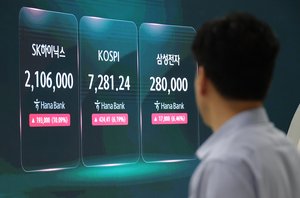
Daily rebalancing fuels debate over whether Korea’s cash-based structure amplifies volatility more than Hong Kong’s swap-based model
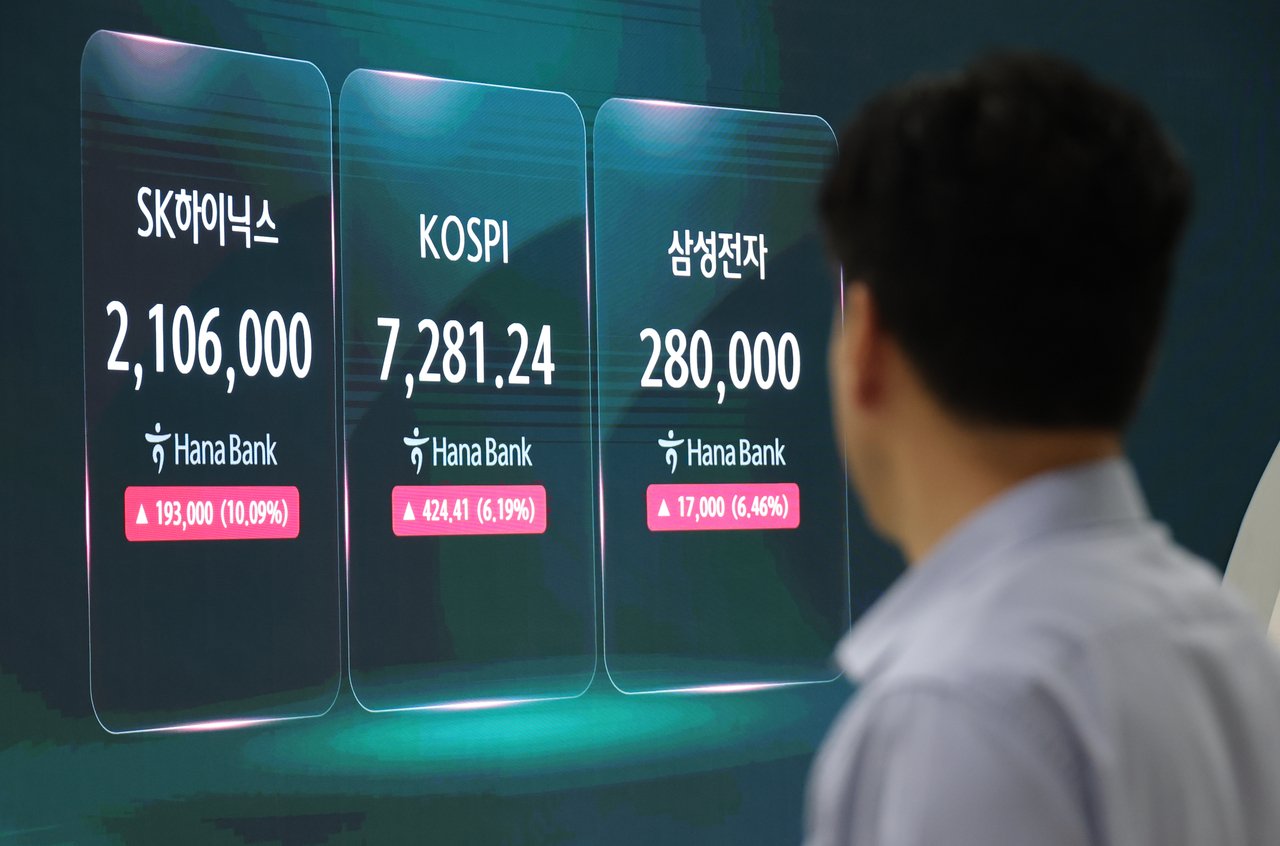
Surging trading in South Korea’s single-stock leveraged exchange-traded funds tracking Samsung Electronics and SK hynix is raising concerns that the products are no longer just following the market but beginning to amplify swings in the country’s two biggest chip stocks — and, by extension, the Kospi.
On some trading days, turnover in leveraged ETFs linked to SK hynix has reached as much as 65 percent of trading in the underlying stock. The unusually high ratio, analysts say, can magnify short-term volatility through the funds’ daily rebalancing.
The concern goes beyond the two chipmakers.
Because Samsung Electronics and SK hynix account for a large share of the Kospi’s market capitalization and trading activity, heavy buying and selling by leveraged ETFs can spill over into the wider market during periods of heightened volatility.
Some market participants say those supply-and-demand dynamics contributed to Samsung Electronics’ recent share-price weakness despite stronger-than-expected earnings. It could also explain the widening gap between SK hynix’s Seoul-listed shares and its recently listed US American depositary receipts.
On Monday, when a marketwide circuit breaker temporarily halted Kospi trading, cumulative turnover in SK hynix leveraged ETFs since their launch amounted to 29 percent of trading in the underlying stock, while the daily ratio recently climbed to 65 percent.
Samsung Electronics’ leveraged ETFs recorded a cumulative turnover ratio of 19.6 percent, while daily turnover has exceeded 27 percent.
By comparison, turnover in the Direxion Daily TSLA Bull 2X Shares typically amounts to only 5 to 8 percent of trading in Tesla shares.
“Single-stock leveraged ETFs are acting as a catalyst in South Korea’s supply-and-demand environment,” said Kim Seok-hwan, an analyst at Mirae Asset Securities.
Why do leveraged ETFs amplify volatility?
Unlike conventional ETFs, leveraged ETFs must rebalance their portfolios every trading day to maintain their target return.
To keep delivering twice the daily return of the underlying stock, they increase exposure by buying shares or futures after prices rise and reduce exposure by selling after prices fall.
The mechanism, known in financial markets as short gamma, generally does not determine whether a stock moves higher or lower. Instead, analysts say it can magnify existing price swings by adding buying pressure during rallies and selling pressure during declines.
In South Korea, those rebalancing trades are typically executed directly in the cash and futures markets during the trading session or near the market close. As trading activity grows, the resulting buy and sell orders become larger, increasing their influence on supply and demand in the underlying shares.
Analysts add that market impact depends less on the size of an ETF’s assets than on the amount of trading generated each day through subscriptions, redemptions and rebalancing.
Why is Hong Kong different?
South Korea introduced single-stock leveraged ETFs in part to attract trading demand that had flowed into Hong Kong-listed products tracking Samsung Electronics and SK hynix.
The domestic products, however, use a different structure. Korea Exchange permits them to gain exposure through cash equities and futures, while Hong Kong-listed products can rely on total return swaps, or TRS, and options.
The decision to use cash- and futures-based structures was intended to lower costs for investors and make the Korean products more competitive with their Hong Kong-listed counterparts. But the same structure has come under scrutiny because it requires asset managers to rebalance their exposure each day to maintain the targeted leverage, potentially adding buying and selling pressure to the underlying shares.
Trading volumes are substantial in both markets. According to Hong Kong Exchanges and Clearing’s data, Hong Kong-based CSOP Asset Management’s leveraged ETFs tracking SK hynix and Samsung Electronics recorded cumulative (May 27-July 13) turnover of HK$344.9 billion ($44 billion) and HK$40.9 billion, respectively, during the seven weeks since Korea launched its domestic products on May 27. On Tuesday alone, the SK hynix and Samsung Electronics products traded at HK$26.5 billion and HK$3.45 billion, respectively.
Over the same period, Korea-listed leveraged ETFs recorded cumulative turnover of 231 trillion won ($159 billion) for SK hynix and 113 trillion won for Samsung Electronics. Daily turnover on Tuesday reached 9.2 trillion won and 2.8 trillion won, respectively.
Some market participants say the different structures help explain why Hong Kong-listed products have had a more limited visible impact on the Kospi despite their heavy trading.
“The product structure itself is one of the reasons for the difference,” a senior ETF industry official said. “KRX allows only cash- or futures-based structures, while Hong Kong-listed leveraged ETFs can use total return swaps for hedging.”
“Since TRS does not require the ETF itself to trade the underlying shares daily, rebalancing pressure is much lower. Combined with the time difference between the Hong Kong and Korean markets, the products are unlikely to have a meaningful direct impact on Korea’s cash market during regular trading hours.”
CSOP, the world’s largest operator of leveraged ETFs tied to Samsung Electronics and SK hynix, relies primarily on swap agreements with global investment banks such as Goldman Sachs and Morgan Stanley. Those banks manage the hedge exposure, while much of the portfolio adjustment takes place after the Korean market closes.
“Given the time difference and the fund’s structure, the impact on intraday trading in South Korea is limited,” a CSOP official said.
Regulators say TRS is not free pass
Korean regulators and domestic asset managers argue that the difference should not be overstated. Although the ETF itself does not directly trade the underlying shares, someone still has to hedge the exposure.
“TRS simply means the asset manager delegates the hedging to a securities firm instead of trading directly,” an industry official said.
“Regardless of the structure, someone ultimately has to trade the underlying shares or futures to deliver twice the daily return.”
The official said the time difference may spread trading across different hours and reduce its immediate market impact, but it does not eliminate the hedging trades themselves.
Financial Services Commission officials share that view.
“It is difficult to conclude that TRS-based products have no market impact simply because of their structure,” an FSC official said.
“Since hedging trades ultimately take place during the swap process, we plan to gather additional views from research institutions and industry participants.”
The official added that regulating only Korean products would not fully address the issue as more overseas-listed leveraged ETFs tied to Korean stocks enter the market.
More overseas products on the way
The debate is expected to intensify following SK hynix’s recent US ADR listing.
US ETF issuers, including Leverage Shares, GraniteShares and ProShares, are preparing leveraged ETFs linked to the ADR, potentially extending price discovery beyond Korean trading hours.
Analysts said the long-term direction of SK hynix shares will continue to depend primarily on semiconductor demand and corporate earnings.
The short-term market impact, however, is likely to depend on investor inflows, daily rebalancing volumes and hedging activity by swap counterparties.
Industry officials also cautioned against blaming leveraged ETFs alone for recent market volatility.
“The view that single-stock leveraged ETFs are the main cause of recent volatility oversimplifies the causal relationship,” an industry official said.
“The fundamental drivers are the high volatility of the semiconductor sector itself and the concentration of domestic investment capital in semiconductor stocks.”
The official added that the longer-term solution lies not in restricting leveraged ETFs alone, but in broadening investment opportunities beyond a handful of dominant semiconductor stocks.
ch0221@heraldcorp.com