

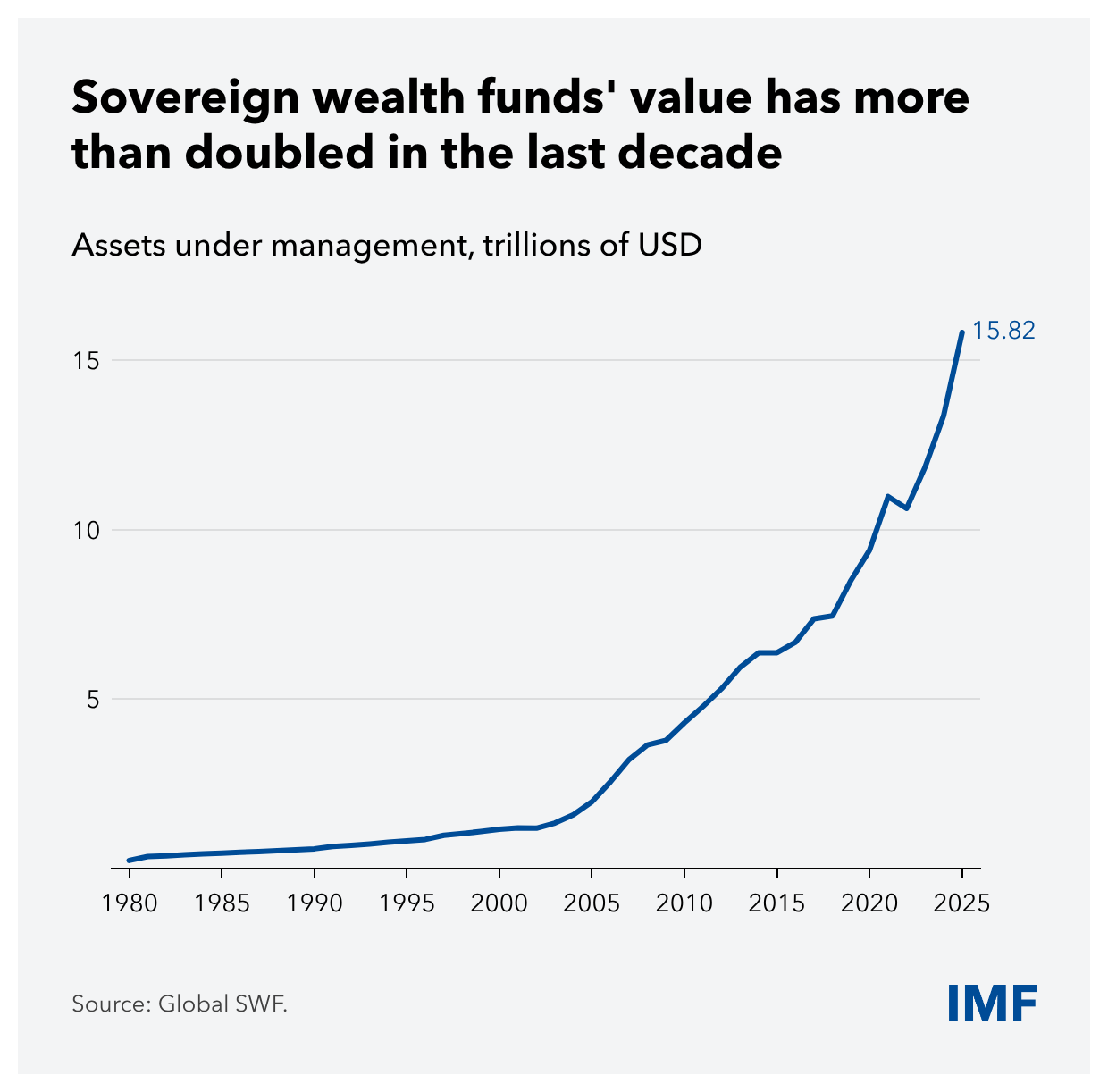
Sovereign wealth funds have become some of the most powerful players in global finance. They now manage more than $16 trillion in total assets, up from about $3 trillion in 2008. Their ability to act nimbly, diversify public wealth, and invest for the long-term have important and lasting benefits for citizens today and future generations.
As funds have grown, their mandates have rapidly expanded beyond cushioning government budgets and stewarding intergenerational savings to roles as diverse as building infrastructure and implementing social and industrial policy. Increasing geopolitical fragmentation has intensified the appeal of these funds as countries seek to be more self-reliant. Funds can boost domestic resilience, preserve national wealth, advance national development objectives, and foster economic dynamism. With projects spanning private equity, real estate, and technology, they have become some of the world’s most influential investors.
While these funds are key players in managing public funds, their massive and complex footprint could pose critical vulnerabilities. Vague and overlapping mandates can weaken accountability and weigh on performance. Weak governance can allow misappropriation, as shown by the high-profile failures of some funds. Funds operating as parallel fiscal authorities and bond buyers without clear fiscal anchoring may risk distorting government budgets, obscuring public debts, and complicating tax treatment cross-border.
Looking across borders, funds partnering on projects concentrate their risk exposures, making a shock to one investor a risk to all. National objectives may also diverge, for instance one partner prioritizes domestic job creation while another focuses on financial returns, weakening governance and investor credibility. And if relations among partner countries sour, it can be difficult to protect assets or exit a project.
These vulnerabilities can be mitigated, however, through strong laws. Internationally accepted guidelines and practices such as the Santiago Principles, developed in 2008 by 26 funds with IMF support, have served as a valuable guide. However, as funds have grown significantly in size, complexity and diversity since then, it is important to examine more closely how funds are structured and governed.
Getting mandates right
Start with the mandate, the binding legal framework that serves as an institutional roadmap by specifying fund objectives, functions, and powers.
When clearly articulated, these objectives anchor decision-making and align investment strategies with national priorities. Commodity exporters, for instance, prioritize short-term fiscal stabilization, as shown by Chile’s Economic and Social Stabilization Fund. Wealthier economies focus on long-term savings, as seen with Norway’s Government Pension Fund Global, the New Zealand Superannuation Fund, and the Future Ireland Fund.
The Indonesia Investment Authority, meanwhile, demonstrates how emerging and developing economies tend to emphasize development objectives, including economic diversification. In some circumstances, multiple objectives may be warranted. In historically oil-dependent economies such as the United Arab Emirates, wealth funds may combine stabilization and economic diversification roles. For Singapore’s two funds, by contrast, the overriding objective is long-term savings, with Temasek supporting strategic sectors and domestic economic development, while GIC invests internationally.
Pursuing multiple mandates, however, can involve difficult tradeoffs. Clear purpose is essential for guiding fund managers while preserving each mandate’s binding force. Overly broad mandates with multiple and potentially conflicting objectives in a single fund can create risks. Risks are heightened when mandates expand without corresponding governance and oversight adjustments.
Legal separation—whether through separate funds or clearly segregated sub-funds—is often a better way to pursue different mandates while ensuring clarity and operational coherence. The Nigeria Sovereign Investment Authority provides a clear example, with its stabilization, future generations, and infrastructure funds legally ring‑fenced. Norway, meanwhile, operates a single fund as a long-term savings vehicle, investing exclusively abroad with a strong legal framework. Its stabilization function is achieved through the fiscal framework, which limits annual budget transfers to expected returns on the fund.
These examples also highlight that a fund’s legal form should follow its mandate. Stabilization funds designed to manage liquidity and short‑term fiscal volatility are often structured simply as accounts managed by separate units in central banks or treasuries. Savings funds, which typically pursue higher‑risk, less liquid investments, require a more extensive legal framework, including independent boards with fiduciary duties and robust internal controls. As some funds assume domestic and strategic roles, they may resemble state‑owned holding companies, and be better governed under corresponding law.
Governance and integration
Once the legal form is fit for purpose, the next step is grounding governance in law with statutory allocation of powers, enforceable fiduciary duties, transparent reporting, and effective oversight. As wealth funds move into more complex direct and unlisted investments, governing bodies must be legally empowered to exercise informed, independent supervision of partnerships and transactions. Laws requiring that board members have a balanced set of skills and expertise, institutionalized audit and risk management, and robust internal control functions act together to ensure good governance.
To avoid funds serving as shadow treasuries—without institutional controls and oversight, or with undue political influence—they should be explicitly integrated into the broader fiscal and public finance legal framework.
Funds are best placed to enjoy operational autonomy when it is clearly defined in law. This includes defining rules on deposit and withdrawal and oversight by the legislature and civil society. Coherence between a fund’s legal framework and fiscal laws is essential to its resilience and legitimacy, and the overall effectiveness of public spending.
Legal backbone
Given sovereign wealth funds’ growing scale and strategic importance, robust legal frameworks are essential to ensure each best serves the people of their countries. They also help ensure the sector can help foster global financial stability. Law should be the foundation of funds’ effectiveness, not a constraint.
The Santiago Principles underpin governance. But growing complexity calls for renewed scrutiny of their assumptions, and more targeted operational guidance to translate them into robust domestic legal frameworks. Since these high-level principles were largely designed for passive, index‑based investors, they do not fully capture the more granular governance and disclosure issues raised by today’s more active investment models, including state-owned enterprises, direct investments, unlisted equity stakes, private equity transactions, and co-investments.
Through bilateral and multilateral surveillance, financial-sector assessments, and technical assistance, the IMF supports countries in anchoring funds in sound public law, fiscal discipline, and public accountability. Applying the Santiago Principles meaningfully in today’s transformed investment landscape requires the renewed collective engagement of all stakeholders. The IMF is ready to support such efforts.