

Last week’s rip-roaring rally in Amazon and Microsoft marked a notable rebound in the Nasdaq Composite (^IXIC +2.59%) and pushed the S&P 500 (^GSPC +1.79%) within less than 3% of its all-time high. But even with that recovery, value stocks and many high-dividend-yield exchange-traded funds (ETFs) have been crushing the major indexes this year.
The Vanguard Value ETF (VTV +1.30%) and Vanguard High Dividend Yield ETF (VYM +1.54%) are both hovering around all-time highs and outperforming the S&P 500 and Nasdaq in 2026 — whereas the Vanguard Growth ETF (VUG +2.31%) is up just 5% year to date.
Meanwhile, Space Exploration Technologies (SPCX +9.43%) closed at just $108.37 on July 31, its lowest closing price since going public on June 12. SpaceX is now down 52% from its all-time high. And despite the sell-off, nine Vanguard ETFs already own SpaceX, and they will keep buying SpaceX even if it continues to fall.
Here’s why investing in SpaceX is fundamentally different from the companies in the Vanguard Value ETF and Vanguard High Dividend Yield ETF, and why both ETFs are great buys now.

Image source: Getty Images.
Earnings-driven growth
A misconception about value stocks is that they’re all boring, slow-growing companies that generate high cash flows, often pay dividends, and feature inexpensive valuations. But a better way of thinking about value stocks is that they’re priced for the mature businesses they are today, rather than purely on their growth potential. Earnings tend to drive price appreciation in value stocks, whereas growth stocks can sometimes rise and fall based on investor perceptions of how likely big bets will pay off.
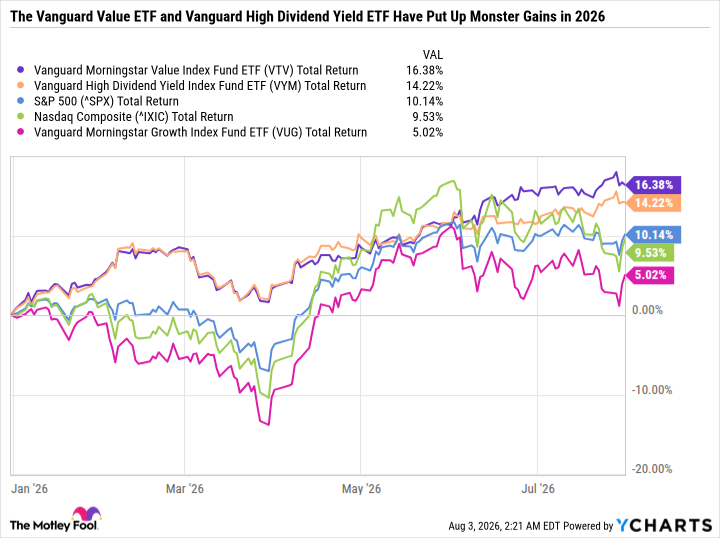
VTV Total Return Level data by YCharts
Although many top value stocks are safe, stodgy companies, there are plenty of examples of value stocks that have outperformed the major indexes over the long term or entered periods of accelerated earnings growth.
Look no further than the top holding of the Vanguard Value ETF, which is Micron Technology (MU +7.61%), with a 4.9% weighting in the fund. And Broadcom (AVGO +6.61%) is the largest holding in the High Dividend Yield ETF, with a 7.3% weighting. These are two established semiconductor stocks that were once viewed as value plays in the industry, but the boom in memory chips accelerated Micron’s earnings growth and, in turn, its stock price. Similarly, Broadcom has been rapidly growing its custom AI chip and AI networking businesses, collaborating with hyperscalers such as Alphabet on Tensor Processing Units that enable cost savings and efficiency improvements at scale.
While you could argue that Micron and Broadcom are growth stocks after their run-ups in recent years, they are still distinctly different from stocks such as SpaceX, as earnings growth is the core driver of stock price appreciation. Whereas SpaceX reported a net loss of $4.94 billion in 2025 and will probably be free cash flow negative in the coming years as it pursues its big and costly bet on orbital AI data centers.
Similarly, Caterpillar (CAT +5.60%) is a top 10 holding in both the Value ETF and the High Dividend Yield ETF. Caterpillar has traditionally been viewed as an industry-leading cyclical value stock with an extensive track record of dividend growth. In June, Caterpillar raised its dividend for the 32nd consecutive year. But Caterpillar has benefited from the boom in AI data center construction and energy demand.
JPMorgan Chase (JPM +1.38%) is the No. 2 holding in both ETFs. Its stock price has soared a staggering 126% in just three years because of — you guessed it — earnings-driving growth.

Today’s Change
(1.30%) $2.87
Current Price
$223.87
Key Data Points
AUM
$254B
Dividend Yield
1.83%
Expense Ratio
0.03%
Top Holdings
MU
4.87%
JPM
3.06%
BRK-B
2.95%
Balancing value, income, and growth
The Vanguard Value ETF and Vanguard High Dividend Yield ETF are excellent buys for investors looking for quality companies with clear paths to future growth, rather than companies that need a lot to go right to reward patient investors.
SpaceX is chock-full of unbelievable potential, with a virtually unlimited total addressable market and unmatched technology. But even after its sell-off, SpaceX’s roadmap for long-term growth is based entirely on abstract models of what the future could bring, whereas Micron, Broadcom, Caterpillar, and JPMorgan Chase are booking real profits and rewarding investors with dividends.
As of June 30, the Value ETF sports a 21.4 price-to-earnings (P/E) ratio and a 1.9% 30-day SEC dividend yield — similar to the 21.6 P/E ratio and 2.3% dividend yield of the High-Dividend Yield ETF.
By comparison, the Vanguard S&P 500 ETF (VOO +1.81%) has a 27.5 P/E ratio and 1% 30-day SEC dividend yield as of June 30, and the Vanguard Growth ETF has a 35.6 P/E and 0.4% dividend yield.
All four ETFs have low fees, with the Value ETF, Growth ETF, and S&P 500 ETF all featuring 0.03% expense ratios, and the High Dividend Yield ETF just slightly ahead at 0.04% — or just $0.40 for every $1,000 invested.
Add it all up, and the Vanguard Value ETF and Vanguard High Dividend Yield ETF will appeal to investors looking for steady passive income from highly profitable, industry-leading companies.