
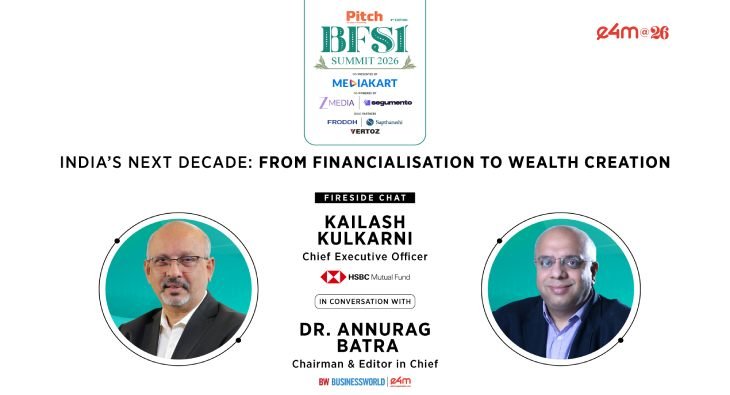
In a fireside chat titled “India’s Next Decade: From Financialisation to Wealth Creation” at the Pitch BFSI Summit 2026, Kailash Kulkarni, Chief Executive Officer, HSBC Mutual Fund, spoke with Dr Annurag Batra, Chairman & Editor in Chief, BW Businessworld and Founder, e4m, on how a fundamental shift in Indian household economics has reshaped the mutual fund industry over the past decade.
“Ten years hence we now have three and a half household incomes,” Kulkarni said, explaining that working children and women monetising home-based skills through WhatsApp and Instagram have expanded family earnings well beyond the traditional single breadwinner model.
That surplus income, he said, is increasingly flowing into investments rather than only savings. “I think mutual fund was a push product. Today, it’s a pull product,” Kulkarni said, adding that the industry is seeing six to seven lakh new-to-industry clients joining every month despite muted market returns over the last two years.
Asked where the next leg of growth would come from, Kulkarni said it would be a combination of new investors, deeper penetration into smaller towns, greater wallet share from existing clients, and new products. He credited technology with shrinking the effort needed to invest. “Within five minutes, you can purchase a mutual fund once you log into a particular site,” he said, adding that two strong years in the market, aided by geopolitical stability, could push monthly new investor additions from six-seven lakh to 15 lakh.
On whether the post-COVID surge in retail investors is structural or sentiment-driven, Kulkarni called market performance “hygiene” but pointed to India’s broader economic momentum as the real driver behind the financialisation story. “Honestly, in 30 years, this is the best macroeconomic environment we have seen,” he said, citing anecdotal evidence from tier three and tier four towns, where he was surprised to learn that beauty parlours, not electronics, are now the fastest-growing business.
On how scale will be built going forward, Kulkarni pointed to two priorities: reaching the last-mile customer through technology, and deploying AI for data analytics to cross-sell more effectively. He also flagged customer acquisition economics, arguing that the industry’s real competition is not other asset managers but everyday spending habits.
“My competition is the people who have money in the bank,” he said, comparing the mutual fund industry’s six and a half crore unique investors to the 30 to 50 crore subscriber bases of OTT platforms and suggesting that anyone paying for a streaming subscription could just as easily start a SIP.
Kulkarni was candid about the industry’s communication shortcomings, particularly its reliance on English, Hindi and financial jargon. “Why is it not in Malayalam? Why is it not in Khasi? Why is it not in Assamese?” he asked, arguing that de-jargonising and localising communication across 20 to 25 languages was key to winning the next wave of customers and turning financialisation into genuine wealth creation at the household level.
On trust, a recurring theme through the summit, Kulkarni said the industry often undermines itself by quoting return figures that raise unrealistic expectations. Using the example of Sensex returns, he explained how historical comparisons can mislead investors about what to expect going forward, noting that a fair current benchmark is closer to nine or ten percent. “If I go and say this in a public forum, people will throw me out of the room because nine to ten in equities does not gel well in the heads of people,” he said.
He added that new investors eyeing complex products should be told plainly when they are not ready. “We should actually say no, this product is very exotic, you need to be in this industry for a few years before you migrate to this.”
Looking a decade ahead, in line with the session’s theme, Kulkarni said India’s mutual fund penetration, currently around 4%, needs to move toward the 40 to 100% levels seen in developed economies for the industry to have truly “arrived.” He said he tracks success not through AUM but through active investor engagement. “AUM is just a derivative of it,” he said.
Fielding a question on career progression for CMOs eyeing the top job, Kulkarni offered three pieces of advice: understand people, including employees, clients, and partners; take risk and compliance seriously, since lapses “can get your company way down in a very short time”; and communicate clearly to clients about what the business can and cannot deliver.
On the festive season outlook, Kulkarni struck an optimistic note despite geopolitical uncertainty. “Do we see a cyclical upside over not just two months, but over the next few years? The answer very clearly is yes,” he said, urging those who haven’t started financial planning to do so, calling mutual funds “the most transparent product amongst any financial product.”