

Debt mutual funds are rarely sold as inflation beaters. Yet, over long holding periods, that is largely what they have been. A bl.portfolio analysis of 130 schemes across 11 debt fund categories shows that 89 per cent of seven-year rolling-return observations and 83 per cent of five-year observations beat consumer price inflation).
The finding is particularly relevant at a time when traditional fixed-income products have themselves held up surprisingly well against equities over recent three- and five-year periods. Equities, often considered the default inflation-beating asset, have faced a reality check in recent years. As highlighted in The Great Indian Bull Market Paradox (bl.portfolio edition dated September 20), even the humble SBI FD and Post Office Time Deposits have outpaced the Nifty 50 and many domestic stocks over the last three years.
We tested whether debt funds’ real-return advantage holds across categories, holding periods and inflation regimes. Here are the insights.
What we analysed
Before we go into details, readers should know that our analysis covers 130 schemes across 11 debt fund categories that predominantly invest in securities with maturities beyond one year: Banking & PSU Debt, Corporate Bond, Credit Risk, Dynamic Bond, Floating Rate, Gilt, Gilt with 10-year Constant Maturity, Long Duration, Medium Duration, Medium-to-Long Duration and Short Duration funds.
Scheme returns were compared with the All-India Combined Consumer Price Index (CPI), the inflation measure used by the RBI in its monetary policy framework. Since monthly data for the current CPI series is available from January 2011, the analysis goes back up to 15 years. The CPI series has been adjusted using MoSPI’s linking factors to ensure consistency across its three base-year revisions.
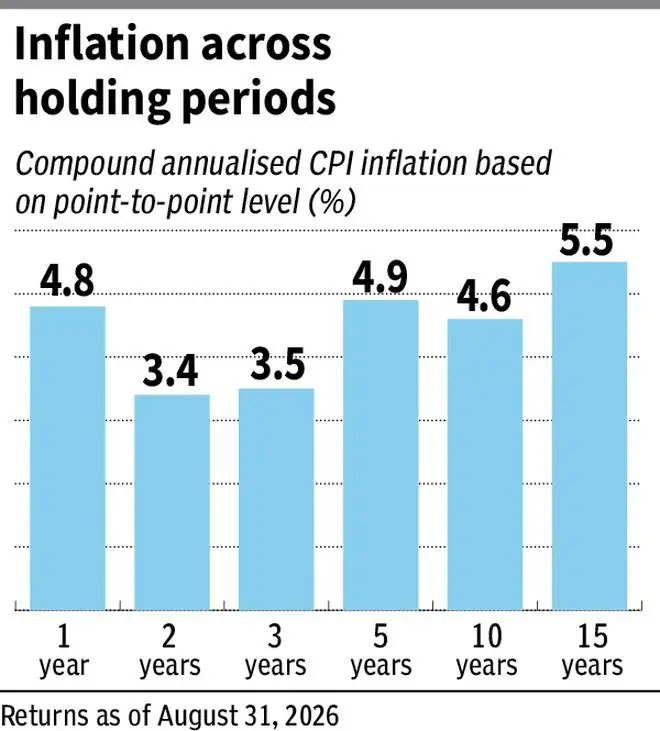
We examined both point-to-point and rolling returns. Over the 15 years ended August 2026, CPI inflation compounded at 5.5 per cent annually. The corresponding annualised inflation rates were 4.6 per cent over 10 years, 4.9 per cent over five years, 3.5 per cent over three years and 4.82 per cent over one year.
For a more consistent test across different entry points, we also calculated one-, three-, five- and seven-year rolling returns at monthly intervals. This analysis was restricted to the last 10 years, given the availability of schemes with sufficiently long track records.
Key findings
Our analysis throws up six broad takeaways on how debt funds have fared against inflation across time periods, categories and market conditions.
Longer horizons improve the odds of beating inflation
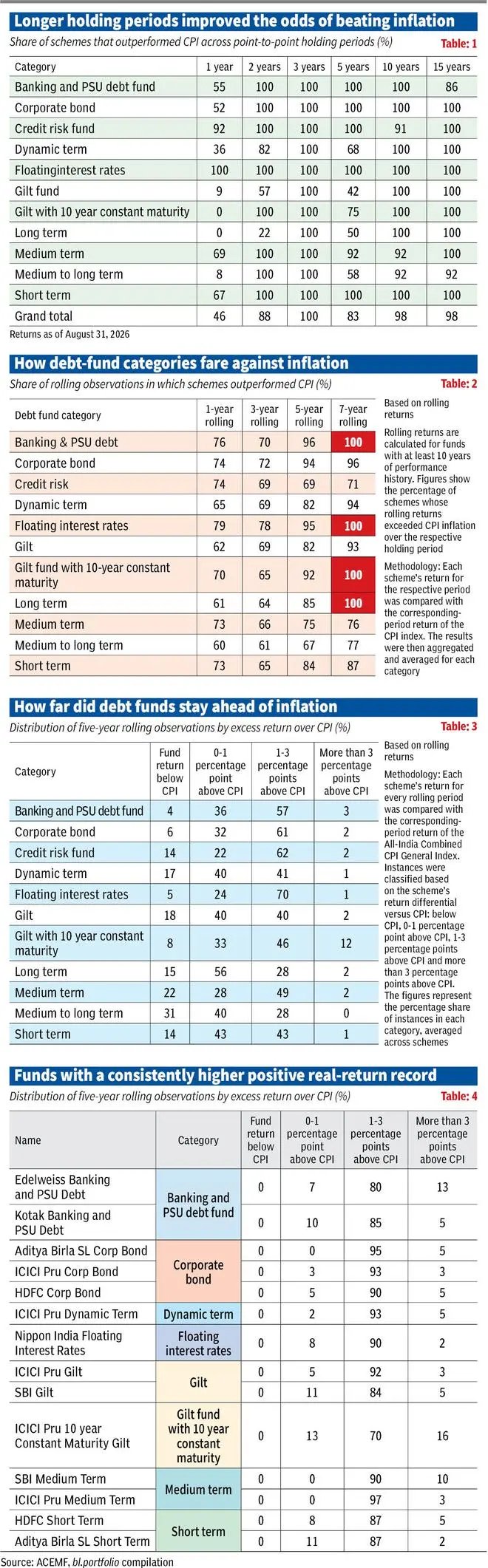
The point-to-point analysis of debt-fund returns against CPI (Table 1) shows a clear pattern: Longer holding periods generally improved the likelihood of beating inflation.
Across all 130 schemes, only 46 per cent beat CPI over the one-year period. The proportion jumped to 88 per cent over two years and reached 100 per cent over three years. It moderated to 83 per cent over five years, before rising to 98 per cent over both the 10- and 15-year periods.
The weak one-year showing is instructive. Debt fund returns can be affected in the short term by movements in interest rates and credit spreads, as well as credit events. Over longer periods, however, there was a marked improvement— Corporate Bond, Floating Rate, Short Duration and several duration-oriented categories saw virtually all schemes beat CPI over the 10- and 15-year periods.
The point-to-point evidence, therefore, suggests that debt funds are far less dependable as inflation-beaters over short periods, while the odds of earning positive real returns improve materially as the holding period lengthens.
Rolling returns show greater consistency
Point-to-point snapshots can be sensitive to the chosen start and end dates. In this analysis, the period ends in August 2026, when CPI inflation was 4.82 per cent, relatively moderate compared with some earlier periods.
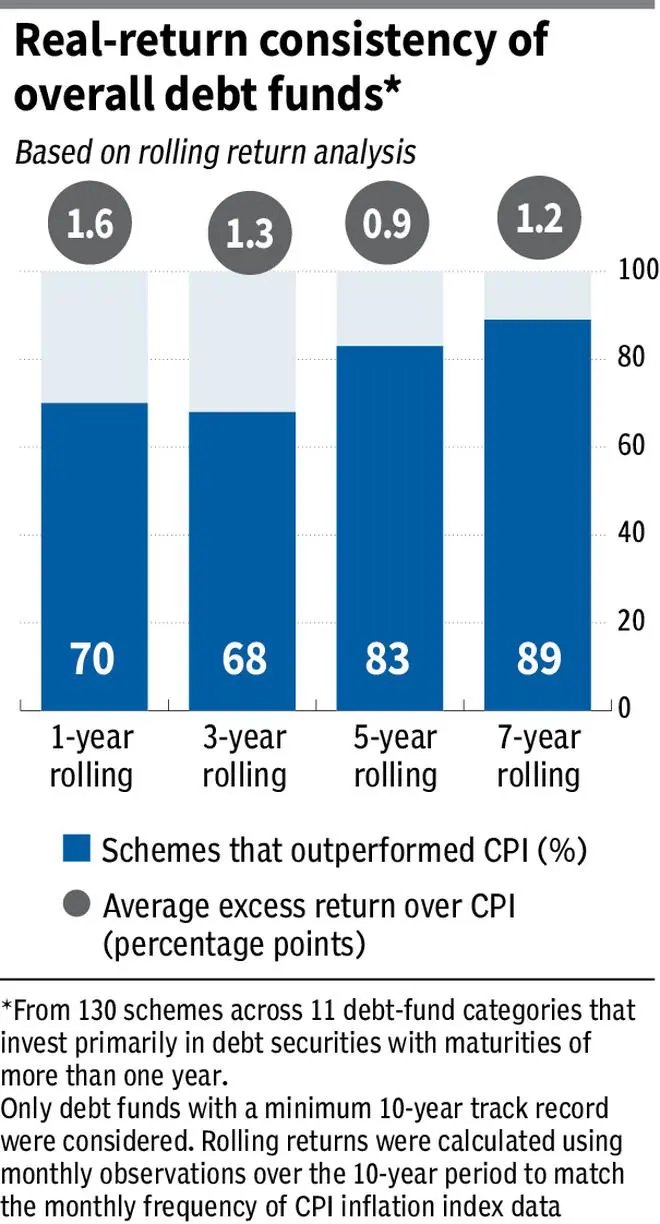
Rolling-return analysis helps reduce this dependence on a single start and end point. Using monthly observations over a 10-year window, with a minimum track-record filter, Table 3 shows that the share of observations beating CPI rises steadily from 70 per cent for one-year rolling returns to 89 per cent for seven-year rolling returns.
This consistency is notable because the decade under review included multiple interest-rate cycles, Covid-era disruptions, record-low interest rates, aggressive post-pandemic tightening and elevated inflation. Despite these swings, debt funds generated positive real returns in the majority of medium- and long-term observations.
Category choice matters
The category-level rolling analysis reveals meaningful differences. Banking & PSU Debt funds were among the most consistent performers, with around 96 per cent of five-year observations and 100 per cent of seven-year observations beating inflation.
Floating Rate funds and Gilt funds with 10-year Constant Maturity also performed consistently, with virtually all seven-year periods generating positive real returns.
At the other end, Medium-to-Long Duration and Credit Risk funds showed lower consistency. Even in these categories, however, the proportion of inflation-beating observations improved significantly as the investment horizon lengthened.
The differences underline why debt funds cannot be treated as a homogeneous asset class. Gilt and Longer-Duration funds are more sensitive to movements in interest rates, while Credit Risk funds carry greater credit-related risks. Short Duration funds, by contrast, are generally less sensitive to large interest rate moves. These differences affect both the consistency and the timing of inflation-adjusted returns.
The margin over inflation
Beating inflation is one thing; beating it by a meaningful margin is another. The five-year rolling analysis shows that, in most categories, the excess return over CPI was positive but modest.
The largest share of observations generally fell in the 1-3 percentage-point range above inflation. For Banking & PSU Debt funds, about 57 per cent of observations were in this band. Corporate Bond funds showed a similar pattern, while Floating Rate funds stood out, with nearly 70 per cent of observations delivering returns 1-3 percentage points above CPI.
The picture was less favourable for some duration-sensitive categories. Medium-to-Long Duration funds had 31 per cent of observations below CPI, while only 28 per cent were 1-3 percentage points ahead of inflation.
Periods in which returns exceeded inflation by more than 3 percentage points were relatively uncommon. The historical experience, therefore, points to modest real-return premiums rather than dramatic outperformance. For investors using debt funds primarily to preserve purchasing power, that distinction matters.
High inflation changes the picture
Debt funds found it much easier to beat CPI during low-inflation phases. In several categories, almost every scheme outperformed inflation during such periods. The picture changed sharply when inflation surged. Around 2022, as inflation climbed and policy rates rose rapidly, the proportion of schemes beating CPI fell markedly. Duration-sensitive categories such as Gilt funds were particularly affected. However as invested time period increases, this negative impact gets nullified
Tax changes the equation
The returns discussed so far are pre-tax. For investors, the post-tax picture can be quite different.
Historically, debt mutual funds enjoyed a significant tax advantage over fixed deposits. Units held for more than three years qualified for long-term capital-gains taxation at 20 per cent with indexation, which adjusted the purchase cost for inflation and reduced the taxable gain.
That advantage was substantially curtailed from April 1, 2023. Gains on specified debt mutual funds acquired from that date are generally taxed at the investor’s applicable income-tax slab rate, bringing their tax treatment much closer to that of fixed-deposit interest.
Debt funds can still offer some tax deferral because tax generally arises when units are redeemed, whereas fixed-deposit interest is typically taxable as it accrues. But the post-2023 changes have sharply narrowed the historical tax advantage. For instance, for an investor in the 30 per cent tax slab, a 7 per cent pre-tax return translates into just 4.9 per cent after tax. If inflation averages 4.9 per cent over five years, the entire post-tax return is effectively eroded by inflation, leaving the investor with no real gain in purchasing power.
With the erosion of their tax advantage, investors also need to factor debt funds’ post-tax, inflation-adjusted returns based on the respective tax brackets. Their suitability will depend on investment horizon, liquidity needs and risk propensity, rather than tax efficiency alone. This is because there are times like last two years when benchmark equity indices are given negative returns and thereby debt funds given with their tax disadvantage have outperformed.
What all this means
CPI is a useful common benchmark, but it is not an investor’s personal inflation rate. Costs such as education, healthcare and housing can move very differently from headline inflation, so beating CPI does not necessarily mean that a financial goal has been fully protected.
Even so, CPI remains a consistent economy-wide yardstick for comparing investment returns over long periods. On that measure, the evidence suggests that debt funds have often delivered positive real returns over longer holding periods, though not uniformly across categories or market conditions.
Despite losing their tax advantage, debt funds can help long-term investors preserve purchasing power. Select Banking & PSU Debt, Corporate Bond, Credit Risk and Gilt funds, including 10-year Constant Maturity Gilt Funds, have demonstrated inflation-beating potential.
How inflation affects debt funds
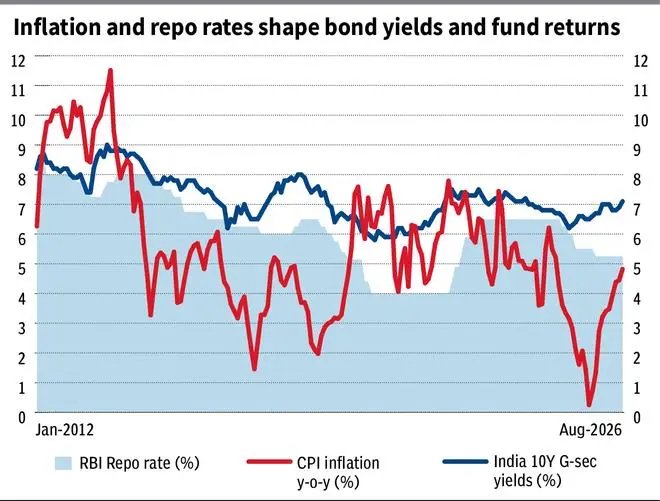
Inflation affects debt fund returns mainly through interest rates and bond yields. When inflation rises sharply, it can prompt the RBI to tighten monetary policy. Higher policy rates and market yields push down the prices of existing bonds, particularly longer-duration securities, hurting debt fund returns in the short term.
For instance, after CPI inflation touched 7.8 per cent in April 2022, the RBI raised the repo rate from 4 per cent to 6.5 per cent over the subsequent tightening cycle. During this period, some gilt funds delivered returns as low as around 2 per cent. Conversely, easing inflation can create room for lower interest rates, which can push bond prices higher and generate capital gains for debt funds.
Debt fund returns broadly come from coupon accrual and changes in bond prices, driven by movements in interest rates and credit spreads. Rising yields can cause mark-to-market losses initially, but they also allow fresh investments and portfolio reinvestments to earn higher yields. Over longer periods, coupon accrual and these higher reinvestment yields can help offset some of the initial price decline and improve the potential for positive real returns.
Published on September 26, 2026