
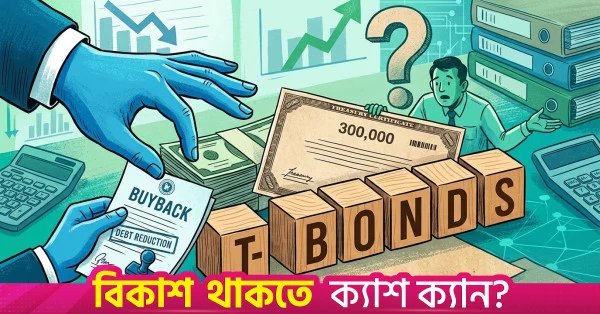
T-bonds are generally used for longer-term government borrowing, while Treasury bills are normally used for shorter periods.
Illustration: AI Generated
“>
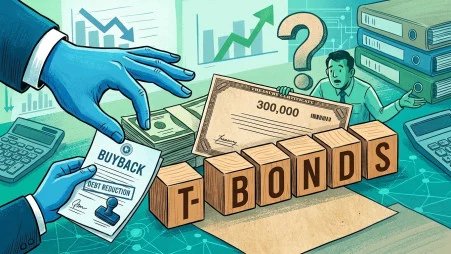
Illustration: AI Generated
The government is planning to buy back a portion of its Treasury bonds (T-bonds) before they mature, in an unusual move aimed at reducing its interest burden and improving liquidity in the financial market.
But what exactly are T-bonds, why does the government borrow through them, and how can buying them back early save money?
What is a T-bond?

A Treasury bond is essentially a loan that investors give to the government. When the government needs money, it can borrow from banks, financial institutions and other investors by issuing government securities. In return, it promises to pay interest at a fixed rate and return the principal when the bond matures.
For example, if the government issues a Tk1,000 crore T-bond with a 12% annual interest rate for two years, investors lend the government Tk1,000 crore. The government pays interest according to the terms and returns the Tk1,000 crore at maturity.
T-bonds are generally used for longer-term government borrowing, while Treasury bills are normally used for shorter periods.
Why does the government borrow this way?
The government regularly spends more than it collects in revenue. The resulting budget deficit has to be financed through borrowing. It can borrow from banks, issue savings certificates or raise money through government securities.
Borrowing through T-bonds has an important advantage: it allows the government to raise large amounts of money from the financial market without relying entirely on bank loans. For banks and other investors, government bonds are also attractive because they are considered relatively safe assets and provide a predictable return.
So why buy back the bonds before maturity?
This is where the government’s new plan becomes interesting. Suppose the government issued a two-year bond when interest rates were high. If that bond carries a 12.30% coupon, the government is locked into paying that relatively expensive interest until maturity.
But if market interest rates subsequently fall, the government can potentially refinance that borrowing at a lower rate.
The planned buyback gives the government an opportunity to retire some expensive debt before its scheduled maturity and replace it with cheaper borrowing.
In simple terms: Old borrowing: 12.30% → buy it back → new borrowing at a lower rate
The government therefore avoids paying the higher interest rate for the remaining period.
Why one month before maturity?
At first glance, buying back a bond only one month before maturity may seem pointless. Why not simply wait?
One reason is that the government can stop paying interest on the debt once it buys back the bond. If a bond carries a high interest rate, repaying it a month early means the government does not have to pay that interest for the remaining month.
For example, if the government owes Tk1,000 crore on a bond carrying a 12% annual interest rate, one month of interest is roughly Tk10 crore. If the bond is bought back a month before maturity, the government can avoid that final month’s interest payment — although the actual saving depends on the buyback price and other terms.
The buyback also gives the government an opportunity to replace relatively expensive borrowing with cheaper borrowing if market interest rates have fallen.
For investors, meanwhile, the early buyback provides an additional exit route. A bank holding Tk1,000 crore of a bond maturing in November can either wait for maturity or participate in the October buyback, if its bid is accepted.
So the move serves two purposes: the government can potentially cut its interest cost, while investors get earlier access to their money.
How does this improve liquidity?
A T-bond is an asset, but it is not cash. A bank holding Tk1,000 crore in bonds cannot use that holding in exactly the same way as cash. A buyback creates an additional exit route.
T-bond → government buys it back → bank receives cash
That makes the market more liquid because investors have greater confidence that they can turn their holdings into cash when needed. The cash released through the buyback can also be redeployed by banks – into new government securities, loans or other investments.
Could this lower interest rates?
Potentially, yes. If banks have more liquid funds and are competing to buy new government securities, they may be willing to accept lower yields. That would reduce the government’s borrowing cost.
But the buyback itself does not automatically create new money. Its immediate effect is to convert an existing bond holding into cash and make government debt management more flexible.
The bigger test will be whether the government can use this mechanism to replace costly borrowing with cheaper debt while keeping the bond market liquid and stable.