

Environmental, social and governance (ESG) investing has become a political lightning rod in recent years. Critics have questioned whether ESG considerations belong in investment decisions, while some corporations and asset managers have pulled back from the terminology amid concerns about regulatory scrutiny and political backlash.
Yet despite the headlines, green bonds and sustainable debt financing haven’t disappeared. In fact, the rapid expansion of artificial intelligence (AI) could create a powerful new source of demand for environmentally focused investments.
AI requires enormous amounts of electricity, water, and physical infrastructure, and green bonds could help finance that transition. For investors, the opportunity extends beyond supporting sustainability initiatives. The involvement of large, financially established technology companies could broaden the green bond market, improve the range of available credit exposures, and potentially create attractive income opportunities.
Green Bonds Remain a Growing Corner of fixed-income
Green bonds are fixed-income securities issued to finance projects with identifiable environmental benefits.
Like conventional bonds, they generally pay interest and return principal at maturity, subject to the issuer’s ability to meet its obligations. The primary distinction is how the borrowed money is used.
Rather than financing general corporate activities, green bond proceeds are earmarked for qualifying environmental projects. According to PIMCO, eligible investments commonly include renewable energy, energy efficiency, clean transportation, sustainable buildings, water management, and climate adaptation. These bonds sometimes carry important tax benefits for issuers.
Despite political opposition to ESG investing, sustainable debt markets continue attracting substantial capital.
According to Moody’s Ratings, global sustainable bond issuance is expected to reach approximately $900 billion in 2026, broadly unchanged from 2025. Green bonds are projected to account for $530 billion of that total, remaining the largest category of sustainable debt.
This chart from VanEck highlights the continued issuance support across the sector.
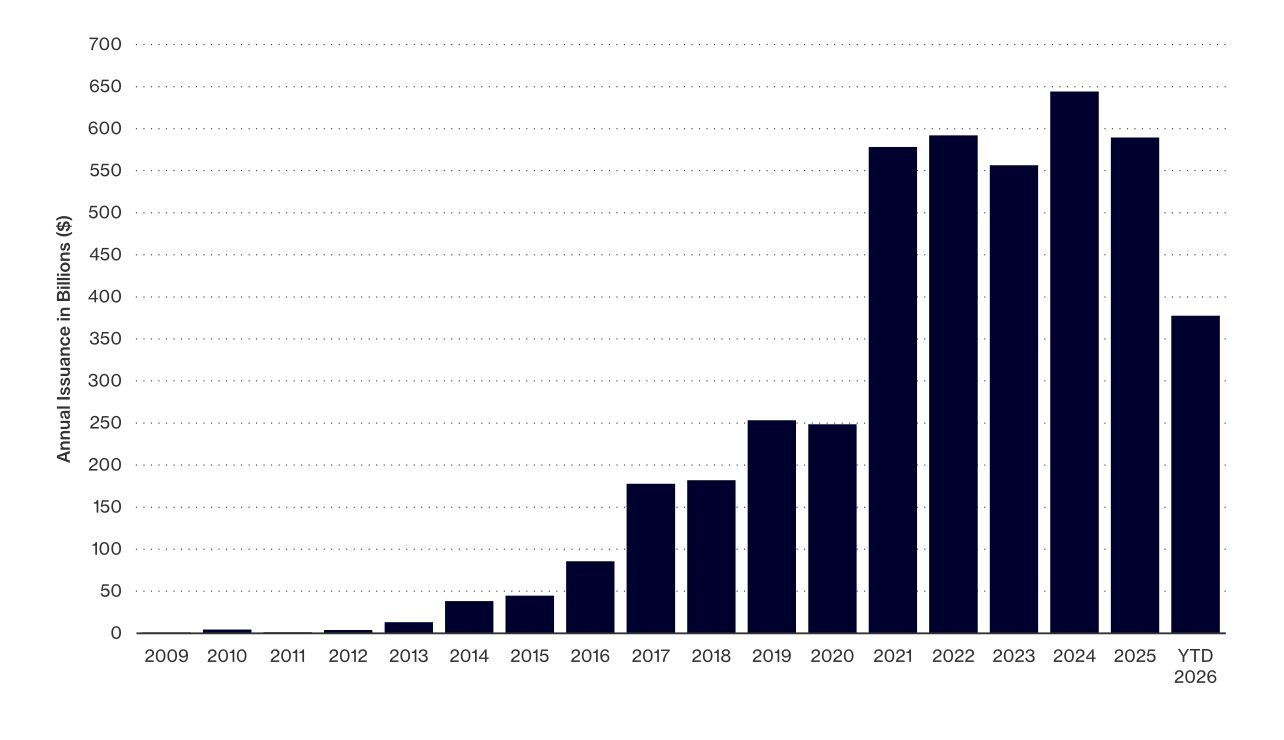 _Source: VanEck_
The outlook suggests that while ESG terminology may have become controversial, underlying demand for financing environmental infrastructure remains intact.
AI’s Growing Energy Needs Are Creating New Demand
AI could considerably strengthen demand for green bonds, as its expansion represents one of the largest infrastructure investment opportunities in decades.
As technology companies invest billions in data centers, electricity generation, and supporting infrastructure, they are finding that environmental considerations are becoming financial and operational necessities as well.
The result could be a new wave of green bond issuance that funds AI development while expanding investment opportunities across fixed-income markets.
Goldman Sachs Research estimates that global data center electricity demand could increase by more than 160% by 2030 compared with 2023 levels. If approximately 60% of that additional demand is met through fossil fuels, the resulting increase in carbon emissions could approach 220 million metric tons annually.
That creates a dilemma for technology companies pursuing ambitious AI development plans while simultaneously maintaining environmental commitments.
Green bonds offer a way to finance some of those investments while demonstrating progress toward reducing environmental impacts.
According to VanEck, the global data center green financing market has generated approximately $61.3 billion across 113 green bonds and loans since 2020, based on Climate Bonds Initiative data through June 2026. Nearly 78% of that financing occurred beginning in 2024, when AI growth took off, illustrating how quickly activity has accelerated.
Green data center financing reached $25.4 billion in 2025 alone, representing approximately 40% of the total issued since 2020, and another 20 qualifying financing transactions were completed during the first half of 2026.
An expanding issuer base could make green bonds more attractive to income-oriented investors.
Historically, some green bonds have traded at slightly lower yields than comparable conventional bonds, reflecting strong investor demand for sustainable investments. This pricing difference is sometimes called the greenium.
Additional issuance could help reduce that premium in certain market segments, potentially improving yields available to investors.
Investing in Green Bonds Through ETFs
For investors, the fact that many well-established technology firms are turning to green bonds to fuel their AI ambitions is great news for the sector. More green bond issuance improves outcomes and strengthens the asset class.
Investors don’t need to purchase individual green bonds to participate in this expanding market.
Green bond ETFs provide diversified exposure through a single investment, combining the income potential of fixed-income with the trading flexibility of exchange-traded funds. Most ETFs in the sector don’t exclusively target AI infrastructure but offer broader green bond exposure, including utilities, financial institutions, government-related issuers, and other sectors. As AI exposure grows, so will ETF holdings of such bonds.
ESG Bond ETFs
These funds were selected based on their exposure to various social, green, and sustainable bonds issued by sovereigns, municipalities, and other enterprises. Sorted by YTD total return, they range from -3.1% to -0.26%, with assets under management between $22M and $3.6B, expense ratios between 0.11% and 0.50%, and current yields between 3.3% and 6.1%.
| Ticker | Name | AUM | YTD Total Ret (%) | Yield (%) | Exp Ratio | Security Type | Actively Managed? |
|---|---|---|---|---|---|---|---|
| NUHY | Nuveen ESG High Yield Corporate Bond ETF | $105M | -0.26% | 6.1% | 0.31% | ETF | No |
| NUSA | Nuveen ESG 1-5 Year U.S. Aggregate Bond ETF | $22.9M | -0.7% | 3.7% | 0.16% | ETF | No |
| ESGB | IQ MacKay ESG Core Plus Bond ETF | $217M | -1.1% | 5.1% | 0.50% | ETF | Yes |
| GRNB | VanEck Green Bond ETF | $89.5M | -1.6% | 3.4% | 0.20% | ETF | No |
| VCEB | Vanguard ESG U.S. Corporate Bond ETF | $516M | -2.1% | 4.2% | 0.12% | ETF | No |
| NUBD | Nuveen ESG U.S. Aggregate Bond ETF | $327M | -2.4% | 3.3% | 0.16% | ETF | No |
| EAGG | iShares ESG Aware U.S. Aggregate Bond ETF | $3.56B | -3.1% | 3.8% | 0.11% | ETF | No |
| SUSC | iShares ESG Aware USD Corporate Bond ETF | $1.08B | -3.1% | 4.3% | 0.18% | ETF | No |
The rapid expansion of AI could become an important catalyst for the next phase of green bond growth.
Although ESG investing continues to face political resistance, the practical need to finance cleaner electricity generation, efficient data centers, and modernized power grids remains substantial. As technology companies and infrastructure developers increasingly turn to green financing, investors could benefit from a larger, more diversified bond market offering additional opportunities for income and credit selection. Greater issuance may also help improve available yields, though credit quality will continue to depend on individual borrowers rather than environmental labels.
For investors, this represents a win-win for portfolios.
Bottom Line
Despite ongoing political opposition to ESG investing, green bonds remain an important part of the fixed-income market, and the rapid expansion of AI could provide a powerful catalyst for future growth.