

Who Benefits from Individual Government Bonds? Connecting Deposits, Bank Profits, NISA, and the State’s Burden
Discussions surrounding individual government bonds often raise questions such as, “Do banks not want to sell them?”, “Why can’t they be bought through NISA?”, and “Who bears the burden of protecting the principal?”. Before explaining these through the lens of good or evil among individuals or organizations, I would like to separate the positions of households, banks, and the state, and examine the flow of money.
This article organizes confirmed facts and potential impacts based on the system as of November 15, 2026.
1. For banks, the profit mechanisms for deposits and government bond sales are different
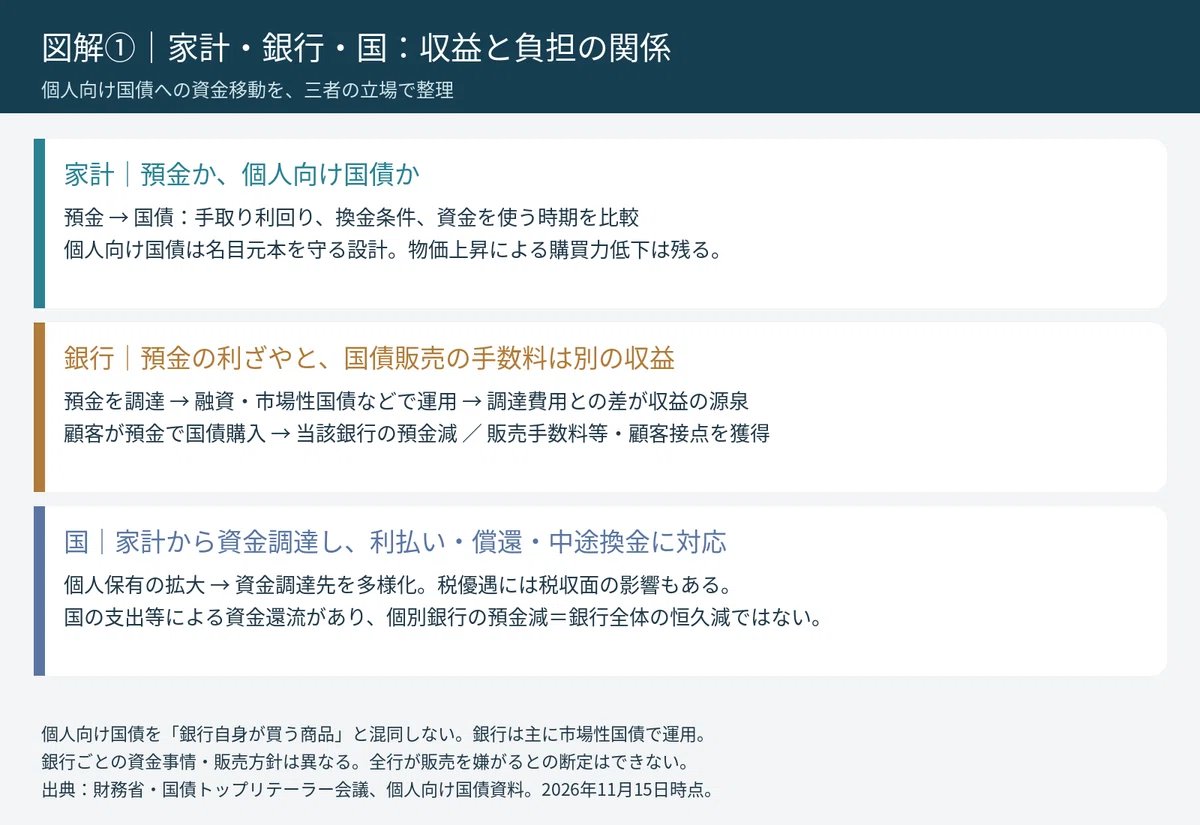
Banks use funds raised through deposits and other means for loans and securities investments, earning profit from the difference between investment returns and funding costs. For example, if the funding interest rate is 0.5% and the investment yield is 2%, the simple difference is 1.5%. However, this is a hypothetical figure for explanation, before deducting expenses, interest rate risks, and credit risks.
When a customer moves funds from a deposit to an individual government bond, deposits at that bank decrease. On the other hand, there is commission income from sales and handling, as well as the effect of maintaining a relationship with the customer. “Retaining deposits to earn a margin” and “selling government bonds to support customer asset formation” are different profit opportunities for banks.
In fact, at the Ministry of Finance’s Top Retailer Meeting for Government Bonds, voices expressing concerns about the balance between deposits and bond sales, as well as voices actively selling government bonds as an important product, can both be confirmed. [1] It cannot be generalized that all banks dislike selling government bonds.
Also, a distinction must be made between government bonds that banks invest in themselves and individual government bonds that customers buy. The explanation that banks buy individual products themselves to take a margin is not accurate. Even if funds move from deposits to government bonds, funds may return to the entire banking system through government spending, and a decrease in deposits at one bank is not the same as a permanent decrease in funds across the entire banking system.
2. It is a fact that they are not eligible for NISA. However, the reasons and motivations should be separated
Currently, individual government bonds are not eligible for NISA. NISA is designed for listed stocks and certain investment trusts, and is not a system for purchasing government bonds directly. [2]
To conclude from this that “the government thinks government bonds are bad” requires other evidence. What can be confirmed in public documents is that there are multiple issues, such as consistency with asset formation policies, fairness of the tax burden, and the movement of funds from deposits.
The Finance Minister’s press conference on November 10, 2026, also explained requests for product improvements and tax measures for government bonds. While a decision to make them eligible has not been reached, the policy to promote the expansion of individual holdings has been indicated. [3]
As for the evaluation of the system, if safe assets could also be managed in tax-exempt accounts, it would expand the options for people who do not want to take on significant price fluctuations. On the other hand, it is necessary to distinguish between tax incentives for those who already buy government bonds and the effect of promoting new purchases, and to examine who benefits and to what extent.
3. The tax revenue loss from tax exemption and the increase in government interest payments are different matters
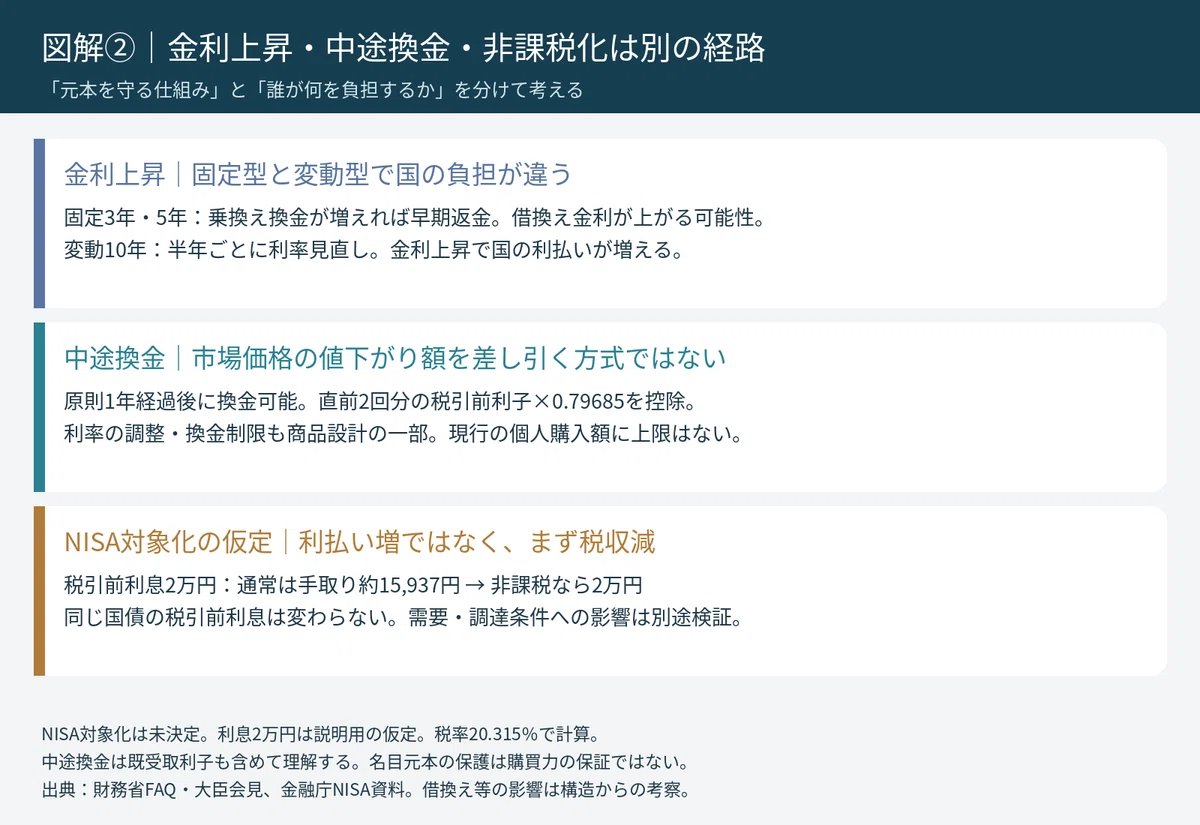
If the annual interest on a government bond is 20,000 yen, the tax at the standard rate of 20.315% would be approximately 4,063 yen, and the after-tax receipt would be approximately 15,937 yen. If they were tax-exempt, the investor’s take-home pay would increase, and tax revenue for the national and local governments would decrease.
However, the pre-tax interest of 20,000 yen on the same government bond does not increase just because of that. The tax revenue loss due to tax exemption and the increase in interest payments due to rising issuance rates have different paths of impact on public finance.
If demand increases due to tax exemption, it could also help stabilize funding. The actual fiscal effect should be judged not only by the tax revenue loss but also by the increase in purchasers, the movement of funds from other products, and the impact on funding conditions. This is a consideration of the system’s effects, not a verification of the effect amount.
4. When the principal is protected, where does the interest rate rise risk go?
For general fixed-rate government bonds, if interest rates rise, market prices fall, and selling before maturity may result in a loss. Instead of selling at market price, individual government bonds can generally be redeemed early according to government rules starting one year after issuance. In that case, the amount equivalent to the pre-tax interest for the two most recent periods multiplied by 0.79685 is deducted. [4]
What is important is to consider not only the deposit amount at the time of early redemption but also the interest received up to that point. Under the system, it is not a mechanism that forces the purchaser to bear the decline in market price due to rising interest rates as is.
For 3-year and 5-year fixed-rate bonds, there is a possibility that more people will redeem them after interest rates rise to switch to products with higher rates. The government may bear the burden of responding to early refunds and, if re-borrowing, procuring at higher interest rates. For 10-year floating-rate bonds, government interest payments increase due to the semi-annual interest rate review. [5]
In other words, what the government bears is not a simple substitution for price decline losses, but rather the funding burden of responding to early redemption and changes in interest payment and refinancing costs. Such product characteristics are also reflected in interest rate adjustments and early redemption conditions. The Ministry of Finance also explains that product characteristics such as early redemption are comprehensively taken into account when setting interest rates. [5]
5. Is it restricted by purchase limits? There is no limit under the current system
Under the current system, individual government bonds can be purchased from 10,000 yen in 10,000 yen increments, and there is no limit on the purchase amount. [6] While there is an issuance plan for the country as a whole, that is separate from individual purchase limits. It cannot be explained that “the government limits individual purchase amounts because it bears the risk.”
Also, the fact that the nominal principal is protected does not mean that purchasing power is protected. If inflation exceeds the after-tax yield, the real value of the funds will decrease. With fixed-rate types, there is an opportunity cost of missing out on interest rate rises, and floating-rate types are not products that directly link to prices.
6. It also leads to a perspective on the future of banks
For banks, rising interest rates increase investment returns, but also affect the interest paid to maintain deposits and the valuation of held bonds. It cannot be said definitively that “banks will definitely profit because interest rates are rising.”
Households consider take-home yield, redemption conditions, and real purchasing power; banks consider funding and profit sustainability; and the government considers stable procurement, tax revenue, and interest payments. There are times when their respective rationales align and times when they clash.
What I want to ask in the discussion of individual government bonds is not to determine someone’s hidden intentions, but which system can expand household options while explaining the burden on financial intermediation and public finance.
Sources/Notes (Outside of this character count)
[1] Ministry of Finance “Minutes of the Top Retailer Meeting for Government Bonds (24th Meeting)”
https://www.mof.go.jp/about_mof/councils/meeting_of_jgbtr/proceedings/outline/e20250609.html
[2] Financial Services Agency “Knowing NISA”, Ministry of Finance Study Group Materials (stating that individual government bonds are not eligible for NISA)
https://www.fsa.go.jp/policy/nisa2/know/index.html
https://www.mof.go.jp/about_mof/councils/study_gov_debt_management/d20251104-4.pdf
[3] Finance Minister’s Press Conference (November 10, 2026, August 25)
https://www.mof.go.jp/public_relations/conference/my20261110.html
https://www.mof.go.jp/public_relations/conference/my20260825.html
[4] Ministry of Finance “Frequently Asked Questions About Early Redemption”
https://www.mof.go.jp/jgbs/individual/kojinmuke/main/qa/answer_qd.html
[5] Ministry of Finance “Frequently Asked Questions About Interest Rates”
https://www.mof.go.jp/jgbs/individual/kojinmuke/main/qa/answer_qc.html
[6] Ministry of Finance “Frequently Asked Questions About Issuance, etc.”
https://www.mof.go.jp/jgbs/individual/kojinmuke/main/qa/answer_qb.html
-
The hypothetical interest rate and 20,000 yen interest in the text are for explaining the mechanism and are not actual offering rates. Individual tax-exempt measures such as the Maruyu system are not included in the calculation examples.
-
“Principal is protected” is an explanation of the current redemption and early redemption system, and does not mean that the government’s credit risk or inflation will disappear. It is a different mechanism from the deposit insurance system for bank deposits.
-
When government bonds are purchased, customer deposits decrease, and settlement funds move to the government side. Because there is a recirculation of funds through government spending and other channels, the final impact on the overall deposits and loans of banks is not uniform. Banks do not simply lend out deposits on a one-to-one basis, and this text simplifies the relationship between procurement costs and investment returns.
-
Refinancing risk, the impact of increased demand on procurement conditions, and the policy advantages and challenges of NISA are considerations based on the institutional structure, not the inner thoughts of specific institutions or empirical values of policy effects.
-
In the study group materials dated November 5, 2026, it is also indicated that the target will be expanded to include some corporations starting with the December offering and January 2027 issuance, to be called ‘Government Bonds for Individuals Plus.’ Distinguish between plans and the current system.
https://www.mof.go.jp/about_mof/councils/study_gov_debt_management/d20261105-1.pdf
#GovernmentBondsForIndividuals #Banks #NISA #InterestRates #AssetFormation #FinancialEducation