

Hello! This is “Learning from Analysts: Stories of Stocks, Currencies, and the Economy.”
Here are the three conclusions for this time in advance:
1. It is meaningless to single out the “expansion” of unrealized losses on life insurance bonds. This is because they match 30-year bonds to 30-year promises and hold them until maturity (Mr. Okazaki).
2. What you should look at is the content of the assets. Domestic bonds have decreased from 60% to 35%, and are now almost on par with foreign currency-denominated assets (Bank of Japan statistics presented by Mr. Okazaki).
3. The story of the weak yen is more important than unrealized losses. Whether the money that went abroad returns to domestic bonds is related to the future of exchange rates and interest rates (Mr. Okazaki).
From “Market Masters” released on November 13, I have organized the segment featuring financial strategist Ryosuke Okazaki into a format that can be read in about 6 minutes. For those who hold Japanese stocks, this is a story that connects to both interest rates and the weak yen.
First, checking the answers to the August outlook
When I wrote the article on August 24 (capital investment negative for two consecutive quarters), I recorded the outlook that “the pain of rising interest rates is skewed toward small and medium-sized enterprises, and will not lead to dividend cuts for large high-dividend stocks for the time being.” The condition for being wrong is that multiple dividend cuts or downward revisions due to “increased interest payments” would emerge from large-cap high-dividend stocks in the April-September financial results. The deadline is November 14.
The result was correct. As far as I could confirm, I did not see any large high-dividend stocks that cut dividends due to increased interest payments. I should note that I have not been able to check every single company.
For another item, the “bank stocks move in line with long-term interest rates” outlook established in the August 26 article on bank stocks, the judgment date is November 16. As of the 13th, the 10-year government bond yield is 2.855%, and the TSE Bank Index is 716.19. It has not touched the line of being wrong (index falling below 690 while the yield remains at 2.8% or higher).
Ryosuke Okazaki | Points
Market Masters (Released November 13, 2026)
▶ Original video:
One term first
Unrealized loss refers to the amount by which the current price of a bond you hold is lower than the price at which you bought it. When interest rates rise, bonds bought when interest rates were low fall in price. Losses are not realized unless you sell.
The reason why “expansion” is meaningless
What Mr. Okazaki took up was a newspaper report that unrealized losses on life insurance bonds are swelling due to rising interest rates. In response, Mr. Okazaki stated that it is “completely meaningless” to just single out and show the expansion.
The reason lies in the nature of life insurance money. Life insurance companies do not buy and sell bonds aiming for price increases like investment trusts. They have promises to pay insurance money in 20 or 30 years, so they buy 20-year or 30-year bonds to match that length and hold them until maturity. The rise and fall of prices along the way is just a passing point, is the summary.
What you should look at is the content of the assets
Instead, what Mr. Okazaki showed was a breakdown of life insurance assets created from Bank of Japan statistics (flow of funds). The total amount is approximately 360 trillion yen. The trend since the end of March 1998 is as follows.
・Domestic bonds: approx. 36% → peaked at approx. 60% → recently in the mid-30% range (35% according to Mr. Okazaki)
・Foreign currency-denominated assets: slightly less than 10% → mid-30% range
・Loans: approx. 36% → slightly less than 10%
(Percentages are approximate figures read from the program’s charts)

Domestic bonds approached 60% around 2012. When interest rates sank to near zero due to the Bank of Japan’s massive monetary easing (April 2013–March 2024), life insurers turned overseas in search of yields. Now, domestic bonds and foreign currency-denominated assets are roughly the same size.
Regarding exchange rates
What Mr. Okazaki identified as more of a problem than unrealized losses was the continuation of this trend. While there are measures in place to avoid exchange rate fluctuations, the view is that if they continue to increase foreign assets, it will to some extent be a factor in the yen’s depreciation.
The 10-year interest rate has returned to near 3%. Mr. Okazaki stated that it is important to return to domestic bonds “naturally” in line with current interest rates. He did not specify when or by how much they would return.
He also touched on discount government bonds, where the interest portion is separated from 30-year bonds and the like. These are products bought at 40 yen that return 100 yen after 30 years. He explained that this is a necessary innovation for the government bond market in an era of interest rates, as it allows life insurers who want interest and investors who only want the capital gains to split the benefits.
Summary
The amount of unrealized losses is an interim figure. Where the ratio of domestic bonds to overseas assets moves is what Mr. Okazaki is watching.
My take: Rather than worrying about insurance and bank stocks due to headlines about unrealized losses, tracking whether the ratio of domestic bonds hits bottom provides better material for predicting the future of the yen and interest rates. High-dividend stocks tend to look less attractive as interest rates rise, so if buyers return to domestic bonds at interest rates near 3%, I took it as not a bad story for those who continue to hold them.
The deciding factor is not the amount of unrealized losses, but “whether they are forced to sell”
Mr. Okazaki did not touch on the amounts. From here on, the material is outside the video. I will present the reported figures, my way of reading them, and my leanings in order (the following is not what was discussed in the video).
Reported figures: 30 trillion yen in unrealized losses and record-high profits
・According to a survey by the Nihon Keizai Shimbun, the unrealized losses on domestic bonds held by 13 major companies were approximately 30 trillion yen at the end of June. This is a 60% increase from a year ago, exceeding the unrealized gains on domestic stocks.
・In another survey by the same newspaper, the total core business profits of 15 major companies for the fiscal year ending March 2026 are approximately 4.4 trillion yen. This is a record high for the second consecutive year.
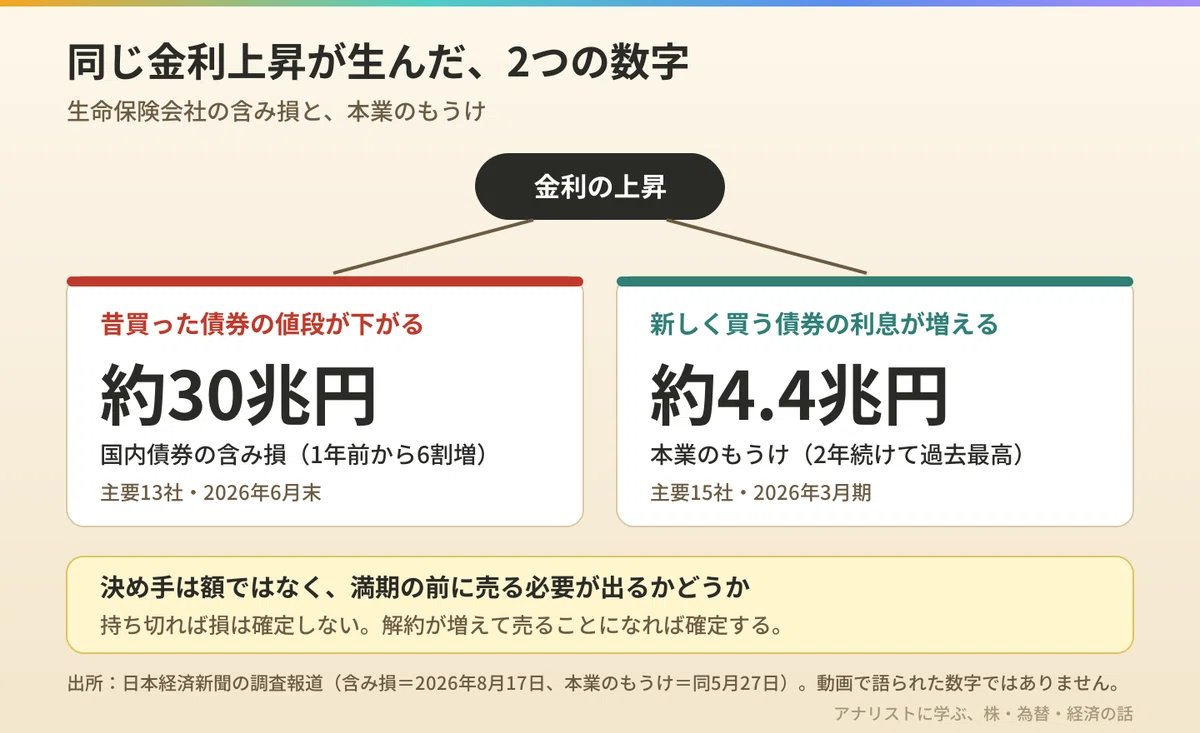
The same rise in interest rates is simultaneously creating unrealized losses and record profits. The newspaper also pointed out that if insurance cancellations increase and bonds have to be sold, the losses will be realized. This is where it diverges from Mr. Okazaki’s assessment that “it doesn’t matter because they will hold them to maturity.” The deciding factor is not the size of the amount, but whether there is a need to sell before maturity.
My interpretation: Ratios also fluctuate with price
The ‘ratios’ in Mr. Okazaki’s chart are based on Bank of Japan statistical balances, which include increases and decreases due to price fluctuations. Even if not a single yen of bonds is sold, if interest rates rise and prices fall, the ratio of domestic bonds will decrease, while rising stock prices and a weaker yen push up the ratios of other assets. Not all of the recent sharp decline necessarily means they have ‘moved away from domestic bonds.’ I have not been able to confirm the extent of the price impact.
My inclination
I lean toward Mr. Okazaki’s view. However, I do not take the decline in the ratio as simply meaning money has ‘gone elsewhere,’ but rather look at it in conjunction with the increase in cancellations. Returning to the video, what Mr. Okazaki was questioning was not the amount, but where the money is headed.
Investor Checklist
・Will the 10-year JGB yield reach 3% at closing? (It was 2.855% on November 13)
・Movements in unrealized losses and cancellations in the April-September financial results of major life insurers coming out this month
・Whether the ratio of domestic bonds will stop falling in the Flow of Funds Accounts for July-September to be released by the Bank of Japan in mid-December
My outlook for this time
・My outlook: The 10-year JGB yield will not reach 3.00% at closing by December 18
・Condition to judge that I was wrong: If it hits 3.00% or higher at closing even once between November 16 and December 18
・Date to check the results: December 18
This is not a recommendation to buy or sell.
My stance on this article
The focus is not on the amount of unrealized losses, but on whether the money that left will return. I am using Mr. Okazaki’s framework—that interest rates near 3% are a reason for money to return—as my benchmark. The next milestone is the Bank of Japan meeting on December 17-18.
If you found this article helpful, I would appreciate it if you could follow me.
I organize and deliver the perspectives of professional analysts with charts around 7:00 PM almost every day.
The numbers to look at on days when the market moves significantly are summarized in the paid guide ‘Identifying the Culprit of a Sharp Drop Using 5 Numbers’ (the price of one cafe latte, 500 yen) →
This blog summarizes and organizes the content of publicly available YouTube videos. It does not recommend any specific investment actions. Please make investment decisions at your own discretion and responsibility.