
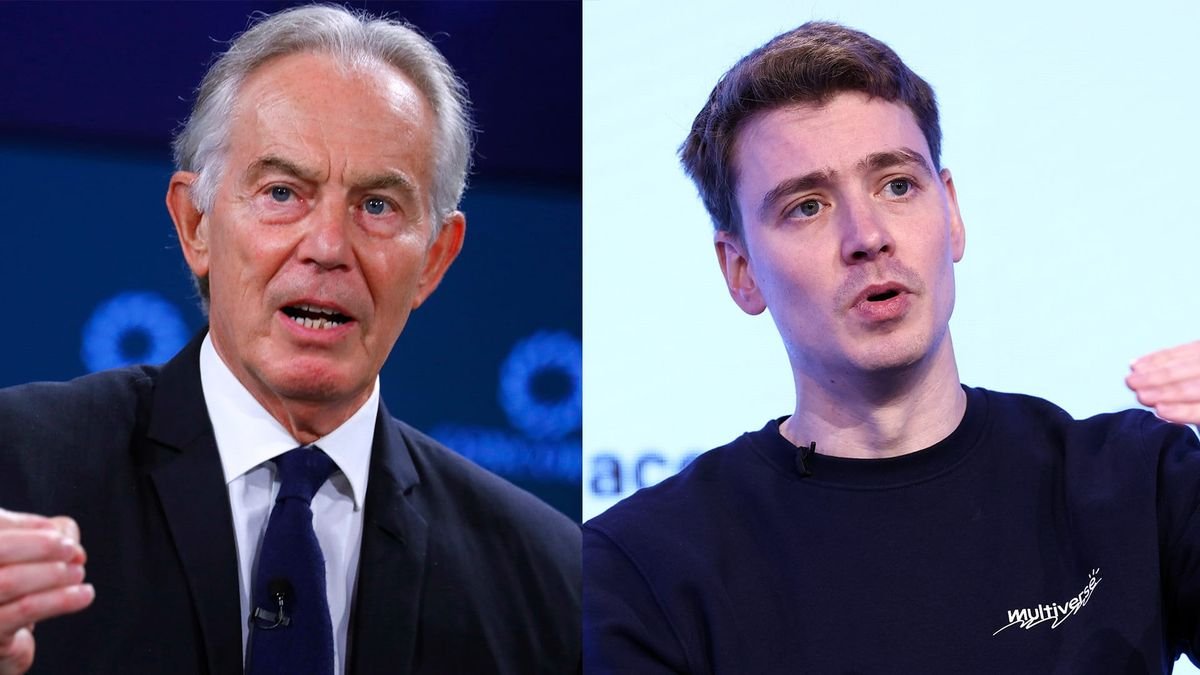
Tony Blair’s son was one of three people invited by the government to a private meeting hosted by BlackRock earlier this year, openDemocracy can reveal.
The meeting, held in the asset management giant’s London offices in April, was attended by then-business secretary Peter Kyle and the Department for Business and Trade’s permanent secretary, Amanda Brooks, as well as representatives of a major private equity investor, high-growth companies, and industry lobbying groups.
After openDemocracy learned that the event took place through emails obtained under Freedom of Information laws, the government said it holds no records of what was discussed. It also declined to comment on why it invited the former prime minister’s son, Euan Blair, who was at the time seeking investment for his AI company.
The government emails also reveal that BlackRock’s UK chair originally tried to arrange the meeting with Kyle’s predecessor, Jonathan Reynolds, in July last year, weeks after the pair met at the summer party of Hakluyt, a secretive consulting firm with links to No 10.
Reynolds – whom Andy Burnham reinstated as business secretary in August – failed to declare his attendance at the party, in what may be a breach of ministerial rules.
A former minister told openDemocracy that “questions must be asked about” the failure, while Green Party leader Zack Polanski called for an investigation into our findings.
“The public deserves to know who ministers are meeting, what is being discussed and whose interests are being served,” Polanski said.
“Increasingly, people are seeing the difference between what this government says and what it does and concluding that it isn’t their interests this government is serving. There must be full transparency and accountability. Any breaches of the ministerial code must be properly investigated as a bare minimum.”
‘City lobbyists saw an opening’
The BlackRock event was billed as dinner and a discussion on ‘Financing Growth in the UK’.
While the Department for Business and Trade said no minutes, notes or readouts from this discussion exist, it did release a briefing note prepared for Kyle by civil servants ahead of time.
The note set out several discussion questions “geared towards attendees” that had been proposed by BlackRock. These included “what would give long-term institutional investors greater confidence to commit more capital to UK growth companies?” and “what would make the UK the most attractive place for companies to grow from start-up into global leaders?”
It also told Kyle to stress the growing role of the British Business Bank – the government-owned economic development bank that has an increasing role providing capital to UK firms – in “crowding-in long-term scale-up finance” and the importance of “regulatory clarity and competitiveness” in attracting investors.
Sara Hall, co-executive director at Positive Money, a non-profit pushing for reform to the financial sector, told openDemocracy the briefing note exposes how Keir Starmer’s government sought to appease the City.
“As these documents show, the Starmer-led government was overly keen to demonstrate its value to the financial sector, whether that meant cutting regulation or sweetening private investment in our critical infrastructure with public subsidies,” Hall said.
“The financial sector will always push to be able to take more risks with our money, or sniff around for subsidies,” she added. “Clearly, City lobbyists saw an opening to advance their demands under the Starmer government.”
‘We do appreciate the short notice’
Five days before the dinner, Kyle’s office reached out to extend an invite to executives at three companies: PsiQuantum, which works in quantum computing, Tokamak Energy, a fusion energy firm, and Multiverse, an edtech and AI skills company co-founded and led by Euan Blair.
In the case of both PsiQuantum and Tokamak Energy, Kyle’s office had to be passed the relevant contact details by other specialist teams in the Department of Business and Trade. Its subsequent emails to both firms explained how their attendance would benefit the government.
The secretary of state was keen to “meet some of our fastest growing companies”, his team told Tokamak chief executive Warrick Matthews, while ministers wanted to better understand PsiQuantum co-founder Mark Thompson’s experience of “founding in the UK but scaling abroad”.
Kyle’s team did not need to be sent an email address for Multiverse’s vice president of corporate affairs – a former Tory special adviser and No 10 staffer – and there was no specific reason given why ministers felt the company’s attendance would benefit them.
Instead, as the email thread shows, the government appeared to be thinking of the younger Blair’s interests when it reached out to invite him.
“I know you have been in contact with the office about organising a conversation between our Secretary of State and your CEO Euan Blair. Without getting in the way of efforts to get that meeting in the diary, I wanted to flag a dinner next week which we thought Euan might be interested in attending in addition,” the email read.
“Given Euan’s interest in the Government’s backing for growth companies, the Secretary of State would be delighted if he would be able to join the group and offer his perspectives if by any chance he is available (we do appreciate the short notice)?”
Multiverse is England’s largest apprenticeship provider by revenue, with much of its income coming from the government’s apprenticeship levy. Its most recent accounts showed a loss of £63.3m for the year to March 2025.
On 15 May, three weeks after the dinner, Multiverse announced it had secured $70m of investment at a funding round valuing it at $2.1bn, its first raise since 2022. Euan Blair is the company’s largest individual shareholder.
openDemocracy asked the government why it had invited Blair, whether the family’s ties to Labour or Kyle – who was a Cabinet Office adviser during Tony Blair’s second term – played a part in the decision to do so, and whether Kyle had personally asked for Blair to attend. It did not respond to any of our questions, although a spokesperson said: “Ministers routinely meet with the CEOs of fast-growing UK firms to support them to scale in the UK.”
“Personal connections inevitably play a role in who gets invited to government events,” Tom Brake, a former whip in the coalition government and the director of Unlock Democracy, a non-partisan organisation campaigning for electoral, constitutional, and political reform.
“It’s up to departments to ensure access is fair and ‘who you know’ does not translate into favouritism,” he added.
After the meeting
BlackRock’s UK chair Sandra Boss, who hosted the dinner, wrote to the Department for Business and Trade after the meeting to say that while the group had discussed “an array of ‘real economy’ ideas”, three in particular “merited further conversation”.
The first, she said, was “planning reform and accelerating the consent process, given our role on the British Infrastructure Taskforce”. BlackRock sits on the taskforce, a government-backed body set up to channel private investment into infrastructure.
The government redacted Boss’s second idea in emails released to openDemocracy, saying its disclosure could harm policy development. The third was public procurement, where Boss said: “The UK could be more professional and deliberate.”
Boss asked for a further one-to-one meeting with Kyle, noting that BlackRock would “be happy to share any further detail on any of the financing-specific topics that arose in our discussion”.
Positive Money’s Hall told openDemocracy: “It’s fallacious to believe that regulation is the key blocker to either investment or growth in the UK economy. Regulation is what’s holding back risk – and growth built on excessive risk-taking isn’t worth having, especially if it heralds another financial crash forcing huge public bailouts.”
Summer party
Boss originally reached out to Reynolds to arrange the meeting in late June 2025, writing: “It was good to see you at the Hakluyt Summer Party last week.”
Hakluyt, a Mayfair-based consultancy, is among the best-connected firms in British politics. Its former managing partner, Varun Chandra, has been the government’s top business and investment adviser since being hired by Starmer in July 2024. He remains in place under Burnham, despite concerns over his continued stake in Hakluyt and the lack of transparency around its clientele.
The company is well known for its lavish parties, where senior figures from the worlds of business and politics mix. While senior government officials from the Foreign Office, the Ministry of Defence, and the Department for Business and Trade – including the latter’s then permanent secretary, Gareth Davies – declared their attendance at last year’s summer party, Reynolds did not.
This omission may constitute a breach of the Ministerial Code, which requires ministers’ hospitality, including drinks receptions, to be published monthly. In the same month as the Hakluyt event, Reynolds declared two £75 dinners from lobbying firm Flint Global and accountancy giant KPMG.
MPs have declared the same event. Shadow chancellor Mel Stride registered two tickets to this year’s Hakluyt summer party, for himself and his wife, worth £550.
The government declined to answer whether Peter Kyle, who was business secretary at the time of this year’s Hakluyt summer party, on 11 June, had attended and not declared doing so.
Brake told openDemocracy: “There ought to be no inconsistencies between what ministers and their civil servants declare when attending the same events. If senior officials considered this event worth declaring, questions must be asked about why the then minister did not.”