
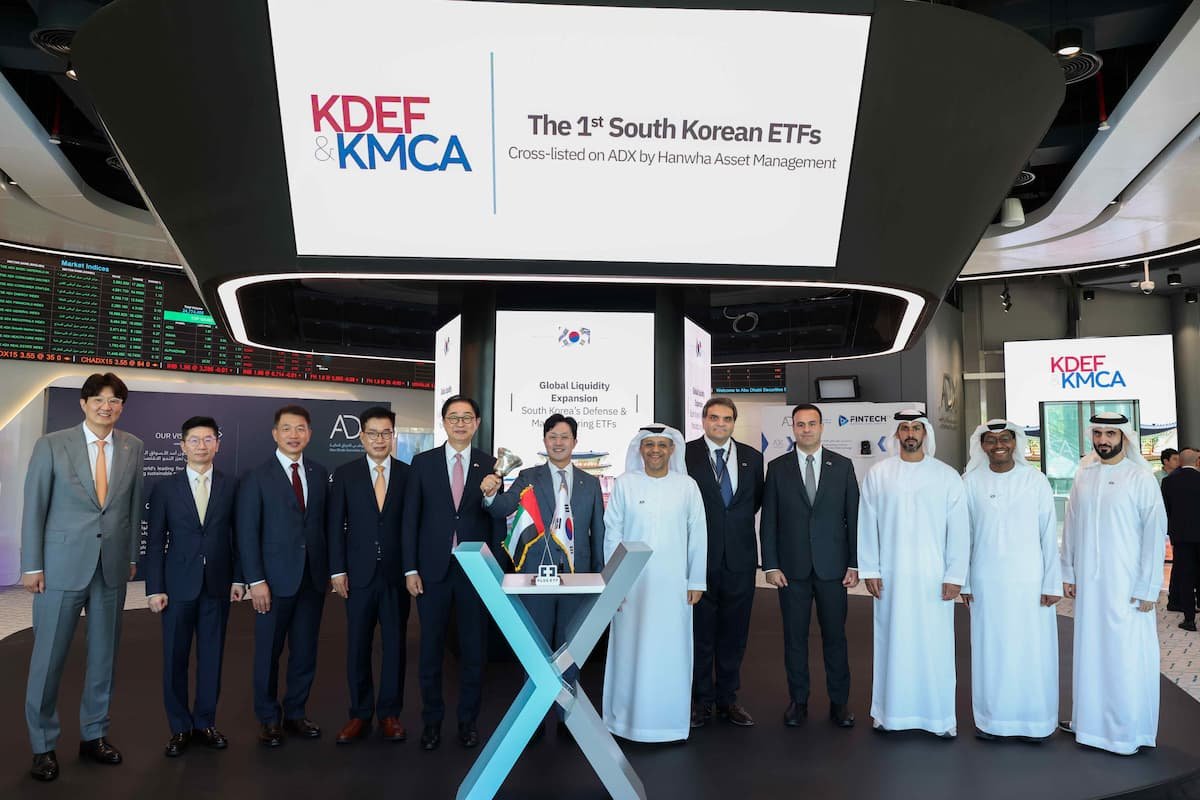
The Abu Dhabi Securities Exchange (ADX) has listed two South Korea-focused exchange-traded funds from Hanwha Asset Management, marking the first time Gulf investors have had direct on-exchange access to Korean industrial and defence sectors during local trading hours. The listings took effect on 2 November 2026 and bring the total number of ETFs on ADX to 26.
The two products are the PLUS Korea Defense Industry Index ETF (KDEF) and the PLUS Korea Manufacturing Core Alliance Index ETF (KMCA). Both are primary-listed on NYSE Arca and are now dual-listed on ADX, making them the fifth and sixth cross-listed US-domiciled ETFs on the exchange. KDEF tracks the Korea Defense Industry USD Index, allocating at least 80% of its assets to South Korean companies in national security technology, defence manufacturing and aerospace, including Hanwha Aerospace and LIG Nex1 across 20 holdings. KMCA tracks the Akros Korea Manufacturing Core Alliance Index, covering 35 companies across six strategic supply-chain sectors, with Samsung Electronics and SK Hynix among its leading constituents.
The deal
Abdulla Salem Alnuaimi, group CEO of ADX, framed the listings as a bridge between capital from the Gulf and South Korea’s industrial base. “The KDEF and KMCA listings come at a time of growing economic ties and stronger cooperation between the UAE and the Republic of Korea,” he said. Young Jin Choi, executive vice president and chief marketing officer of Hanwha Asset Management, described the move as extending an existing industrial partnership between Hanwha Financial Group and the UAE into the financial markets domain.
ADX reported ETF trading values of more than 291 million dirhams between January and October 2026, a figure the exchange cited to support its positioning as the Gulf’s most active and liquid ETF hub.
Market context
The dual-listing structure reflects a broader trend among Gulf exchanges competing to deepen their thematic ETF catalogues and attract international asset managers as listing partners. ADX, the second-largest exchange in the Arab region by market capitalisation, has been particularly active in cross-border ETF arrangements as part of the UAE’s strategic diversification agenda. Its regional rival, the Saudi Exchange (Tadawul), has pursued a comparable strategy, while the Dubai Financial Market has focused more on domestic equity products.
The choice of South Korea as the exposure is notable in the current geopolitical environment. Korean defence and advanced manufacturing have attracted significant institutional interest globally, driven by elevated defence budgets across NATO and partner states and by the strategic importance of Korean semiconductor supply chains to the AI buildout. Both KDEF and KMCA are positioned to capture that demand from a Gulf investor base that has historically concentrated its international equity exposure in US and European markets.
From a regulatory standpoint, the UAE Capital Market Authority governs securities admitted to ADX, and the dual-listing framework allows the products to trade under Abu Dhabi’s regulated market infrastructure, including ADX’s post-trade subsidiaries AD Depository and AD Clear. For Hanwha, the arrangement avoids the cost and complexity of a standalone UAE fund registration while still reaching local investors directly through a recognised exchange venue.
The near-term markers to watch include trading volume in KDEF and KMCA once liquidity settles after launch, whether Hanwha uses the ADX relationship as a template for further Gulf listings, and whether competing Korean asset managers follow with their own cross-listings on ADX or alternative Gulf venues.
AI level 1 of 5: written by Darlyn Ho; AI helped with tone, structure or wording; edited and signed off by Mark Walker, Editorial Director. What the levels mean