

Taking a step beyond savings accounts: Where, when, and how much can you buy in government bonds for individuals?
With the Bank of Japan’s policy interest rate rising to 1.25%, a “world with interest rates” has returned to Japan.
In the previous article, we looked at how the BOJ’s rate hike would ripple through to home loans.
For those taking out home loans, rising interest rates manifest as interest payments.
On the other hand, for those holding cash, it also leads to interest received through
deposit interest rates
and
government bond interest rates
.
So, in this article, for those who are thinking,
“I’m not considering stock investments with volatility risk, but what should I do with the money sitting in my savings account?”
we will organize the basics of government bonds for individuals.First, what are “government bonds”?
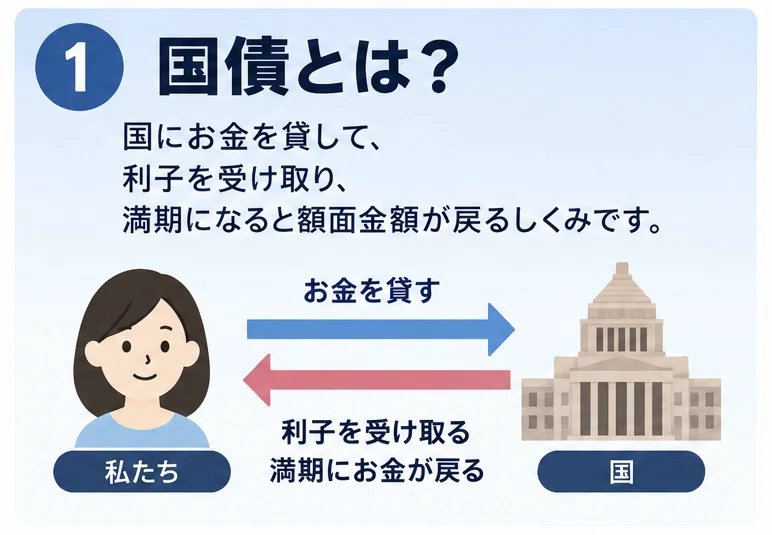
Government bonds are bonds issued by the government to raise funds.
From the perspective of the public, the purchaser, the mechanism is:
Lend money to the government
↓
Receive interest
↓
The face value is returned at maturity
.
What we are covering this time are government bonds for individuals, designed to be easy for individuals to purchase.
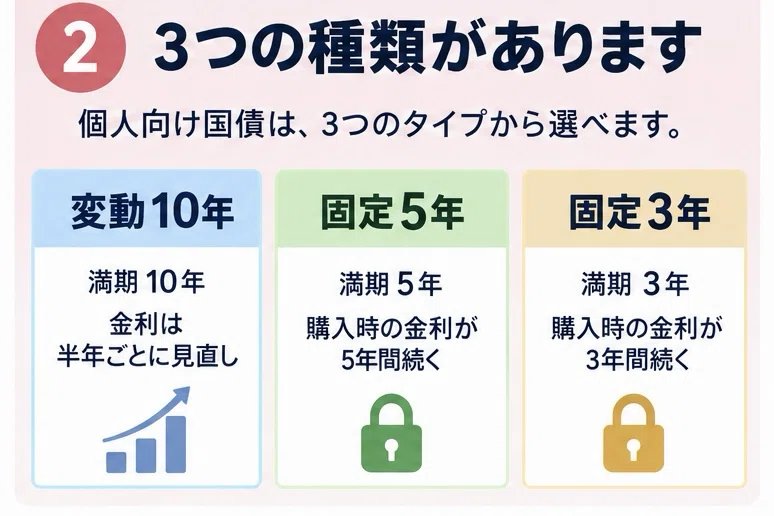
The current products are three types:
Floating 10-year
, Fixed 5-year
, and
Fixed 3-year.According to the Ministry of Finance, all three types are issued every month and can be purchased from a minimum of 10,000 yen in 10,000-yen increments. There is no set maximum purchase amount.
What is the relationship between the BOJ’s rate hike and government bonds?
When the BOJ raises its policy interest rate, the impact spreads to various market interest rates.
In the big picture, the relationship is:
BOJ policy rate hike
↓
Market interest rate rise
↓
Government bond yield rise
↓
Reflected in the interest rates of newly issued government bonds for individuals
.
Compared to Japan up until a few years ago, the significance of individuals being aware of government bond interest rates has become much greater.
Q. What is the difference between Floating 10-year, Fixed 5-year, and Fixed 3-year?
The biggest difference is how the interest rate is determined.
Floating 10-year: The maturity is 10 years. The interest rate is reviewed every six months. If market interest rates rise, the interest received may also rise.
Fixed 5-year: The maturity is 5 years. The interest rate set at the time of purchase continues for 5 years.
Fixed 3-year: The maturity is 3 years. The interest rate set at the time of purchase continues for 3 years.
For all three products, the minimum interest rate is 0.05% per year.
Q. Where can I buy government bonds for individuals?
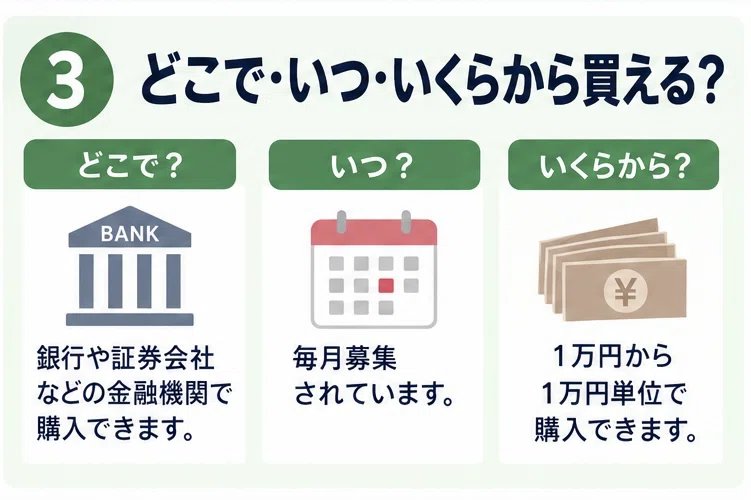
You can purchase them at financial institutions such as securities companies and banks.
Handling institutions include:
securities companies
,
city banks
,
trust banks
,
regional banks
,
credit unions
,
credit cooperatives
,
labor banks, agricultural cooperatives
, and
Japan Post Bank.When purchasing for the first time, you will open an account to manage government bonds at the financial institution you use.Depending on the financial institution, you may be able to purchase them online.
Q. When can I buy government bonds?
Government bonds for individuals are offered every month.
Usually, the interest rate for the month is announced at the beginning of the month, and the subscription period is from the next business day until around the last business day of the month
.
In other words, rather than purchasing while watching a screen where prices move every second like stocks, it is a product closer to the feeling of
“checking the conditions for this month’s government bonds for individuals and applying.”
Q. How much can I buy government bonds from?
The minimum purchase amount is 10,000 yen.
After that, you can purchase in 10,000-yen increments.
For example, purchasing methods like 10,000 yen, 100,000 yen, 500,000 yen, 1 million yen, or 1.23 million yen are possible.While it is easy to imagine large-scale financial products from the term government bond, government bonds for individuals are designed to be started with small amounts.
Q. What happens if the BOJ raises interest rates further from here?
This is where the “Floating 10-year” becomes easy to understand.
Because the Floating 10-year interest rate changes every six months, it reflects the future interest rate environment in the form of
Market interest rate rise
↓
Benchmark interest rate rise
↓
Applicable interest rate rise from the next time onwards
.
On the other hand, with Fixed 3-year and Fixed 5-year, you receive the interest rate at the time of purchase until maturity.
Therefore, it is a difference in thinking between fixing the current interest rate and incorporating future interest rate changes.
Which one you choose depends on your interest rate outlook and when you will use the funds.
Q. If it has a 10-year maturity, does that mean I can’t use the money for 10 years?
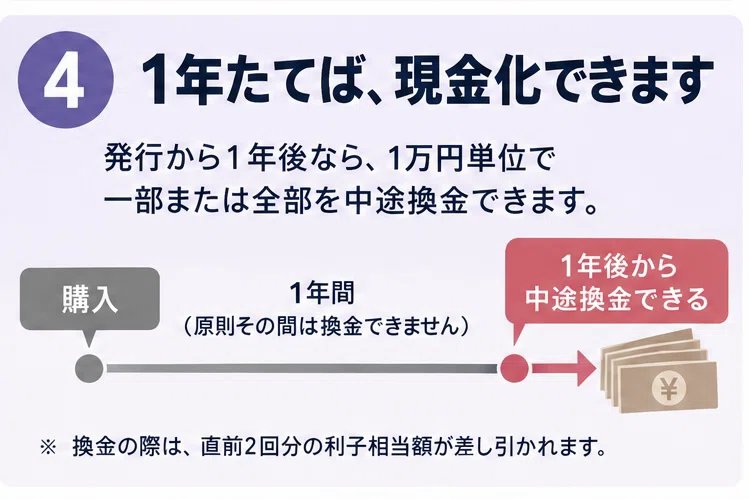
Government bonds for individuals have an early redemption system.After one year has passed since issuance, you can redeem part or all of it early in 10,000-yen increments.
The face value portion at the time of early redemption is bought back by the government at 100 yen per 100 yen.
At that time, an early redemption adjustment amount based on the interest equivalent of the last two payments is deducted.
Therefore, even for the 10-year type, it is easier to understand the mechanism if you think of it as
“one year as the basic fund lock-up period, and after that, you can redeem the necessary amount in 10,000-yen increments”
rather than “locking up funds for 10 years.”
Q. Can I cancel government bonds if I suddenly need cash?
This is a major difference from savings accounts.
Savings accounts are funds that can be used immediately for daily payments and sudden expenses.
Government bonds for individuals are, in principle, products that can be redeemed early after one year has passed since issuance.
Therefore, there is a way to think about dividing funds into money that might be used immediately and money that is unlikely to be used for more than a year.
For example, the division of roles is:
Daily living expenses/emergency funds → Savings accounts, etc.
Funds not planned to be used for the time being → Consider government bonds for individuals.
Since living expenses and necessary funds differ by household, the amounts are determined by each household’s budget.
Q. If I have 1 million yen, should I buy 1 million yen at once?
There are multiple ways of thinking about this.
For example, if you have 1 million yen, you can purchase 1 million yen at once. Or, you can buy in ways like 200,000 yen x 5 times or 100,000 yen x 10 times.Since government bonds for individuals are issued every month, you can diversify the purchase timing.
Q. What is the merit of buying government bonds little by little?
If you divide the purchase timing, you will hold government bonds with interest rates from different months.
For example, if interest rates continue to rise in the future, the conditions at the time of purchase will change for the April purchase, May purchase, June purchase, and July purchase.
Especially in the case of Fixed 3-year and Fixed 5-year, the interest rate at the time of purchase continues until maturity, so by dividing the purchase timing, you can also diversify the timing of fixing the interest rate.
Also, if you divide the issuance months, the time when you can redeem early after one year will also come in order.
This is also a feature in terms of fund management.
Q. What are the ways of thinking about lump-sum purchases?
If you want to take advantage of current interest rate conditions, or if the use and period of the funds are clear, there is also a method of purchasing at once.In other words, lump-sum purchase and time diversification each have different uses.The points to consider are future interest rate outlook, when you will use the funds, cash to keep on hand, and ease of management.
Q. What about the idea of putting all savings into government bonds?
Before thinking about government bonds for individuals, it becomes easier to understand if you organize when the money will be used.
For example, even if you have 5 million yen, there are funds planned to be used in the near future, such as living expenses, medical expenses, home repair costs, car replacement, and education expenses.
After confirming that part, if you think about how much funds are unlikely to be used for more than a year, the amount that can be allocated to government bonds will become visible.
This is a way of thinking about separating where money is placed rather than “increasing assets.”
Q. When do I receive interest?Interest on government bonds for individuals is paid twice a year.
Interest is usually subject to 20.315% tax, which is deducted at the time of receipt.
For example, if the displayed interest rate is 2% per year, it is not a calculation where 2% is the net yield as is, but you will look at the amount received after tax.
Q. Where can I check the interest rates for government bonds for individuals?
Monthly interest rates can be checked on the Ministry of Finance’s “Government Bonds for Individuals Currently on Offer” page.
Before purchasing, it becomes easier to understand if you line up and check this month’s Floating 10-year, this month’s Fixed 5-year, and this month’s Fixed 3-year.
Thinking about “Government Bonds for Beginners” in this order: If you are a person centered on savings accounts, you can first organize in the following order: 1. Check cash on hand. 2. Check funds likely to be used within one year. 3. Check funds unlikely to be used for the time being. 4. Compare Floating 10-year, Fixed 5-year, and Fixed 3-year. 5. Check this month’s interest rates. 6. Think about lump-sum purchase or time diversification. 7. Apply from a bank, securities company, etc. More than understanding the government bonds themselves, it is important to first organize “when this money will be used.”
What are the points to watch in the BOJ rate hike phase?
Connecting future BOJ policy and government bonds for individuals, the flow is: CPI → underlying inflation → wages → BOJ additional rate hike pressure → market interest rates → government bond interest rates for individuals.In the previous home loan article, we looked at interest rate rise → burden on borrowers. In this government bond for individuals article, we are looking at interest rate rise → interest received by those who have money.
Even with the same BOJ rate hike, the view changes depending on which side of the household you are on.
Summary: Government bonds for individuals are a mechanism that can be purchased every month, from 10,000 yen in 10,000-yen increments, with Floating 10-year, Fixed 5-year, and Fixed 3-year types, interest paid twice a year, and early redemption possible in 10,000-yen increments from one year after issuance. In a phase where the BOJ’s policy interest rate rises, government bond interest rates also become familiar numbers for households. For those who have only used savings accounts until now, you can look at government bonds for individuals from the entrance of “thinking about where to place money according to the time of use” rather than “starting investment.” There is a method of purchasing at once. There is also a method of purchasing a small amount every month. There is also a method of choosing a floating interest rate. There is also a method of choosing a fixed interest rate. The important thing is to think first about when the money will be used, how much cash to leave, and how long it can be placed. The BOJ’s rate hike is a negative factor for the stock market and those with home loans, but for those with savings accounts, it is a change that makes them aware of a new option of “receiving interest.” KANSODONews will continue to observe how the interest rates of government bonds for individuals change every month along with the BOJ’s policy interest rate. Latest information is released at any time on “KANSODONews” X. https://x.com/KANSODONews