

In bl.portfolio, we have extensively covered fixed income products, their features, risks and potential returns. In this article, we shift the spotlight to investment channels, particularly online bond platform providers (OBPPs), which are transforming how retail investors access the debt market.
OBPPs are technology-driven intermediaries facilitating the buying and selling of listed debt securities, ranging from highly-rated and high-yield corporate bonds to Central and State government securities. By enabling small-ticket investments, digital onboarding, demat account integration and access to exchange-based quotations, these platforms are removing operational barriers that historically-restricted direct bond investing largely to institutions and wealthy investors.
Currently, around 60 entities are registered as OBPPs under SEBI’s regulatory framework. These include specialised new-age fintech fixed income platforms such as BondBazaar, Wint Wealth, IndiaBonds, GoldenPi, Grip Invest and Jiraaf; established broking houses such as Motilal Oswal, ICICI Securities, Axis Securities and JM Financial; digital brokers including Zerodha, Groww, Upstox and Angel One; and wealth management and financial product distribution firms such as Neo Wealth, NJ India Invest and Prudent Corporate Advisory.
The OBPP industry is witnessing rapid growth, aided by regulatory reforms and increasing retail participation. According to SEBI, the number of trades on the Request for Quote (RFQ) platform (explained later) surged nearly 6.5 times from 2.76 lakh in FY25 to 17.84 lakh in FY26, largely driven by retail participation through OBPPs. The momentum has continued in the current fiscal, with NSE reporting 30.45 lakh gross trades through OBPPs in the first half of FY27 alone. The industry’s growth comes against the backdrop of a rapidly-expanding corporate bond market, with outstanding corporate bonds rising from ₹17.5 lakh crore in March 2015 to ₹62 lakh crore in October 2026.
Muted equity market returns over the past two years have increased interest in fixed income alternatives offering higher returns than bank deposits.
The attraction is understandable. While bank fixed deposits offer relatively-modest returns, online platforms showcase corporate bonds with yields extending into double digits. Some provide regular cash flows, while others offer defined maturities, appealing to investors seeking predictable income.
However, the convenience of buying bonds online should not be mistaken for the safety of the underlying investment. Unlike bank deposits, corporate bonds expose investors directly to the financial health of issuers. Even secured and rated bonds can face repayment delays or defaults. More importantly, the ease of purchasing a bond does not guarantee that it can be sold at a reasonable price before maturity.
Understanding how these platforms operate, what they charge, the securities they offer and the safeguards available is, therefore, essential. The differences between OBPPs extend beyond their interfaces and advertised yields to how they source securities, arrange counterparties, integrate demat accounts and facilitate secondary-market transactions.
Here, we explain how these platforms operate, from selecting bonds and executing transactions to understanding risks and exit options, and how investors can navigate them without falling into the high-yield trap.
Onboarding
Onboarding with an OBPP is fully digital and can be completed in as little as five minutes if all details are in order. Investors register using their mobile number and email address, followed by KYC verification involving PAN, Aadhaar authentication, bank account details and other personal information.
Since listed bonds are held in dematerialised form, investors need a demat account. While several platforms allow customers to link existing demat accounts maintained with other brokers, others require them to open a new account. OBPPs operated by established broking houses allow existing customers to invest in bonds through their brokerage accounts.
Investors can begin transacting immediately after successful onboarding, subject to completion of the required verification.
Minimum investment and products offered
Debt securities may have face values of ₹100, ₹1,000, ₹10,000 or ₹1 lakh. The minimum investment, therefore, varies across securities and platforms. BondBazaar, for instance, allows investments starting at ₹100, while Wint Wealth offers certain bonds with a minimum investment of ₹1,000.
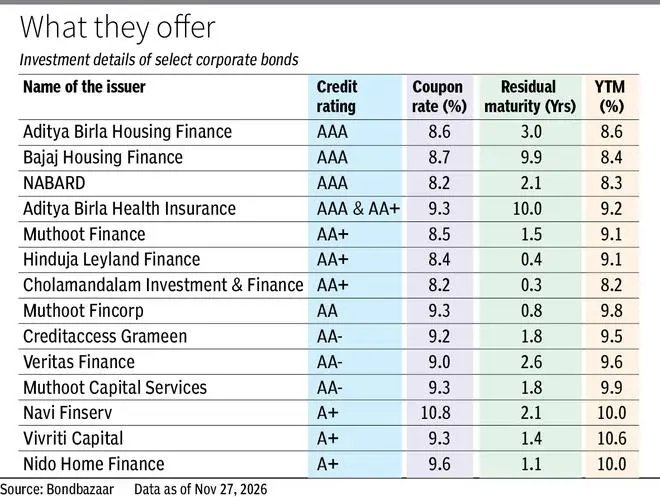
OBPPs primarily offer listed corporate bonds across investment-grade credit ratings, from AAA to BBB−, with varying yields, maturities and repayment structures. A-rated securities, particularly those rated A+, A and A−, feature prominently among the offerings on several platforms.
Besides corporate bonds, investors can access government securities (G-Secs), State Development Loans (SDLs) and Treasury Bills (T-Bills). For those looking to invest in these instruments, the RBI Retail Direct platform offers a convenient way to buy and hold them directly. Some platforms also facilitate corporate fixed deposits and Market-Linked Debentures.
Securitised debt instruments, particularly Pass-Through Certificates (PTCs), are permitted but not universally offered. Wint Wealth has selectively distributed PTCs, subject to internal credit assessment, while Motilal Oswal currently excludes them, citing large ticket-sizes, tax considerations and limited retail demand.
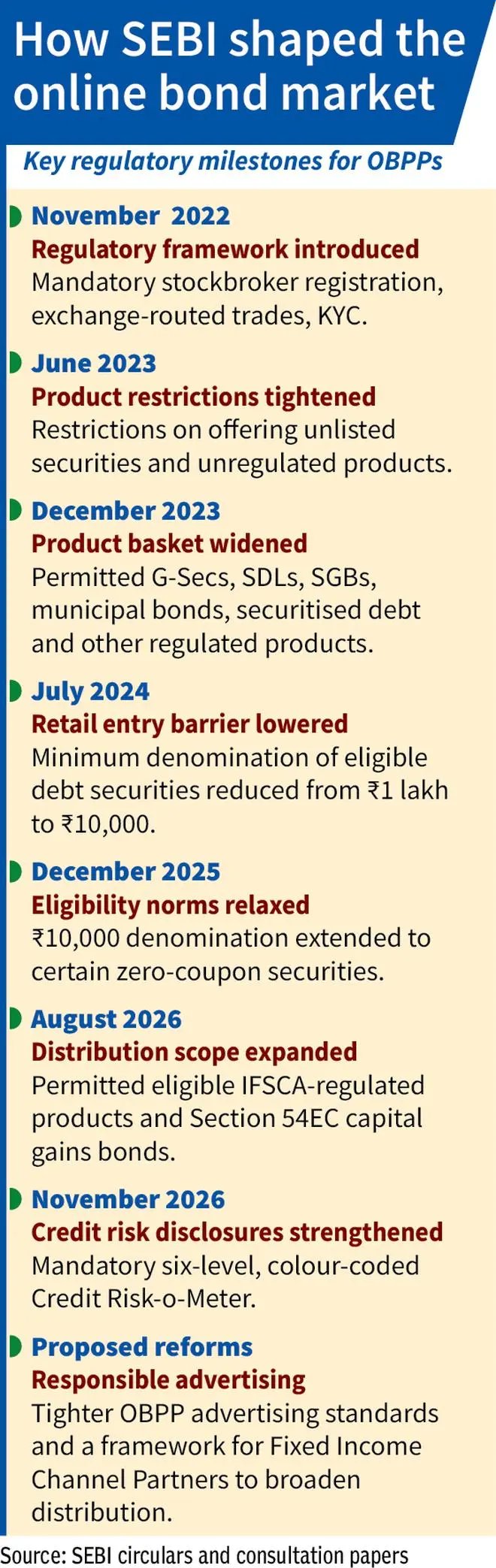
In December 2023, SEBI allowed OBPPs to offer products and services regulated by the RBI, IRDAI and PFRDA. In August 2026, it further widened the product basket to include IFSCA-regulated offerings in GIFT City and Section 54EC capital gains tax-saving bonds. Under the broader framework, OBPPs may also distribute debt-focused Portfolio Management Services (PMS), subject to applicable distribution regulations.
Bond inventories
OBPPs follow different models for sourcing and distributing bonds. Some purchase and hold securities in their own accounts as inventory before selling them to investors, acting as direct counterparties. Others function as aggregators, sourcing bonds from third-party dealers without maintaining proprietary inventory.
Wint Wealth follows a hybrid model, co-investing 2 per cent in every bond offering it distributes while sourcing the remaining securities from counterparties. BondBazaar also follows this hybrid model. Broking houses such as Motilal Oswal maintain their own bond inventories.
Irrespective of the business model, transactions in listed corporate bonds through OBPPs are routed through the stock exchanges’ RFQ mechanism, with settlement facilitated by clearing corporations.
Bond selection
Once onboarded, investors can browse available securities on the platform’s dashboard, which displays key details such as issuer name, ISIN, credit rating, coupon rate, Yield to Maturity (YTM), residual maturity, current price, repayment schedule and whether the bond is secured or unsecured. Platforms also offer curated investment ideas, SIP options, trending bonds and filters to shortlist securities by yield, credit rating and tenure.
Investors should focus on net YTM rather than coupon rates or headline yields. Net YTM represents the annualised return based on the actual purchase price, future interest payments, principal repayments and applicable transaction charges, assuming the issuer honours all obligations. It enables meaningful comparisons between bonds trading at premiums or discounts to their face value.
Platforms such as BondBazaar display quotations sourced from both the exchanges’ regular trading segments and RFQ mechanism. Investors should compare credit quality, effective yields, repayment structures and liquidity before selecting a security.
RFQ mechanism
The RFQ system forms the backbone of OBPP transactions. It is an exchange-operated mechanism that enables bond buyers and sellers to negotiate prices and execute trades.
Unlike equities, corporate bonds often lack continuous trading and readily available counterparties. RFQ addresses this by allowing quotations to be directed either to a specific counterparty (one-to-one) or multiple market participants (one-to-many).
In practice, the counterparty is often the OBPP itself or its group entity, which holds or sources bonds for investors. Transactions are settled through clearing corporations. Some platforms, such as BondBazaar, additionally provide access to NSE and BSE’s regular exchange cash market trading segments.
Investors can pay through UPI or net banking. Some platforms also offer wallet facilities that allow investors to preload funds for exchange-based transactions.
For RFQ transactions, payments are made directly to the clearing corporation. Settlement is done generally on a T+1 basis. The purchased securities are subsequently credited to the investor’s demat account.
Selling bonds and liquidity
OBPPs facilitate the sale of bonds before maturity, but liquidity is not guaranteed. Investors can place sell requests through the platform, which helps identify potential buyers, often the OBPP itself or its group entities.
While some OBPPs claim to facilitate exits in over 99 per cent of cases, these arrangements do not assure liquidity under all market conditions. Platforms such as BondBazaar also allow investors to place sell orders through NSE and BSE’s regular trading segments.
The selling price depends on prevailing market yields, the issuer’s credit quality and demand for the security. Investors may, therefore, have to accept a discount or incur losses when exiting prematurely. Platform-assisted liquidity should not be confused with guaranteed buybacks or assured exit prices.
Charges and remuneration
Most OBPPs do not levy explicit brokerage or transaction charges on investors. Instead, they primarily earn through trading spreads, purchasing bonds at lower prices and selling them at a markup.
Thus, zero brokerage does not necessarily mean zero cost, as intermediary margins may already be embedded in bond prices. Investors should compare the final purchase price and net YTM rather than relying solely on claims of zero charges.
However, such comparisons can be difficult because bond quotations on individual platforms are generally accessible only to registered users.
Look beyond attractive yields
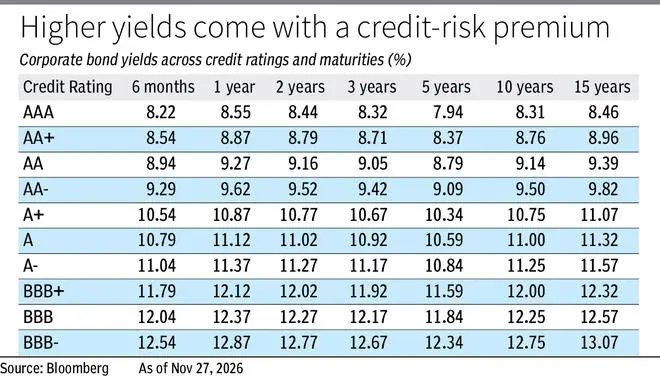
Online bond platforms have made corporate debt investing considerably easier, but investors should not confuse convenience with safety. Although several OBPPs maintain dedicated credit-research teams, screen securities and showcase curated investment opportunities, such due diligence cannot eliminate the underlying credit risks.
These platforms primarily facilitate bond distribution and transactions. Some operate as aggregators, while others hold proprietary inventory or co-invest alongside customers. None of these arrangements guarantees repayment of principal or interest.
Recent defaults and credit deterioration involving securities distributed through OBPPs highlight the dangers of chasing double-digit yields.
TruCap Finance’s debentures, carrying coupons of around 13 per cent, illustrate how even a one-notch credit-rating downgrade can trigger a repayment crisis. In June 2025, CareEdge downgraded its NCDs from BBB− to BB+, pushing them below investment grade and activating early-redemption clauses. With bondholders declining to waive these provisions and committed funding delayed, the company defaulted on ₹72.28 crore of repayment obligations in July. Its rating was subsequently cut to D (default).
Risks can be even more complex in securitised debt instruments, where repayments depend on pools of underlying loans and multiple intermediaries.
In August 2025, investors in a securitisation backed by loans originated by Up Money missed an interest payment despite reported underlying collections being 14 times the interest due and cash collateral covering it 8.5 times. The default arose because collections were not transferred to the designated account and collateral could not be accessed in time.
Similarly, a microfinance loan-backed securitisation originated by VFS Capital suffered sharp rating downgrades in 2025 amid concerns over the originator’s financial strength, loan collections and remittance arrangements.
These episodes demonstrate that diversification across underlying borrowers, collateral backing and investment-grade ratings cannot eliminate operational or credit risks.
Investors must also distinguish between secured and unsecured bonds. Secured bonds are backed by specified assets, potentially providing recovery rights in the event of default. However, actual recoveries depend on the value, enforceability and seniority of the security and may be delayed or substantially lower than the outstanding amount.
Unsecured bondholders lack specific collateral backing and generally face greater recovery uncertainty.
Liquidity is another major concern. Although OBPPs facilitate premature exits, their willingness to arrange buyers or repurchase securities is generally not a binding commitment. A listed bond may attract few buyers, particularly after a credit downgrade. Investors could be forced to accept substantial discounts or hold the security until maturity, with repayment still dependent on the issuer.
Before investing, investors should examine the latest credit-rating rationale, issuer financials, leverage, cash flows, repayment schedule, security cover and actual secondary-market trading activity. They should check the net YTMs across securities, diversify across issuers and avoid excessive exposure to lower-rated NBFCs or complex securitised products.
Investors unable to independently assess creditworthiness should consider simpler, highly rated securities or diversified debt mutual funds instead.
Investors should, therefore, choose bonds based on their financial goals, ability to absorb losses and capacity to hold until maturity, rather than merely the attractive yields displayed on a dashboard.
Published on November 28, 2026