

“Are government bonds a loss or not?” I will answer that question.
While I have heard in the news that “when interest rates rise, government bond prices fall,” I have also seen explanations that “government bonds are safe products where you won’t lose your principal.” Don’t these two things feel contradictory?
Actually, this is because the answer changes depending on which government bond you are talking about.
Today, I will try to organize this difference as simply as possible.
First, the basic relationship between interest rates and government bond prices
There is only one mechanism.
It is because “newly issued government bonds have better terms.”
Since a government bond issued this year with a “1.25% interest rate” looks more attractive than a government bond issued last year with a “1% interest rate,”
it becomes harder to sell last year’s government bonds at their current price.
Therefore, the yield is balanced by lowering the price slightly.
This is the basic mechanism behind “when interest rates rise, government bond prices fall.”
Up to this point, the logic applies to all government bonds.
However, it diverges from here on.
“Government bonds for individuals” and “government bonds traded on the market” are completely different things
1.
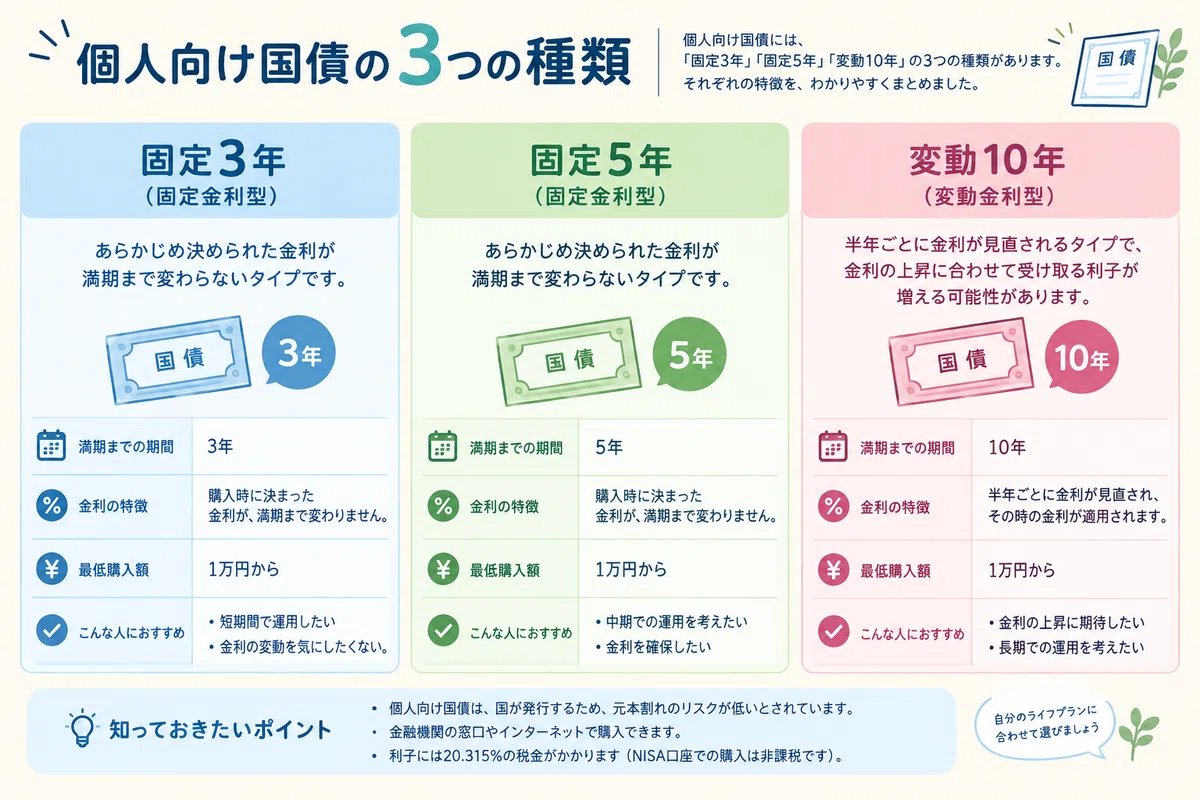
Government bonds for individuals (the type issued by the Ministry of Finance for individuals)
These are government bonds exclusively for individuals that can be purchased starting from 10,000 yen.
The biggest feature of these bonds is that you will not lose your principal even if you redeem them early.
One year after issuance, the government will buy them back at face value at any time.
Even if interest rates rise and the “theoretical value on the market” drops,
that is irrelevant.
However, it is not completely unscathed,
as there is a rule that
a certain amount will be deducted from the last two interest payments
if you redeem early after one year has passed.
“Your principal won’t decrease, but if you stop midway, you will give up part of the interest”
is the accurate image.
Actually, I personally hold “Floating 10-Year” government bonds for individuals.
The reason was simple:
until interest rates were raised, the interest rate on ordinary savings accounts was too low.
Since the state of having money sit there without growing much had continued for a long time,
I chose them as a slightly more advantageous place to keep my money.
There are three types of government bonds for individuals:
“Floating 10-Year”,
“Fixed 5-Year”,
and “Fixed 3-Year,”
but the “Floating 10-Year” I chose has features that the others do not.
The good thing about the Floating 10-Year is that the applicable interest rate is reviewed every six months.
Fixed types remain at the interest rate at the time of the contract, but
the Floating 10-Year updates its interest rate every six months in line with market interest rate trends.
In other words, in a phase where interest rates are rising like now, the interest I receive will gradually increase as time passes, which is the mechanism.
Furthermore, no matter how much interest rates fall, a minimum interest rate of 0.05% per year is guaranteed.
Since there is no worry about it falling all the way down,
I feel it is a compatible choice during periods when interest rates are likely to move, as “you gain if they rise, and a minimum is protected even if they fall.”
Of course, interest rates won’t necessarily keep rising forever,
so it is not “absolutely profitable.”
However, it was at least a choice that was likely to work more advantageously than deposits during the period when low interest rates continued is my actual feeling.
② Government bonds traded on the market (the type included in investment trusts, etc.)
This is what is known as a “regular government bond,” which is traded on the market through securities companies and banks. Since there is no buyback guarantee like there is with government bonds for individuals, if interest rates rise, the market price will fall accordingly. If you hold them through an investment trust, this is the type that is directly reflected in the valuation.
In other words, the image that “government bonds are safe” mainly refers to ①, while news that “government bonds fall in value when interest rates rise” mainly refers to ②.
The confusion arises because the same term “government bond” refers to products with completely different mechanisms.
My personal experience: The discrepancy in the term “government bond” that I felt at the counter
When I was at the bank, when I confirmed with customers who said they “held government bonds” which type they had, I often found that they didn’t actually know exactly.
One person assumed that the government bonds included in their investment trust “would not lose principal, just like government bonds for individuals,” and was surprised to see a negative valuation. On the other hand, another customer who held government bonds for individuals was worried, saying, “Since interest rates have risen, these must have fallen in value, right?” but since this was the type with a principal guarantee, it was actually a case where there was no need to worry.
Even though it was the same term “government bond,” the people who should be worried and the people who didn’t need to worry were reversed. From this experience, I came to strongly feel the importance of not lumping them all together as “government bonds” and checking which type you hold.
Three things you can do starting today
-
① Check whether your government bonds are “government bonds for individuals” or “government bonds included in investment trusts, etc.”: You can check this via your securities company or bank’s balance inquiry, or in the prospectus if it is an investment trust.
-
② If they are government bonds for individuals, just remember the rules for early redemption (one year from issuance, a certain amount deducted from the last two interest payments).: You don’t need to worry about the principal itself.
-
③ If they are government bonds included in an investment trust, assume that fluctuations in valuation are due to “market prices.”: Try not to be too surprised by temporary declines.
Summary: Do not lump the term “government bond” all together
Neither “government bonds are safe” nor “government bonds fall in value due to interest rates” is wrong. It’s just that they are referring to different things.
If you just know which type you hold, when you see the news, you will be able to judge without hesitation whether “this is a story that concerns me or not.”