
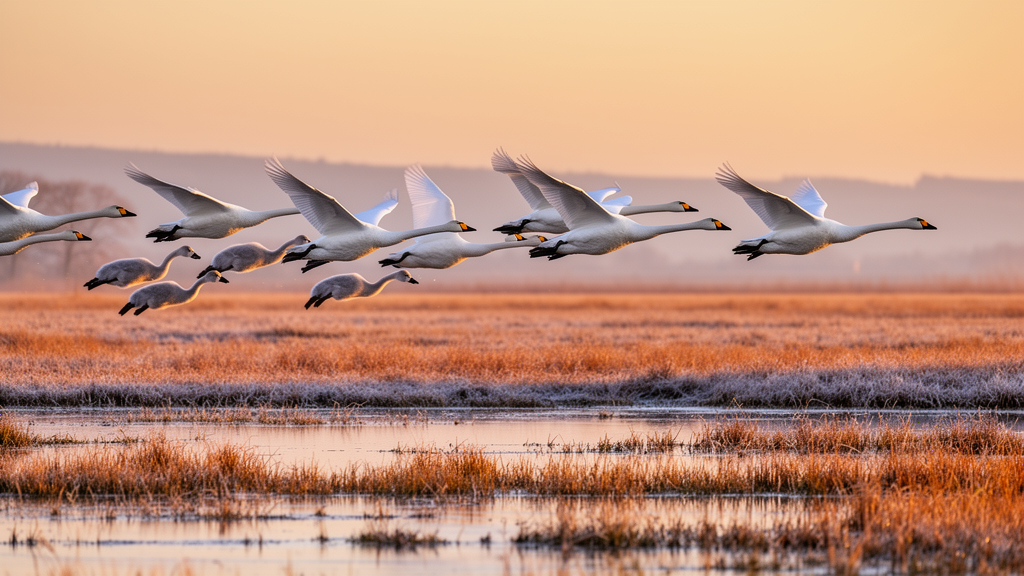
Long-lived migratory birds often maintain close family associations long after young fledglings achieve flight, yet the functional significance of these durable bonds for offspring survival and development has historically proven challenging to quantify in the wild. A comprehensive investigation tracking the Western Palearctic population of Bewick’s swans (Cygnus columbianus bewickii) has established that extended parental care is vital to juvenile survival and successful spring migration. Drawing upon solar-powered GPS-GSM telemetry paired with high-resolution restriction-site associated DNA sequencing from 55 tracked swans, an international research team documented that under normal conditions, young swans remain alongside their parents well into the second half of their first northward migratory flight, separating only when approaching approximately nine to eleven months of age. Conversely, young birds that suffered premature separation during their first winter—primarily triggered by sudden anthropogenic disturbance events on their European wintering grounds—departed on their spring journey roughly one month late and experienced drastically reduced survival over their first year compared to juveniles that maintained intact parental bonds.
The phenomenon of extended parental care represents one of the primary pathways facilitating social learning across animal taxa, allowing developing offspring to acquire complex ecological and navigational behaviours through sustained interaction with experienced kin. In long-distance avian migrants, such as cranes, terns, and waterfowl, parents have been observed guiding juveniles along flyways and buffering the substantial energetic costs of flight by leading aerodynamic formations. However, the exact duration of parent-offspring associations varies widely even among closely related populations and species. In Svalbard-breeding barnacle geese, approximately three-quarters of juveniles accompany their parents at the onset of their first northward journey, whereas neighboring Baltic-Russian flyway families frequently disband on wintering grounds prior to departure. Similarly, greater white-fronted geese can sustain multi-year familial associations spanning up to thirteen years across multiple generations, whereas European wintering populations often experience early midwinter break-ups. Prior to the present investigation, field observations had largely relied upon visual resightings of marked individuals in localized flocks, leaving the broader spatial and temporal dynamics of family disbandment and the survival consequences of premature separation largely unresolved.
To evaluate these dynamics across extensive geographical distances, researchers monitored Bewick’s swans breeding along the coastal Arctic tundra of the Pechora Sea in European Russia and overwintering across North Sea landscapes. In recent decades, the wintering center of this declining population has shifted northeastward in response to milder winter conditions, consolidating predominantly within northern Germany and the Netherlands. Field teams captured swans using cannon nets deployed on agricultural foraging sites across fourteen separate catching events between the winters of 2016/2017 and 2022/2023 in the Netherlands, as well as Lower Saxony, Germany during 2021/2022 and 2022/2023. Catches yielded an average of 16.5 individuals per event, allowing researchers to fit 148 birds with high-precision solar-powered GPS-GSM transmitter neck collars. Early tagging efforts between 2016 and 2020 targeted adult females and juvenile males, while subsequent tagging expanded to juvenile females and adult males to permit simultaneous tracking of intact family units. Neck collars weighed either 70 grams (custom-built by MadebyTheo) or 65 grams (Ornitela OrniTrack-N55), comprising between 0.8 and 1.6 percent of adult body mass and 1.0 to 1.6 percent of juvenile mass, while recording GPS coordinates every five minutes to two hours with an average spatial accuracy of 3.6 meters.
To establish genealogical relationships independently from spatial movement data or field observations, researchers collected blood samples from either the medial metatarsal or brachial vein of captured individuals. Genomic DNA was isolated and processed using double-digest restriction-site associated DNA sequencing (ddRAD) protocols with single-end 150-base-pair sequencing executed on an Illumina NovaSeq X Plus platform. Following rigorous quality filtering and clustering of sequence reads into putative loci, bioinformatic workflows aligned sequences against the reference genome of the mute swan (Cygnus olor) via blastn to establish chromosomal coordinates. Genotyping algorithms scored loci as heterozygous when distinct alleles satisfied established sequencing depth thresholds, retaining loci with median per-sample coverage of at least ten reads, greater than 95 percent genotype completion, and minimal missing data. Morphological cloacal sexing performed in the field was corroborated genetically by evaluating read depths across female-specific W chromosome loci, which exhibited robust read counts in females while remaining near zero in males.
Familial relatedness across the dataset was quantitatively resolved using fineRADstructure, an algorithm that clusters individuals based on shared haplotype co-ancestry across autosomal single nucleotide polymorphisms arranged in haploblocks. To identify specific parentage and siblingship arrangements, the authors employed the maximum-likelihood pedigree reconstruction software COLONY v.2.0.6.8 under models accounting for both monogamous and polygamous mating configurations. Simultaneously, spatial interactions between related pairs were evaluated by computing median hourly coordinates along continuous GPS movement trajectories. Researchers established a biologically grounded break-up threshold defined as the day preceding the first sustained period where the inter-individual distance between related swans consistently exceeded 30 meters. This metric reliably separated active social affiliation from background flock aggregation, while remaining well above the transmitter measurement error. Furthermore, subsequent reunions between previously separated kin were identified when birds maintained proximity within 30 meters for more than two consecutive days, or exhibited coordinated paired flight trajectories during shorter periods.
Analysis of movement data from 18 tracked parent-offspring pairs yielded 16 measurable break-ups, complemented by nine additional break-ups from tagged juveniles that became parentless following capture, resulting in 25 total parent-offspring separations. Under undisturbed conditions, 14 juveniles remained with their parents throughout their entire first winter season and well into their first northward spring migration, traversing thousands of kilometers before separating between Estonia and the Arctic breeding grounds between 10 April and 25 May. At the point of natural family dissolution, these offspring were approximately nine to eleven months old and had successfully completed nearly two full migratory flyway transits alongside experienced adults. By contrast, sibling pairs exhibited considerably broader separation schedules: among 13 tracked sibling pairs across seven families, eight pairs separated between 20 April and 18 September at ages ranging from 10 to 15 months, indicating that sibling bonds frequently persist beyond parent-offspring dissolution through the summer staging period and into the subsequent autumn migration.
The study incorporated an unplanned, quasi-experimental dimension during the winter of 2021/2022 following severe anthropogenic disturbances at wintering roosts. On 18 December 2021, two days following a tagging operation, hunters entered a protected nature reserve hosting the release night roost, killing six marked swans along with an undetermined number of unmarked birds. Telemetry revealed that one marked mother (027T) was killed, abruptly separating her juvenile daughter (036T) from her surviving father (047T) and siblings. In total, researchers documented ten orphaned juveniles during that winter, comprising six individuals directly disrupted by the hunting event and four additional juveniles inadvertently separated from their untagged parents during capture operations. These ten prematurely separated birds, with an estimated age of approximately six months at separation, formed an orphan study group whose migratory behavior and survival were systematically compared against a reference group of 14 contemporary juveniles that maintained normal family status.
Premature parental separation induced severe behavioral disruption and substantial delays during the subsequent spring northward migration. The reference group of juveniles accompanied by parents departed the wintering range—measured as the date of crossing 12.5 degrees East longitude, which delineates the eastern margin of the core wintering range—between 23 February and 28 March. Conversely, all surviving orphaned juveniles lingered extensively on the wintering grounds in the Netherlands and northern Germany. Although nine of the ten orphans originally mingled within general flocks of conspecifics or resident mute swans, they consistently failed to depart alongside migrating flocks. The orphaned cohort eventually embarked on migration independently, crossing the 12.5 degrees East boundary between 25 March and 12 May, representing a statistically significant average delay of 29 days compared to family-guided peers (two-sample t-test, t = -4.63, degrees of freedom = 10.90, p < 0.001). Furthermore, while orphans followed a general northeasterly trajectory toward the breeding grounds, their paths exhibited wider front dispersals and less synchronized progression.
The migratory delays and lack of adult guidance among orphaned juveniles translated into severe fitness deficits. Survival until the subsequent winter season reached only 40 percent (4 of 10 individuals) among the orphaned group, compared to an 86 percent survival rate (12 of 14 individuals) among juveniles in the reference cohort. This profound disparity in first-year survival was statistically significant under Fisher’s exact test (odds ratio = 0.124, 95 percent confidence interval: 0.009 to 1.046, p = 0.032). One orphan perished directly on a wintering roost in April, another succumbed in Latvia during spring transit, and four individuals vanished after transmitting their final GPS locations while crossing beyond GSM network coverage into northern stopover regions, never returning to network ranges nor appearing in international resighting registers. Given the high 91 percent annual resighting probability documented for marked Bewick’s swans, the absence of telemetry and visual reports confirms that non-surviving orphans died prior to their second winter.
Researchers emphasized that the mechanisms driving high juvenile mortality likely stem from a combination of physiological, navigational, and competitive disadvantages. In migratory waterfowl, young birds exhibit lower foraging efficiency and reduced food intake compared to mature adults when competing within dense conspecific flocks. Dominant parental escorts shield offspring from aggression, facilitating access to high-quality foraging patches and optimizing energy accumulation during demanding staging intervals. Furthermore, juvenile geese and swans experience higher aerodynamic and energetic expenditure when migrating in isolation rather than drafting within parental flight formations. While juvenile Bewick’s swans demonstrated sufficient innate or learned knowledge from their initial southward journey to navigate northeastward without guidance, the cumulative physiological stresses of solitary foraging, suboptimal stopover choices, and late arrival in challenging Arctic climates substantially eroded their survival prospects.
Remarkably, long-term tracking confirmed that family associations in Bewick’s swans are not permanently severed after the initial break-up, but frequently reform in subsequent years. Among twelve parent-offspring pairs monitored for more than three months following separation, eight pairs reunited at least once, totaling 13 separate reunion events spanning durations from less than a day up to 97 days. Similarly, five of twelve tracked sibling pairs engaged in 13 recorded reunions lasting up to 73 days, with multiple pairs travelling together across hundreds of kilometers of their migratory route. One tracked female offspring (353E) exhibited exceptional social fidelity, remaining alongside her parents through her entire second winter and second northward spring migration, and continuing to associate with them during her third winter and spring journey. In another striking case, daughter 036T, separated from her family during the 2021 hunting disturbance, reunited with her father (047T) nearly two years later on the Arctic archipelago of Novaya Zemlya, subsequently migrating southward together for a week before separating along the White Sea.
These observations indicate that Bewick’s swans operate within relatively closed, kin-based social networks rather than fluid flock structures. Unlike whooping cranes or Eurasian spoonbills, where naive juveniles readily assimilate into mixed-age flocks to acquire migratory routing from unrelated conspecifics, orphaned swans in this study rarely established enduring associations with non-kin. Only one orphan (036T) successfully attached to a foster family for several weeks before dispersing. This reliance on direct parental bonds underscores the ecological vulnerability of family-living waterfowl to habitat fragmentation and human disturbance. In many European jurisdictions, intentional disturbance is utilized as a management tool to deter geese and swans from agricultural lands, while legal and illegal hunting persists along flyways. The study’s authors emphasize that management frameworks must recognize that scattering flocks not only displaces birds temporarily, but can permanently shatter delicate family structures, jeopardizing juvenile survival and driving demographic declines in sensitive, long-lived migratory species.
Subject of Research: Extended parental care, family cohesion, and juvenile survival in migratory Bewick’s swans
Article Title: Family life is critical for migration and survival in a long-lived social bird
Article References: Linssen, H., van Loon, E. E., Wilson, R. E., Sonsthagen, S. A., Eichhorn, G., Shamoun-Baranes, J. Z., & Nolet, B. A. (2026). Family life is critical for migration and survival in a long-lived social bird. Behavioral Ecology and Sociobiology, 80(9), Article 114. https://doi.org/10.1007/s00265-026-03787-5
Image Credits: AI Generated
DOI: 10.1007/s00265-026-03787-5
Keywords: Bewick’s swans, Cygnus columbianus bewickii, extended parental care, avian migration, social learning, GPS tracking, juvenile survival, family break-up, genetic kinship, ddRAD sequencing, Western Palearctic flyway, human disturbance, waterfowl ecology, migratory timing, roost disturbance, wildlife conservation