
What Are Treasury STRIPS?
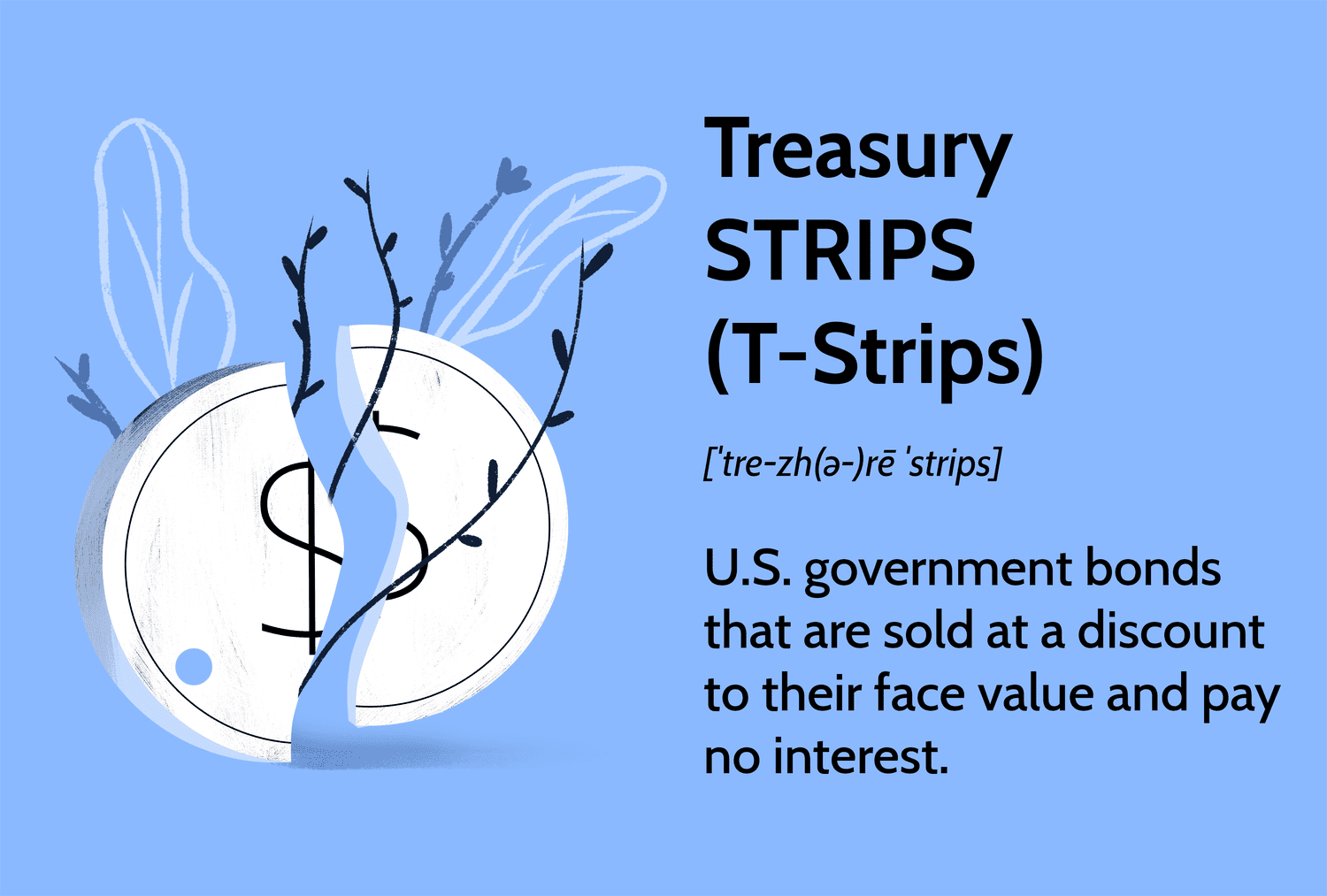
Treasury STRIPS, also known as zero-coupon bonds, are government-backed securities sold at a discount. They offer investors the opportunity to receive the full face value upon maturity. Unlike typical bonds, STRIPS involve no regular interest payments. Instead, the return for investors comes from the difference between the purchase price and the face value at maturity. Separated from bonds, their individual coupon payments can be traded separately, providing investment flexibility. Since 1985, STRIPS have catered to longer-term financial planning, with eligibility expanding to a broader range of Treasury securities over time.
Key Takeaways
- Treasury STRIPS are zero-coupon bonds sold at a discount, paying investors the full face value on maturity.
- STRIPS are backed by the U.S. government, ensuring extremely high credit quality and safety for investors.
- These bonds must be purchased through financial institutions or brokers due to their secondary trading nature.
- STRIPS were launched in 1985, expanding beyond 10-year securities to include all Treasury notes and bonds by 1997.
- Despite no cash interest payments, investors have annual taxable interest, deferrable in tax-advantaged accounts such as IRAs.
How Treasury STRIPS Work
Treasury STRIPS are created by separating a bond’s coupons from the bond itself. The bond without coupons is sold to an investor at a discount. The investor’s profit is the difference between the purchase price and the bond’s face value at maturity.
The coupons become separate investments that are sold separately. Treasury STRIPS are issued by the U.S. Treasury and backed by the U.S. government. They were introduced in 1985, replacing previous zero-coupon bond issues that were known as TIGRs and CATS.
STRIPS cannot be bought from the government directly; instead, brokerages sell them to investors.
The Evolution of Treasury STRIPS
The first Treasury STRIPS from 1961 were different from today’s version. These original STRIPS consisted of a package of re-opened bills maturing over a period of several weeks. They were eventually phased out in 1974.
After changes to the tax law, a new STRIPS program was initiated in 1985. This allowed bonds with a maturity greater than ten years to be divided into separate principal and coupon payments, which could be traded as separate securities. In 1986, the Treasury set up a facility to recombine principal and coupon payments into the original securities.
As the new securities proved popular on the market, eligibility was slowly expanded. In 1997, the program expanded from only 10-year and 30-year securities to all Treasury notes and bonds. In 2000, the program included 5-year notes that were previously ineligible.
Fast Fact
The first STRIPS were introduced in 1961, but they were later discontinued. The STRIPS that are available today were initiated in 1985.
The Process of Coupon Stripping
The process of detaching the interest payments from the bond is called coupon stripping. The coupons become separate securities, with the principal payments due at maturity. No interim coupon payments are made along the way.
For instance, a 10-year bond with a $40,000 face value and a 5% annual interest rate can be stripped. Assuming it originally pays coupons semi-annually, 21 zero-coupon bonds can be created, including 20 semi-annual coupon payments and the bond itself. Each stripped coupon has a $1,000 face value, which is the amount of each coupon. All 21 securities are distinct and are traded separately in the market.
Benefits of Investing in Treasury STRIPS
Like all Treasury securities, STRIPS are backed by the full faith and credit of the U.S. government, which is considered extremely unlikely to default. This makes them extremely attractive to investors seeking a safe investment.
STRIPS are also extremely simple instruments, with predictable costs and payoffs. Since there is a wide selection of maturity dates, an investor can simply choose the STRIP that best fits the date when they may need cash. This helps investors prepare for specific goals.
The required capital outlay is relatively small. While the minimum institutional purchase of Treasury bonds is $10,000, a STRIP based on bond interest may cost only a few hundred dollars. Moreover, they have an active secondary market, and it is fairly straightforward to invest in STRIPS through a tax-advantaged retirement account.
Why Treasury STRIPS Are Popular
STRIPS are a popular choice for fixed-income investors. They have extremely high credit quality because they are backed by U.S. Treasury securities. Since STRIPS are sold at a discount, investors do not require a large stash of cash to purchase them. Assuming the STRIPS are held to maturity, their investors know the precise payouts they’ll receive.
Important
There is a robust secondary market for Treasury STRIPS, with individual STRIPS trading at market value until they reach maturity.
STRIPS also offer a range of maturity dates, since they are based on the dates of the interest payments. If an investor wishes to sell a bond prior to its maturity, the market has enough liquidity to accommodate the transaction.
Tax Implications of Treasury STRIPS Investments
Generally speaking, taxes are due on the interest earned each year, even though there is no cash payment until the bond reaches maturity or the STRIPS are sold.
However, this tax can be delayed with a tax-deferred account, such as an individual retirement account (IRA). Each holder of STRIPS receives a report detailing the amount of taxable interest income earned.
The Bottom Line
Treasury STRIPS (Separate Trading of Registered Interest and Principal of Securities) offer a secure investment backed by the full faith and credit of the U.S. government. As zero-coupon bonds, they are purchased at a discount and provide a precise payoff at maturity, making them attractive for investors aiming for specific financial goals.
While STRIPS are only available via financial institutions or brokers, their simplicity and range of maturity dates offer flexibility to meet various needs. Consider potential tax implications when investing outside of tax-advantaged accounts. Despite these considerations, STRIPS remain a favorable choice for those seeking safe, predictable returns.