
A strategy that’s delivered specialist investors huge returns is now facing scrutiny, amid concerns that its risk-reward dynamics might be skewed against some issuers.
Catastrophe bonds, which are issued by insurers, reinsurers and governments seeking an extra layer of disaster coverage, have been handing investors double-digit returns. Issuers, meanwhile, have seen their costs soar.
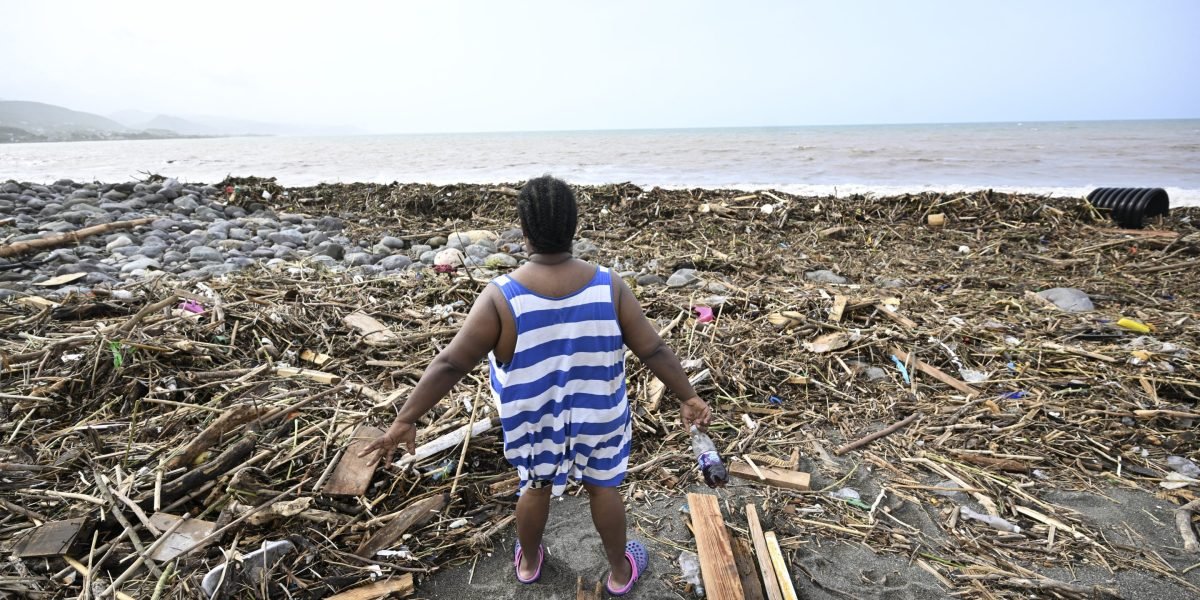
Grievances surfaced in July, after it emerged that Jamaica’s catastrophe bond wasn’t triggered by the devastation wrought by hurricane Beryl. Though the entire Caribbean island was officially declared a disaster area, the carefully calibrated terms of the bond meant its holders were shielded from losses. In the event, it was decided that the precise level of air pressure required for a payout wasn’t achieved.
For cat bond investors — who are currently reaping an average return of around 15% after raking in 20% in 2023 — the outcome in Jamaica underpins the appeal of a strategy that’s attracted some of the brightest minds in finance. For others, it’s set off a difficult debate.
Caribbean heads of government within the group known as Caricom recently discussed the financial ramifications of Beryl. This month, the group said it will be seeking “an examination” of cat bonds and other insurance-linked securities, and wants the region’s finance ministers to take a closer look at which markets governments should choose and which they should avoid.
“We recognize that at the end of the day, investors need to make returns,” Jwala Rambarran, a former governor of the central bank of Trinidad and Tobago, said in an interview. “But at the same time, fairness and equity says it can’t be all the time that the investors are making the returns. It’s a one-way street.”
The Jamaican Ministry of Finance didn’t respond to requests for comment.
The country’s $150 million cat bond — arranged by the World Bank and bought by private investors — was issued this year to replace a 2021 bond. The new bond costs the government 60% more per unit of coverage, which reflects the heightened risk posed by climate change as well as higher reinsurance costs, according to Conor Meenan, a risk finance specialist at the London-based Centre for Disaster Protection.
Cat bonds make it possible for issuers (also referred to as sponsors) to pass part of their risk over to capital markets. Sales of the instruments have soared lately, with factors including climate change, population density and inflation adding to their appeal. Investors face potentially substantial losses if a bond is triggered, but can generate market-beating returns if a predefined catastrophe doesn’t occur.
For the $47 billion cat bond market, Beryl proved an early win for investors navigating their way through a hurricane season that’s expected to be unusually active.
Zurich-based Plenum Investments AG, one of the private-market buyers of Jamaica’s cat bond, said it was drawn to the opportunity to diversify away from the US market. “We also like the parametrictrigger structure, which minimizes uncertainty post event,” Plenum said in an emailed response to questions.
Issuers turning to cat bonds get a very specific type of coverage whose terms should be clear to all stakeholders at the point of purchase, according to the World Bank.
Cat bonds are “for tail events,” which are rare disasters outside the norm, said Michael Bennett, head of derivatives and structured finance at the World Bank treasury. “The parameter isn’t the fine print, it is the print.”
In the case of Jamaica, Beryl very narrowly missed hitting the parameter that would have caused the bond to pay out. The pressure reading “was one or two millibars too high in one or two zones,” said Robert Muir-Wood, chief research officer in insurance solutions at Moody’s. “It was a very close call.”
Rambarran, the former Trinidad and Tobago central banker, recently co-authored a report by the Vulnerable Twenty Group — or V20 — which represents countries who are among the world’s most exposed to climate change. V20 says it’s time to overhaul the triggers that determine whether a cat bond investor will be called on to cover losses. The group’s concern is that thanks to skillful financial engineering, such triggers are becoming increasingly narrow and rigid.
In the case of Jamaica’s cat bond, investors were protected because the conditions for triggering a payout “are hard and specific,” the V20 report said. “This rigidity protects investors but leaves Jamaica vulnerable to catastrophic risk.”
Sara Jane Ahmed, managing director and finance adviser to the V20 group and the report’s lead author, says it’s “clear that we need a lot more financial protection triggers that are reliable and timely.”
The “disappointing” payout outcome of Jamaica’s cat bond underscores the need for the World Bank “to reassess the usefulness of this complex and costly financial instrument and even perhaps for Jamaica to renegotiate the terms of its cat bond,” the report concluded.
But designing cat bonds with lower trigger thresholds would only drive up the price, according to the World Bank.
“If you want these bonds to pay out more frequently, you’ll be charged more in premiums,” said George Richardson, director of capital markets and investments at the World Bank treasury. “There’s a trade-off to be considered.”
Aside from Jamaica, investors were spared losses on cat bonds in Mexico and Texas, which were also hit by Beryl. Other forms of disaster insurance did pay out, however. The Caribbean Catastrophe Risk Insurance Facility, or CCRIF, disbursed a record $44 million to Grenada due to Beryl’s destruction. CCRIF also delivered smaller payouts to other Caribbean nations, including Jamaica.
And with a total disaster safety net of $1.6 billion, Jamaica is particularly well-insured against the threat of hurricanes, according to Meenan. “They’re taking risk very seriously,” he said.
The Philippines chose not to renew its cat bond when it lapsed in 2022, favoring an indemnity insurance program. Bennett at the World Bank, which helped arrange the country’s catastrophe risk insurance, says the government in Manila is still “considering cat bonds as part of their larger insurance strategy.”
Ahmed of the V20 group says that “as development partners think about their role in this climate crisis, part of that is really taking a hard look at some of these products.” And then “figuring how do we make them fair,” she said.