

Former Bank of Japan official, PhD in Mathematics from the University of Tokyo, and former Chief Interest Rate Strategist at Nomura. First analyst in history to rank 3rd in two categories (Bonds and Securitization) in the Nikkei Veritas analyst rankings. I deliver the ‘essence of finance’—which bankers and securities professionals can use directly in client talks and internal presentations—based on my experience of 400 proposals per year to institutional investors. Past articles are fully available to members (free articles move to members-only two days after publication).
‘Amazing Diversified Investment’ (Diamond Inc., subtitle: Don’t lose, be prudent, but make money), to be released on November 26, 2026.
In this morning’s (November 12) Nihon Keizai Shimbun morning edition, there was an article titled Life insurers to find it easier to buy government bonds; no impairment needed even if prices fall, new accounting rules in fiscal 2030.
Japanese interest rates have risen significantly over the past year. The 10-year yield, which was 1.7% a year ago, rose to 3.11% on October 7.
The background includes the Bank of Japan’s interest rate hikes and the government’s proactive fiscal policy, as well as a shortage of government bond buyers.
The Bank of Japan bought over 90% of government bond issuance in fiscal 2022, but this fiscal year (April–September) it remains at just over 20%. ‘Who will buy government bonds?’ has become a market concern.
This is why life insurance companies are attracting attention. Life insurers hold 15% of all government bonds, making them the second-largest holder after the Bank of Japan, which holds 47%. They are, in particular, the main buyers of ultra-long-term government bonds with maturities exceeding 10 years.
If a client asks, ‘If life insurance accounting rules change, will they buy government bonds?’ how would you answer?
In this article, I will organize what is changing, why it affects the supply and demand of government bonds, and how it relates to how individuals hold bonds.
■ What is changing: Impairment will no longer be required for ‘price declines’
Impairment accounting is the process of reflecting the decline in value of assets held as a loss in financial statements when their value drops significantly.
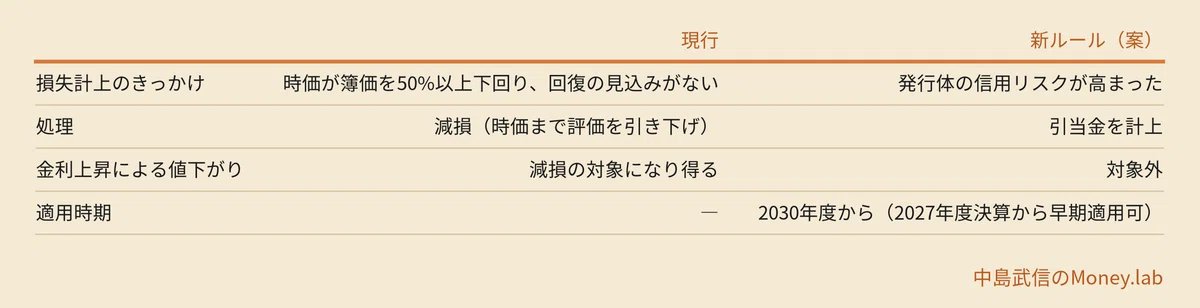
Currently, for bonds held by life insurers, impairment is required if the market value falls more than 50% below the book value (the price at the time of purchase) and there is no prospect of recovery.
The problem is the ultra-long-term government bonds bought during the low-interest-rate era. Prices have fallen significantly due to rising interest rates, and according to the Nikkei, out of 97 issues of government bonds with maturities over 10 years issued since 2016, 18 issues have fallen more than 50% below their issue price..
In fact, Nippon Life Insurance recorded an impairment of approximately 44 billion yen on domestic bonds in the April–June 2026 quarter, and Meiji Yasuda Life Insurance recorded 25.3 billion yen.
Amidst this, the draft amendment (exposure draft) of the Japanese Institute of Certified Public Accountants’ Industry-Specific Audit Committee Report No. 21, ‘Accounting and Auditing Treatment of ‘Bonds Corresponding to Policy Reserves’ in the Insurance Industry’ published on February 17, 2026, attracted attention.
The Accounting Standards Board of Japan (ASBJ) published an exposure draft for new financial instrument accounting standards in October 2025.
The policy is to remove bonds held to maturity from the scope of impairment due to price declines and shift to a method of setting aside provisions according to credit risk (expected credit loss model).
This time, a proposal was also presented that ‘bonds corresponding to policy reserves’ held by life insurers would ‘not be impaired solely due to price declines’.
Now, ‘bonds corresponding to policy reserves’ are the bonds that back our insurance contracts.
Life insurance companies use the premiums we pay to invest in assets such as ‘bonds corresponding to policy reserves,’ which are then used to pay out insurance claims, such as in the event of a policyholder’s death.
This means that ‘bonds corresponding to policy reserves’ are highly likely to be held until the insurance contract expires, i.e., until maturity.
Therefore, treating ‘bonds corresponding to policy reserves’ as something close to ‘bonds held to maturity,’ so that they are not impaired solely due to price declines caused by rising interest rates, is the idea.
According to the Nikkei, Taiyo Life and Daido Life are considering early adoption. Under the new rules, if the issuer’s credit rating is maintained, the loss amount is expected to be almost zero.
If you were to explain this to a customer, it would go like this:
The government bonds held by life insurers will no longer have to be recorded as losses just because their prices have fallen. As long as the life insurer does not sell the government bonds, the only time they will record a loss is when ‘the Japanese government bond is on the verge of default.’
■ Why does this affect the supply and demand of government bonds?
The key is ‘bonds corresponding to policy reserves.’ Policy reserves are liabilities that life insurers accumulate to prepare for future insurance claim payments.
Since life insurance contracts span several decades, the premise is to buy ultra-long-term bonds that match that duration and hold them until maturity. At Dai-ichi Life, 15.7 trillion yen of their 18.7 trillion yen in yen-denominated bonds are these types of bonds (as of the end of December 2025, Bloomberg).
Even though the premise is to hold them until maturity, there was a contradiction in that they had to record losses if the price fell in the meantime. This is because, unless the country goes bankrupt, government bonds are returned at face value at maturity.
In a nutshell, it comes down to this:
The price decline of bonds held to maturity will disappear as they approach maturity, unless there is a default
For example, even if a 30-year bond with a face value of 100 yen falls below 50 yen due to rising interest rates, it will be returned at 100 yen at maturity. The price decline is less of a ‘loss’ and more of a ‘missed opportunity to have bought at a higher interest rate.’
So, why does this affect supply and demand?
With impairment rules in place, the more interest rates rise and prices fall, the harder it becomes for life insurers to buy ultra-long-term bonds. This is because if they fall further, they get closer to the impairment line. In other words, it was a structure where the largest private buyers might pull back during periods when yields were high and it would normally be a good time to buy.
Major life insurers also told the Nikkei that ‘there will no longer be a need to rush to sell government bonds or refrain from purchasing them out of concern for depressing profits.’
On February 17, when the exposure draft was released, the yield on 30-year government bonds fell from 3.46% the previous day to 3.38%, and the following day, the insurance industry index hit a record high, rising 3.9% at one point (Bloomberg).
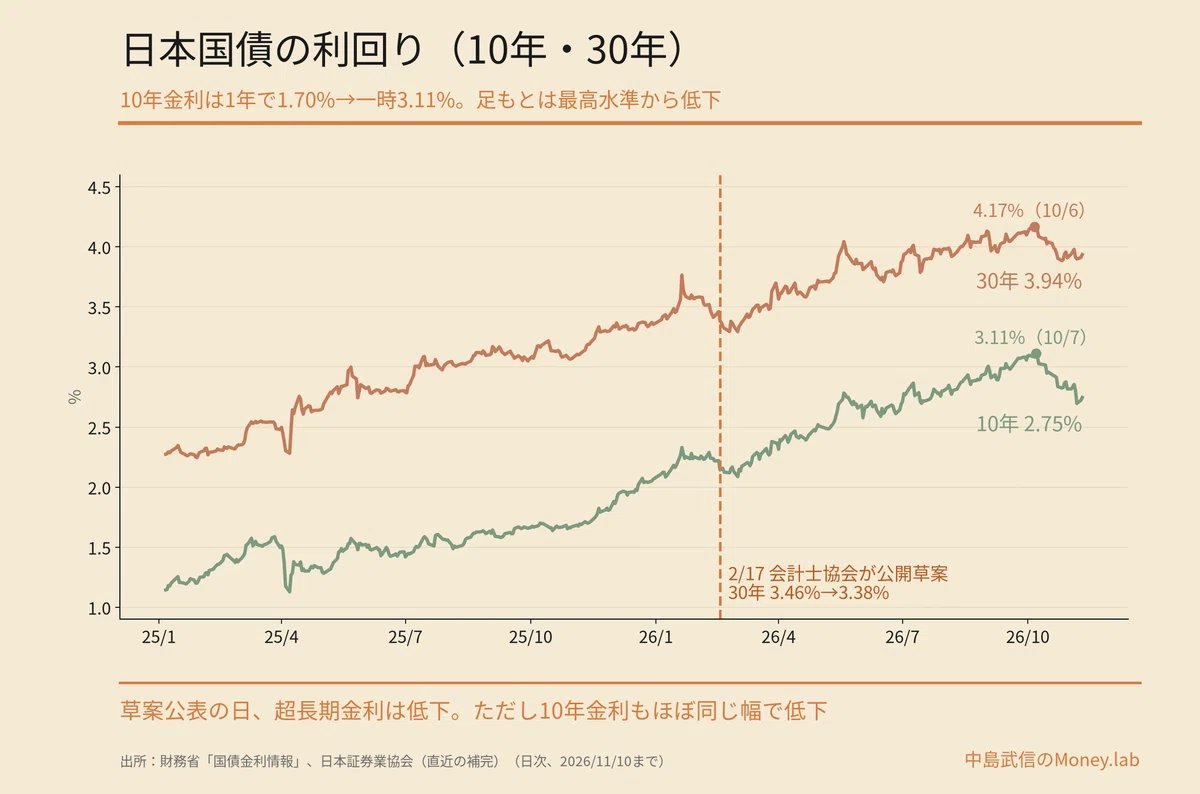
However, the 10-year interest rate also fell by roughly the same amount on the same day, so it cannot be said that this was solely the effect of the draft.
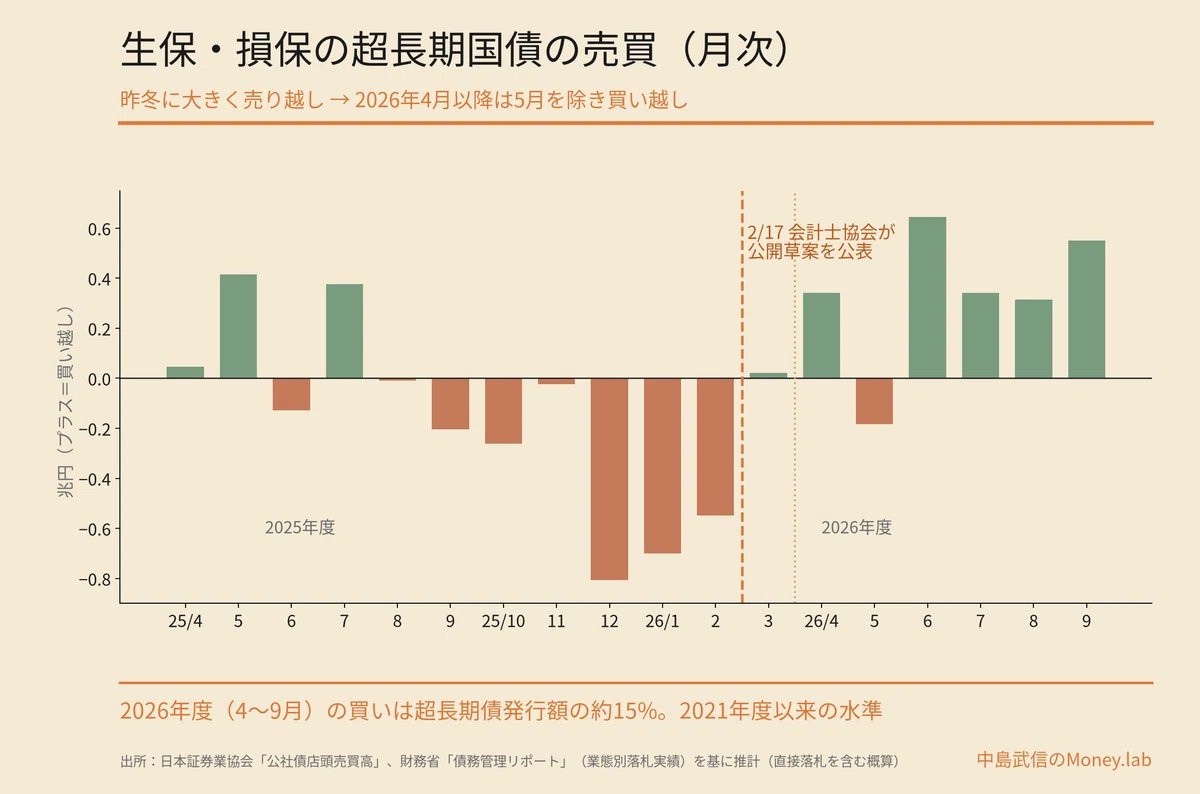
Life and non-life insurance companies were net sellers of approximately 2 trillion yen in ultra-long-term government bonds over the three months from December 2025 to February 2026. This was largely due to the sale of held bonds following a rapid rise in interest rates.
However, the net selling stopped in March, the month after the draft was released, and they have remained net buyers since April, with the exception of May.
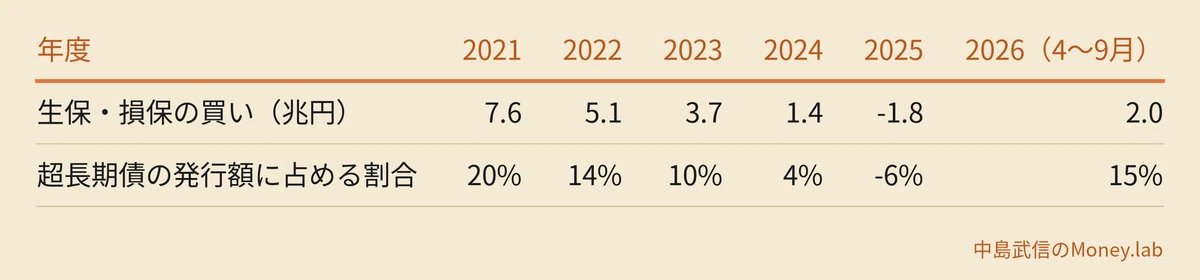
The share of life insurers in the current fiscal year is approximately 15% of the total issuance, returning to levels not seen since fiscal year 2021.
Of course, the reason for the return to trading is not just the accounting rules.
It is also considered significant that the sale of bonds with unrealized losses has largely run its course and that the appeal of government bonds themselves has increased due to higher yields. However, it is possible that the reduced concern over impairment is encouraging purchases.
However, there are two points to note.
First, while this avoids reporting accounting losses, the unrealized losses themselves do not disappear. The unrealized losses on domestic bonds held by the 13 major companies exceeded 30 trillion yen at the end of June. If sold midway, the loss becomes realized.
Second, this only applies to insurance companies. Regional banks and credit unions are not included. According to the Regional Banks Association of Japan, the unrealized losses on bonds held by regional banks were approximately 3.3 trillion yen at the end of March.
■ Applying the life insurance mindset to personal asset allocation
What happens if we apply what life insurers are doing to individuals?
Life insurers choose bond maturities to match the timing of insurance payouts (liability deadlines). This is called ALM (Asset Liability Management).
Individuals also have things close to “liabilities.” These are funds for which the timing and amount of use are somewhat determined, such as education expenses, down payments for housing, and withdrawals for retirement. Thinking this way, the things to look at for the same bond change depending on its role.
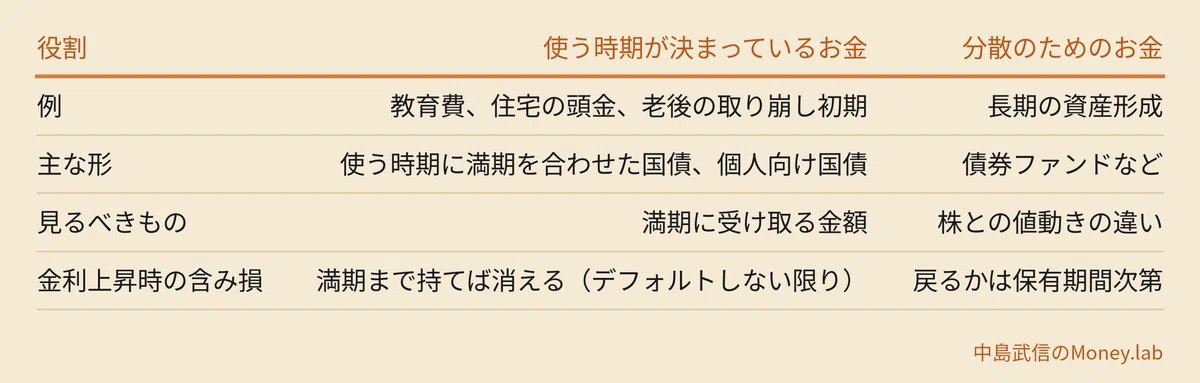
Note that government bonds for individuals do not decline in market price, and the principal is returned even if redeemed early (the interest equivalent for the most recent two periods is deducted).
On the other hand, bond funds have no maturity and continuously replace the bonds they hold. Since there is no mechanism where “the face value is returned at maturity,” whether unrealized losses will recover depends on whether the holding period is longer than the duration (the sensitivity of price to interest rate fluctuations; generally the average remaining term).
Also, the role of bonds for diversification is to provide support when stocks fall. However, in situations where stocks and bonds fall simultaneously due to rising interest rates, that effect is weakened.
In other words, the perspective for considering allocation is not just the “percentage of assets,” but “what you are holding those assets for”. The reason life insurers are moving to a rule where they “do not judge by price declines” for government bonds is also because their role of holding until maturity is clear.
If you were to explain this to a client, it would go like this.
If you have money with a set usage date, holding it in government bonds that mature at that time means you don’t need to worry about price drops along the way. On the other hand, for bonds held to diversify against stocks, the price movement itself is the role. Even for the same bond, the perspective changes depending on the purpose.
■ Summary
-
Life insurers’ bond holdings will not be impaired solely due to price drops caused by rising interest rates (effective from fiscal year 2030, with early adoption possible from fiscal year 2027)
-
Price drops in bonds held to maturity will disappear as they approach maturity, provided there is no default
-
When concerns about impairment decrease, it becomes easier for life insurers to buy ultra-long-term bonds in a high-interest-rate environment. Purchases this fiscal year have recovered to about 15% of the issued amount
-
Unrealized losses themselves do not disappear, and regional banks and credit unions are not covered
-
For individuals, it is easier to organize the meaning of unrealized losses if you divide bonds into ‘money with a set usage date’ and ‘money for diversification’
■ Points to note
The new rules are at the exposure draft stage, and the official decision is scheduled for within this fiscal year. The underlying Accounting Standards for Financial Instruments by the Accounting Standards Board of Japan (ASBJ) have also not been finalized.
Also, while a rule change would make it easier for life insurers to purchase government bonds, it is, of course, up to the life insurers whether or not to buy them. Therefore, if fiscal concerns intensify regarding budget compilation, etc., a scenario where ultra-long-term interest rates rise again is possible.
This does not constitute solicitation for specific products or an indication of future interest rates.
Related past articles
Thank you for reading to the end. Since free articles become unavailable two days after publication, we recommend joining our membership if you wish to view past articles.
■ Book Information
On November 26, I will release ‘Amazing Diversified Investment’ (Subtitle: Unbeatable, Solid, Yet Profitable) from Diamond Inc. It is already available for pre-order on Amazon and elsewhere. Designing an unbeatable investment not by ‘what to buy’ but by ‘what, when, and with what to combine.’ I have summarized the overall picture in one book.