
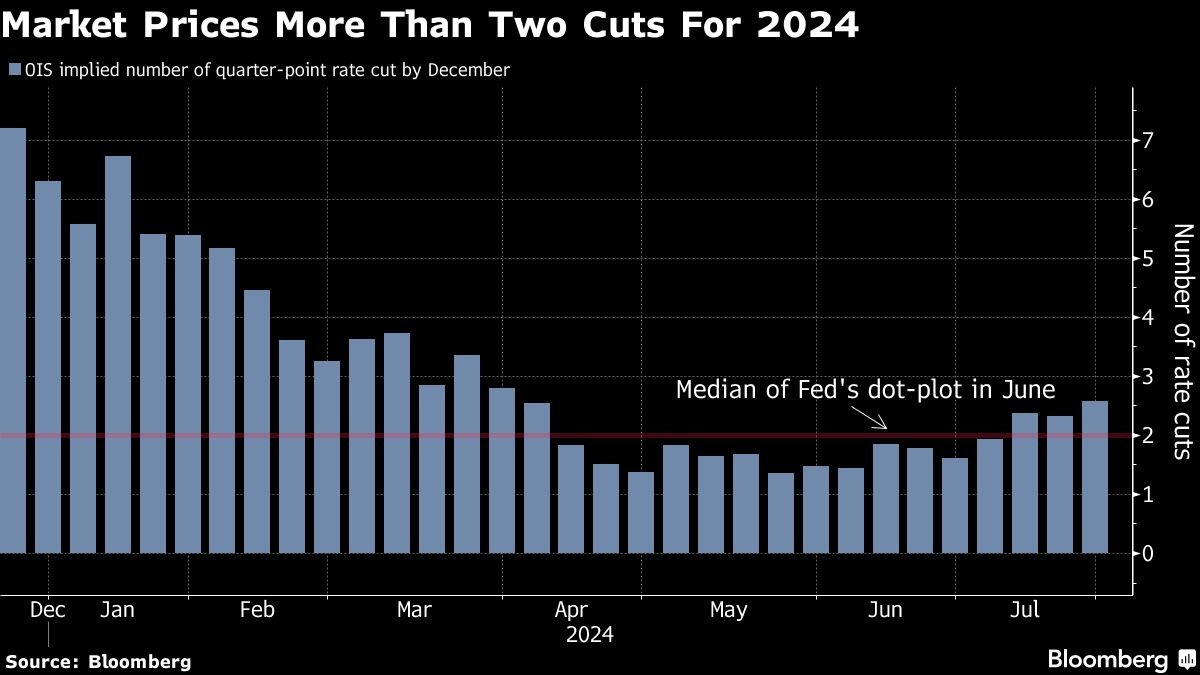
(Bloomberg) — Bond traders who’ve set themselves up for gradual interest-rate cuts starting in September are ramping up side bets in case a sudden slide in the US economy forces the Federal Reserve to be even more aggressive.
Most Read from Bloomberg
As Treasuries advance for a third-straight month, investors are fully pricing in at least two quarter-point rate reductions this year, slightly more than what policymakers have telegraphed. In the derivatives market, some traders have gone even further with wagers that pay off if central bankers go bold and deliver a half-point cut in mid-September — or start lowering rates sooner.
While still an outlier scenario, speculation around the need for such a move has gained traction amid evidence that companies and consumers are feeling the pinch from two-decade-high benchmark rates. Even as inflation has ebbed, investors are increasingly concerned the labor market is about to crack — something Fed officials said they’ll be attuned to. The sizable time gap between the July policy meeting and September’s adds risk to the equation.
“It’s fair to say that if labor shows more signs of weakening, then the economy is in worse shape and that gets the Fed to cut more,” said Jack McIntyre, portfolio manager at Brandywine Global Investment Management. “What we don’t know is what kind of cutting cycle it will be.”
Anxiety reached a new level last week, when former New York Fed President William Dudley and Mohamed El-Erian said the Fed risks making a mistake by holding rates too high for too long — with Dudley even calling for a move at this week’s policy meeting. Both were writing as Bloomberg Opinion columnists.
The commentary alone was enough to roil the market, sending policy-sensitive short-term US yields tumbling in a so-called steepening pattern, as is customary before an easing cycle. Still, eco-friendly data on jobless claims, US growth and consumer spending helped support the case for the central bank to hold tight this week.
The data “removes the urgency for the Fed to have to act,” Michelle Girard, head of US at Natwest Markets, told Bloomberg Television on Thursday. “The Fed does not want to appear panicked.”
Anticipation of imminent rate cuts has buoyed Treasuries overall, sending yields markedly lower from peaks set in late April — despite some recent turbulence sparked by election concerns. A Bloomberg index of US government debt touched a two-year high this month and is poised to end July on a three-month winning streak last seen in mid-2021.
Policymakers have left their target rate at 5.25% to 5.5% for a year while awaiting signs of a sustained cooling in inflation. With prices seemingly headed in the right direction — data released Friday showed the Fed’s preferred measure of inflation rose at a tame pace in June — they’ve begun placing more emphasis on the other side of their so-called dual mandate: full employment.
On that front, the coming couple of months will be crucial — including next week’s jobs report. Evidence of material weakness “may bring renewed questions about the soft landing and perhaps the Fed falling back behind the curve and missing the opportunity to have cut rates in July,” said George Catrambone, head of fixed income at DWS Americas.
With the Fed widely expected to stand pat, Chair Jerome Powell could use his press conference on Wednesday to raise fresh economic concerns or policy changes.
Should he start laying the groundwork for deeper-than-expected cuts, it would send a dire signal: Only in the wake of the dot-com bubble deflating in early 2001 and the onset of the financial crisis in September 2007 did the Fed deliver half-point reductions to initiate what became big easing cycles.
JPMorgan Chase & Co.’s Michael Feroli doesn’t expect a turn like that. In a note Friday, he said he expects Powell will “steer away from pointing to any specific meeting for the first cut.” As for fielding questions about not cutting this month, Powell could say central bankers want further evidence of progress on inflation, according to the note.
What Bloomberg Strategists Say …
“Bill Dudley’s recent column arguing for cuts next week is indicative of the change in mood. Suddenly, it’s not inflation that is on everyone’s mind since the downward trajectory interrupted this winter has reasserted itself. It is the increase in the unemployment rate.”
— Edward Harrison, The Everything Risk newsletter. Read on MLIV.
George Goncalves, head of US macro strategy at MUFG, sees more signs of a weakening economy by September possibly prompting a preemptive response from the Fed.
“This idea of slow and steady cuts makes no sense given how data is shaping up,” Goncalves said. “The longer you wait, the more you may need to do later.”
Some in the market see enough uncertainty to warrant just—in-case bets. Traders in recent weeks have used options linked to the Secured Overnight Financing Rate, which closely tracks Fed policy expectations, to position themselves for long-shot scenarios such as quarter-point moves starting as early as July, or a half-point cut in September.
“When a 25-basis-point cut is fully priced, you only have two options,” said Ed Al-Hussainy, a rates strategist at Columbia Threadneedle Investment. “You can position for zero or you can position for 50.”
For now, “the macro picture does currently not demand or even justify” rapid easing, said Derek Tang, an economist at LH Meyer, a policy analysis firm in Washington. He said officials were more likely to opt for quarter-point cuts per meeting — or 50 basis points per quarter — before trying something as drastic as a half-point reduction.
Going from being on hold for more than a year “to suddenly doing 50 means something has hit the fan, and it doesn’t smell good,” said Al-Hussainy.
What to Watch
-
Economic data:
-
July 29: Dallas Fed manufacturing activity
-
July 30: FHFA house price index; Jolts jobs openings; Conference Board consumer confidence and expectations; Dallas Fed services activity
-
July 31: MBA mortgage applications; ADP employment; MNI Chicago PMI; pending home sales
-
Aug. 1: Challenger job cuts; initial jobless claims; nonfarm productivity; unit labor costs; S&P Global US manufacturing PMI; construction spending; ISM manufacturing; Wards total vehicle sales
-
Aug. 2: US employment report for July; factory orders; durable goods orders; capital goods orders
-
-
Fed calendar:
-
Auction calendar:
–With assistance from Steve Matthews.
Most Read from Bloomberg Businessweek
©2024 Bloomberg L.P.