
Close Menu
Fund Focus News
    Facebook X (Twitter) Instagram
    Trending
    • How to Analyze Mutual Funds and ETFs
    • Why are more young Indians and women entering mutual funds, markets?
    • No TDS, no NRE account: GIFT City is changing how NRIs invest in Indian mutual funds – Immigration News
    • Looking beyond mutual funds, SIPs? Here are 7 investment options that can generate regular income
    • Back these energy funds – big winners from the Gulf crisis
    • Average Cost Basis Method: Simplifying Mutual Fund Tax Reporting
    • Ripple (XRP) ETFs Hit $1.32B Cumulative Inflows After a 3-Day Inflow Streak in May
    • How to Pick Investments for Your 401(k) | Investing
    Facebook X (Twitter) Instagram
    Fund Focus News
    • Home
    • Bonds
    • ETFs
    • Funds
    • Investments
    • Mutual Funds
    • Property Investments
    • SIP
    Fund Focus News
    Home»Bonds»New insights into interfacial hydrogen bonds could enhance photocatalytic hydrogen evolution
    Bonds

    New insights into interfacial hydrogen bonds could enhance photocatalytic hydrogen evolution

    July 19, 2024


    Positive and negative impacts of interfacial hydrogen bonds on photocatalytic hydrogen evolution
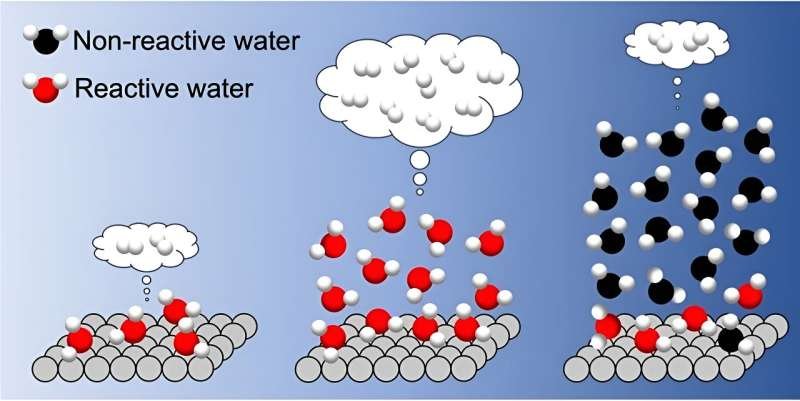
    Schematic of changes in the reaction activity associated with variation of water layer thickness on the photocatalyst surface. The H2 formation rate increases with increasing water layers up to three layers. When more than three water layers cover the surface, the liquid-like water overlayers strengthen/harden the interfacial H-bond networks. The hardened interfacial H-bond networks hinder the interfacial proton-coupled hole transfer, resulting in a dramatic decrease in the H2 formation rate. Credit: Zhongqiu LIN, Toshiki Sugimoto

    Photocatalytic hydrogen evolution from water is a key technology for achieving sustainable hydrogen production. However, the direct impact of the microscopic structure of interfacial water molecules on photocatalytic reactivity remains unexplored.

    In a study, appearing in Journal of the American Chemical Society, the crucial roles of interfacial hydrogen bond structure and dynamics, as well as the optimal interfacial water environment for promoting H2 evolution were uncovered. The paper is titled “Positive and negative impacts of interfacial hydrogen bonds on photocatalytic hydrogen evolution.”

    These findings provide molecular-level insights that can guide the design of interfacial water conditions to enhance photocatalytic performance.

    Hydrogen production via photocatalytic water splitting is a sustainable solution for next-generation energy by utilizing light energy at room temperature. However, the design of innovative photocatalysts remains a challenge due to a limited molecular-level understanding of interfacial water molecules and their hydrogen bond networks.

    Unveiling the physicochemical properties of these interfacial water molecules is critical to optimizing photocatalytic efficiency and achieving breakthroughs in sustainable hydrogen production.

    Researchers (Zhongqiu Lin and others) led by Toshiki Sugimoto, Associate Professor at Institute for Molecular Science / The Graduate University for Advanced Studies, SOKENDAI, have comprehensively investigated the impact of interfacial H-bond networks using various TiO2 photocatalysts and uncovered a crucial role of interfacial H-bond structure/dynamics and optimal interfacial water environment for H2 evolution.

    They controlled the thickness of adsorbed water from sub-monolayer to multilayers by precisely adjusting water vapor pressure. With this approach, they succeeded in directly demonstrating the correlation between H2 formation rate and the microscopic structure of H-bond networks using real-time mass spectrometry and infrared absorption spectroscopy.

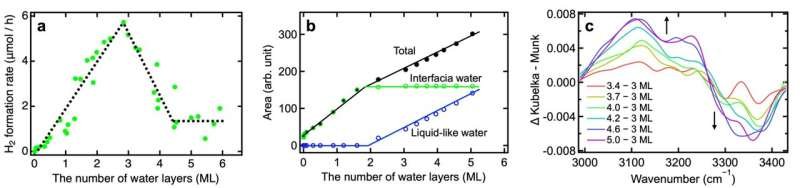
    Regardless of the crystalline structure of the TiO2 photocatalyst (brookite, anatase, or a mixture of anatase and rutile), they observed a linear increase in H2 formation rate with water adsorption up to three layers , indicating that reactive water molecules are present not only in the first adsorbed layer but also in several overlying layers.
    Positive and negative impacts of interfacial hydrogen bonds on photocatalytic hydrogen evolution
    (a) Change in the rate of hydrogen formation through photocatalytic water splitting when the number of water layers (amount of adsorbed water molecules) is systematically changed under various water vapor pressures. (b) The dependency of the O−H stretching band area on the number of water layers (black: total spectrum area, green: spectrum area of interfacial water component, blue: spectrum area of liquid-like water component). The spectrum of the interfacial water component, which shows a spectral shape clearly different from that of bulk liquid water, is nearly saturated in area at two molecular layers, while the liquid-like water component, which shows a spectral shape almost the same as that of bulk liquid water, increases when water molecules are adsorbed in layers thicker than three. (c) Change in the O-H vibration spectrum of the interfacial water component induced by the adsorption of more than three molecular layers of water. Credit: Zhongqiu LIN, Toshiki Sugimoto

    However, the H2 formation rate turned to decrease dramatically when more than three layers of water covered the TiO2 surface.

    In this situation, infrared spectra clearly indicated two distinct types of adsorbed water on the TiO2 surface: interfacial water and liquid-like water. Due to many-body interactions among adsorbed water molecules, the liquid-like water adsorbed in more than three layers led to strengthening of the interfacial H-bond, which hindered interfacial proton-coupled hole transfer and drastically decreased the H2 formation rate.

    Based on these microscopic insights, their study suggests that depositing three water layers in a water vapor environment is optimal for photocatalytic hydrogen evolution.

    Photocatalysis has been extensively studied for over half a century, predominantly in aqueous solution environments. In this context, this study represents a potential paradigm shift, demonstrating the effectiveness of water vapor environments compared to traditional liquid-phase reaction systems.

    These findings open new avenues for the molecular-level design and engineering of interfacial water toward the development of more innovative photocatalytic systems for next-generation renewable energy production.

    More information:
    Zhongqiu Lin et al, Positive and negative impacts of interfacial hydrogen bonds on photocatalytic hydrogen evolution, Journal of the American Chemical Society (2024). DOI: 10.1021/jacs.4c04271

    Provided by
    National Institutes of Natural Sciences


    Citation:
    New insights into interfacial hydrogen bonds could enhance photocatalytic hydrogen evolution (2024, July 19)
    retrieved 19 July 2024
    from https://phys.org/news/2024-07-insights-interfacial-hydrogen-bonds-photocatalytic.html

    This document is subject to copyright. Apart from any fair dealing for the purpose of private study or research, no
    part may be reproduced without the written permission. The content is provided for information purposes only.


    Source link

    Share. Facebook Twitter Pinterest LinkedIn Tumblr Telegram Email

    Related Posts

    news.gov.hk – Institutional bonds issued

    May 8, 2026

    I bonds are the best place to put your cash right now – and that should worry you

    May 6, 2026

    New threat to Labour spending plans as UK long-term borrowing costs hit highest level since 1998 | Gilts

    May 5, 2026
    Leave A Reply Cancel Reply

    Top Posts

    The Shifting Landscape of Art Investment and the Rise of Accessibility: The London Art Exchange

    September 11, 2023

    Charlie Cobham: The Art Broker Extraordinaire Maximizing Returns for High Net Worth Clients

    February 12, 2024

    Ripple (XRP) ETFs Hit $1.32B Cumulative Inflows After a 3-Day Inflow Streak in May

    May 8, 2026

    The Unyielding Resilience of the Art Market: A Historical and Contemporary Perspective

    November 19, 2023
    Don't Miss
    Mutual Funds

    How to Analyze Mutual Funds and ETFs

    May 9, 2026

    In this episode of Motley Fool Hidden Gems Investing, Motley Fool personal finance expert Robert Brokamp…

    Why are more young Indians and women entering mutual funds, markets?

    May 9, 2026

    No TDS, no NRE account: GIFT City is changing how NRIs invest in Indian mutual funds – Immigration News

    May 9, 2026

    Looking beyond mutual funds, SIPs? Here are 7 investment options that can generate regular income

    May 9, 2026
    Stay In Touch
    • Facebook
    • Twitter
    • Pinterest
    • Instagram
    • YouTube
    • Vimeo
    EDITOR'S PICK

    Titan Wealth acquires Innes Reid Investments Limited

    January 13, 2026

    Mutual Funds: SIP Contributions Nearly Hit Rs 3 Lakh Crore, AUM Crosses Rs 65 Lakh Mark

    May 9, 2025

    The No. 1 enemy of your 401(k) plan may be you

    July 27, 2024
    Our Picks

    How to Analyze Mutual Funds and ETFs

    May 9, 2026

    Why are more young Indians and women entering mutual funds, markets?

    May 9, 2026

    No TDS, no NRE account: GIFT City is changing how NRIs invest in Indian mutual funds – Immigration News

    May 9, 2026
    Most Popular

    🔥Juve target Chukwuemeka, Inter raise funds, Elmas bid in play 🤑

    August 20, 2025

    💵 Libra responds after Flamengo takes legal action and ‘freezes’ funds

    September 26, 2025

    ₹9000 monthly SIP can help you retire at 45 with ₹2 lakh monthly pension

    May 5, 2026
    © 2026 Fund Focus News
    • Get In Touch
    • Privacy Policy
    • Terms and Conditions

    Type above and press Enter to search. Press Esc to cancel.