
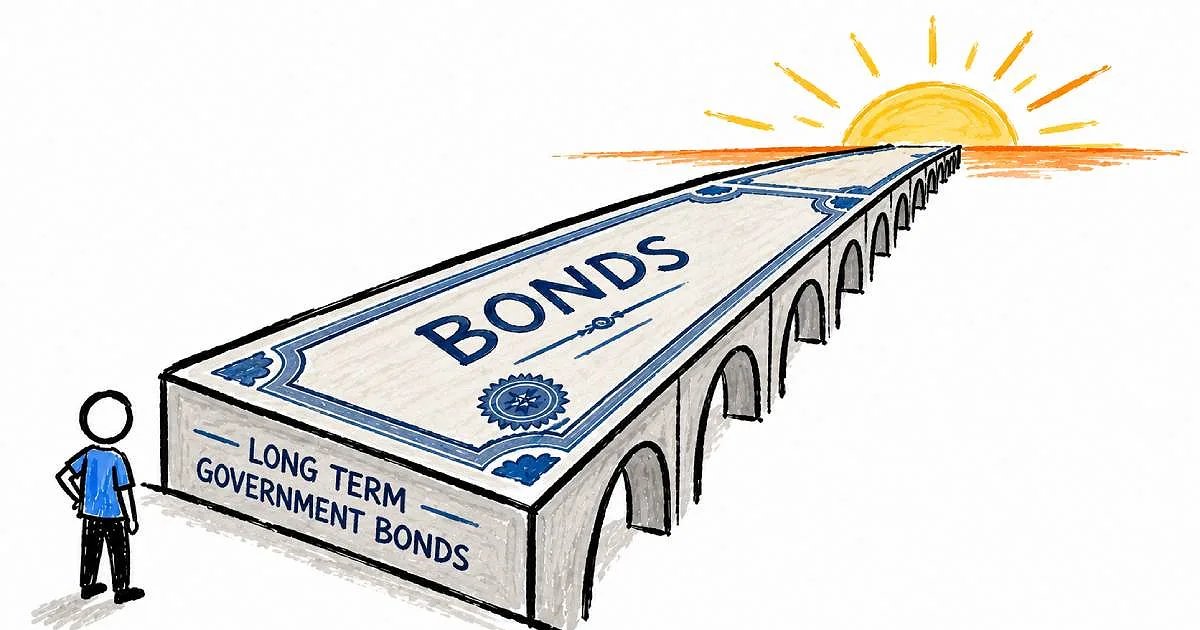
Long-duration bonds allow investors to match investment tenure with long-term liabilities and also stabilise their long-duration portfolios.

Kindly note that this illustration generated using ChatGPT has only been posted for representational purposes.
Goldman Sachs’ call to go long on India’s 30-year government bonds has put long-duration government securities in the spotlight.
It expects yields to decline after the benchmark 30-year bond’s inclusion under the Fully Accessible Route (FAR), which could broaden foreign-investor demand.
Household savings are also moving from bank deposits into pension funds, Public Provident Fund (PPF) and insurance.
This shift can raise demand for ultra-long government securities.
Goldman Sachs Bond Bet
Besides the 10-year benchmark government security (G-sec) 2035, bonds with tenures of 14-, 15-, 30-, 40- and 50 years are available.
State governments also issue State Development Loans (SDLs) with long tenures.
SDLs offer slightly higher yields than central government securities.
Sovereign Green Bonds with 10-year and 30-year tenures are also available.
Key Points
- Goldman Sachs expects India’s 30-year government bond yields to fall after wider foreign investor participation under the FAR route.
- Long-duration government securities offer sovereign safety, predictable income and potential capital gains if interest rates decline.
- Investors should understand interest-rate, inflation and liquidity risks before committing to ultra-long government bonds.
- Holding bonds until maturity and laddering different maturities can help reduce volatility and reinvestment risks.
- Experts recommend long-duration G-secs primarily for retirement and other long-term financial goals rather than near-term needs.
Sovereign safety, predictable returns
Safety is their key advantage.
“Long-duration G-secs provide sovereign credit quality and virtually eliminate default risk,” says Saurabh Bansal, founder, Finatwork Investment.
They offer income visibility.
“Investors who hold these bonds to maturity can lock in today’s yield for the next two to three decades,” says Nischay Nath, founder & chief executive officer, BondScanner.
Central government securities do not attract tax deducted at source (TDS).
If yields fall, existing long bonds gain in price.
“Investors may then earn capital appreciation in addition to regular income,” says Bansal.
Long-duration bonds allow investors to match investment tenure with long-term liabilities and also stabilise their long-duration portfolios.
Beware interest-rate and liquidity risks
G-secs carry no credit risk, but they carry interest-rate risk.
“Longer-duration bonds can experience significant price volatility when interest rates rise,” says Bansal.
The longer the maturity, the sharper the price swing.
“If rates rise and investors need to sell a 30-year bond before maturity, they can suffer a real capital loss,” says Nath.
“Prices can fluctuate significantly with changes in inflation, interest rates, fiscal borrowing and global yields,” says Vineet Agrawal, co-founder, Jiraaf.
Inflation can erode fixed returns over time.
A fixed coupon that looks attractive today can lose considerable purchasing power over 25 or 30 years.
Liquidity is another risk since trading volumes are thinner at the very long end.
“An investor who tries to exit a 40- or 50-year bond early may find wider spreads and fewer buyers than for the 10-year bond,” says Nath.
Investors also face reinvestment risk on coupons.
Furthermore, interest income is taxed at the investor’s slab rate, lowering the effective return.
Hold to maturity to reduce risks
Investors can reduce the high interest-rate sensitivity of these bonds by holding them to maturity.
“Interest-rate volatility along the way matters less if investors intend to hold till maturity,” says Nath.
Check yield
Investors should match bond maturity with their goals and let the latter drive the choice of tenure.
They should check the yield to maturity (YTM), not just the coupon.
What investors earn depends on the price they pay.
Check the YTM right before investing because it changes every day.
Laddering bonds of different maturities can help reduce reinvestment risk.
This prevents all the bonds from maturing on the same date, reducing the possibility of reinvestment risk if rates are low at that point.
Investors should compare post-tax yields with alternatives such as fixed deposits or debt funds.
Best for distant goals
Long-duration government securities suit distant goals, such as retirement income or a child’s education or marriage.
“Institutional investors like pension funds and insurers buy long-dated government bonds to match long-dated commitments,” says Nath.
Retail investors can use them similarly.
Agrawal says 30-year G-secs should ideally be used for the safety-oriented part of a retirement corpus, not for near-term goals.
Retirees, those saving for retirement, and conservative long-term investors may use them.
“Investors who expect interest rates to decline over the long term may also go for these bonds,” says Harsh Vira, chief financial planner and founder, FinPro Wealth.
“All investors who invest in these bonds must, however, have the ability to tolerate interim price volatility,” says Agrawal.
Vira warns that investors with short horizons, frequent liquidity needs, or low appetite for interim price volatility should avoid them.
Disclaimer: This article is meant for information purposes only. This article and information do not constitute a distribution, an endorsement, an investment advice, an offer to buy or sell or the solicitation of an offer to buy or sell any securities/schemes or any other financial products/investment products mentioned in this article to influence the opinion or behaviour of the investors/recipients.
Any use of the information/any investment and investment related decisions of the investors/recipients are at their sole discretion and risk. Any advice herein is made on a general basis and does not take into account the specific investment objectives of the specific person or group of persons. Opinions expressed herein are subject to change without notice.

Feature Presentation: Ashish Narsale/Rediff