

Key points in 10 seconds
-
The Ministry of Finance is researching whether blockchain and similar technologies can be used for the trading and transfer of government bonds.
-
The goal is to speed up reconciliation and settlement between financial institutions and make it easier to use government bonds as collateral.
-
However, implementation has not been decided. It is currently at the stage of examining challenges such as fragmentation from existing markets, legal systems, and 24-hour operation.
What happened this time?
The Ministry of Finance’s “Study Group on On-Chain Government Bonds” held its second meeting on October 30, 2026. They heard from companies including Mizuho Financial Group, Nomura Holdings, Japan Securities Clearing Corporation, Digital Asset Holdings, and Mitsubishi UFJ Group, and discussed the practical aspects of using new ledger technology for government bond transactions. What is important here is that the government has not decided to issue new “blockchain government bonds.” As of November 3, it is still under consideration by the study group, and the minutes of the second meeting have not yet been posted on the Ministry of Finance’s study group page.
What are government bonds in the first place?
Government bonds are securities issued when a country borrows money. Simply put, it is a mechanism where investors lend money to the government, the government pays a set interest rate, and returns the principal when it matures. Government bonds for individuals are in the same category, but the focus of this discussion is not on how individuals buy them over the counter. It is about the back-end of the market where banks and securities companies buy and sell large quantities of government bonds, use them as collateral, and settle funds.
What will “on-chain” change?
In current financial transactions, banks, securities companies, and clearing organizations each have their own systems and ledgers, and process transactions while confirming that the details match. As the number of parties involved increases, it becomes necessary to reconcile the same transaction multiple times and connect separate systems. Therefore, the idea of “on-chain support” is to link the recording of transactions and rights with a distributed ledger such as a blockchain, allowing them to be updated under the same rules. In the Ministry of Finance’s study group, this is used in a broad sense that includes not only displaying government bonds digitally, but also streamlining a series of processes including purchase, holding, sale, transfer, and interest payment.

In a daily example, it is similar to moving from a state where multiple companies have separate inventory lists and reconcile the numbers later, to a state where they use a ledger linked by common rules. However, in finance, because it is legally important who holds the rights and when the settlement is finalized, it is not a matter that can be solved simply by replacing it with a shared table.
Government bonds are already “digitized”
This is a point that is easy to misunderstand. Current Japanese government bonds are not settled by people carrying paper securities around. In the Bank of Japan’s book-entry system for government bonds, transfers are made by moving the rights to government bonds on the ledger. According to the Bank of Japan, more than 99.9% of government bond settlements are carried out using this mechanism, and they have been paperless since the transition to the current system in 2003.
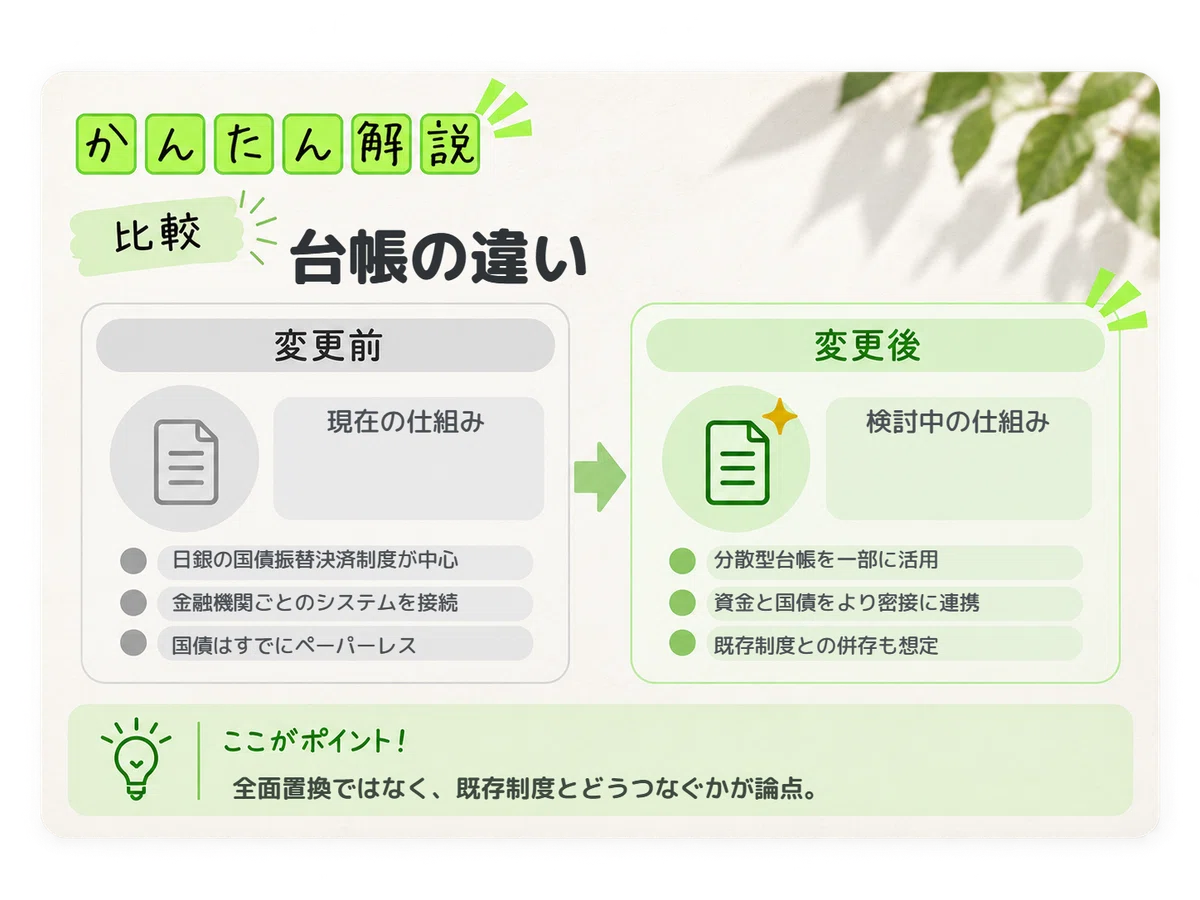
In other words, this consideration is not about “turning paper into digital.” It is about whether the records and settlements of the already digitized government bond market can be further streamlined using distributed ledgers and automated processing.
Demonstration proposals shown in public materials
In the materials released at the second meeting, Mitsubishi UFJ Group’s proposal for putting “repo transactions” using Japanese government bonds on-chain was presented. A repo transaction is a transaction in which government bonds and funds are temporarily exchanged to secure funds or government bonds for a short period of time. For example, suppose a financial institution temporarily needs cash during the day. If they can use government bonds to raise funds for the necessary time and finish the transaction within the same day, it may be possible to reduce the need to hold excess cash all day long. The public materials also examine a method of conditionally transferring both government bonds and digital money at the same time so that one side does not end up “just handing over one side.” This is officially called DVP, and it is an important mechanism in the current government bond market to prevent failure to receive assets.
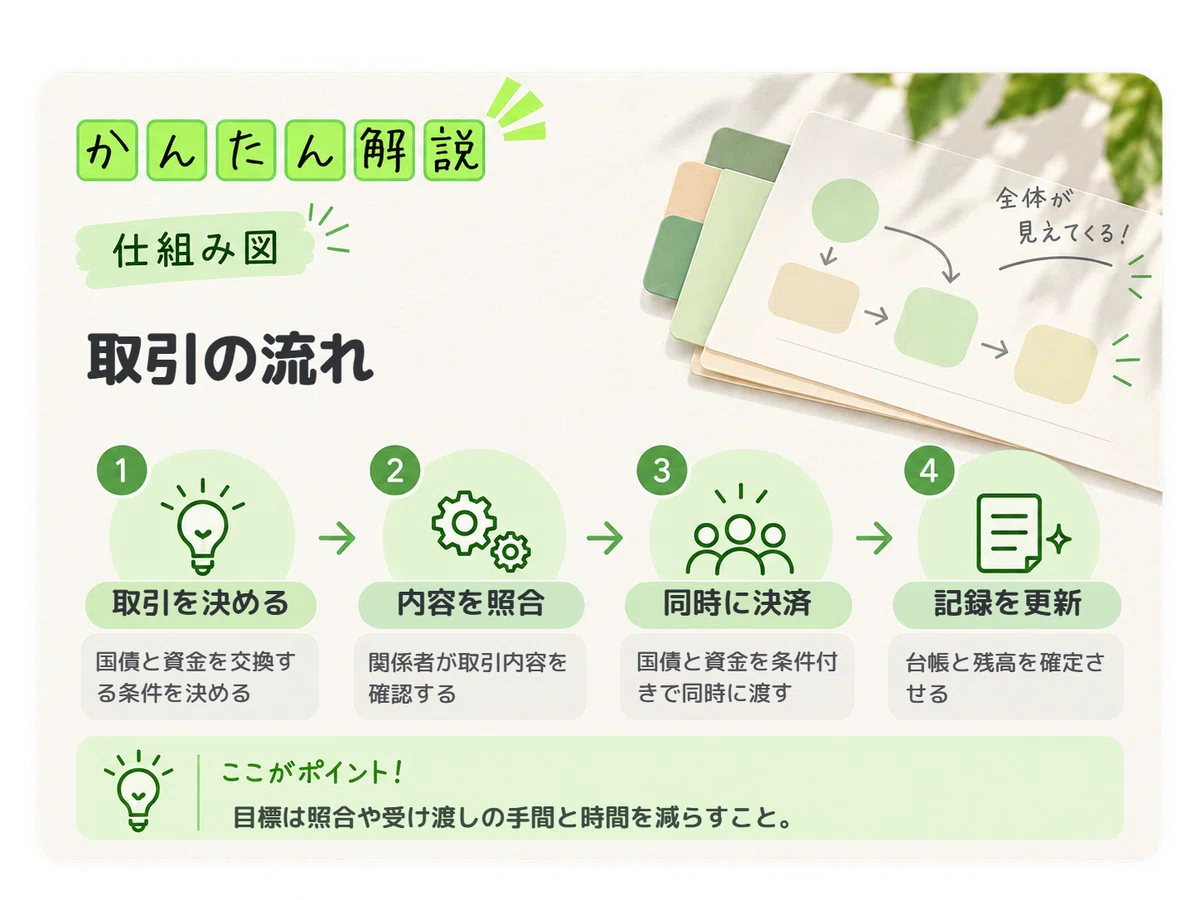
However, the materials from the Mitsubishi UFJ Group represent their own demonstration concept and perspective. These are not documents confirming that the Ministry of Finance has decided to adopt this method.
Why is a change necessary?
The primary expectation is to improve efficiency behind the scenes for financial institutions. If the time required for verification and settlement can be shortened and government bonds can be moved more easily as collateral, it may become easier to secure necessary funds for only the required duration. The Ministry of Finance is also focusing on maintaining the functionality of the government bond market and responding to new investors and changes in international financial markets. On the other hand, since the government bond market already has high liquidity, it has not been confirmed that using blockchain will necessarily yield significant benefits.
The challenge is not just ‘technology’
The biggest issue is how to connect the current system with the new one. If the on-chain market and the traditional market become separated, there is a risk that the ease of trading and the prices for the same government bonds could diverge, leading to market fragmentation. While it may seem convenient to enable 24/7 trading, it would require personnel to provide pricing and handle issues during nights and holidays. The study group has also discussed the possibility that prices could become more volatile during periods of low trading volume. Furthermore, it must be decided who is legally recognized as the holder of the government bonds, how to handle rights in cases of seizure or bankruptcy, and which mechanism should be used to settle the funds exchanged for the bonds. Even in the published demonstration materials, legal and technical frameworks, connection with the Bank of Japan’s systems and institutions, operational structures, and fund management are cited as challenges.

How does this affect us?
At this moment, this is not a story about immediate changes to how individuals buy government bonds, or changes to interest or taxes. It has not been decided that you will be able to buy government bonds using a cryptocurrency wallet on your smartphone. However, government bonds are important assets that serve not only for national fundraising but also as collateral for financial institutions and as a benchmark for financial markets. If the trading infrastructure changes significantly, it will have long-term effects on the fund management of financial institutions, market stability, and the country’s ability to raise funds stably, so it is not irrelevant to taxpayers.
What to look for next
The Ministry of Finance announced the establishment of the study group on September 30, held the first meeting on October 8, and the second on October 30. According to the meeting materials, they plan to summarize the discussions by around December 2026 to January 2027.

The future focus will be on specifically which parts to move on-chain, how much of the existing government bond book-entry system to retain, and whether the benefits justify the costs. The criterion for judgment will not be the use of technology itself, but whether the government bond market can be kept safe and easy to use.
In short, this news is…
This is news that the Ministry of Finance has begun a full-scale study into the possibility of using blockchain and other technologies for the trading and settlement of government bonds. The goal is to improve the efficiency of verification, settlement, and collateral management for financial institutions, but implementation has not yet been decided. Since government bonds are already digitized, this discussion is not about moving from ‘paper to digital,’ but rather about ‘how to rebuild the backend of an already digital market.’ It is necessary to verify not only convenience but also legal aspects, market fragmentation, 24-hour operations, and connections with existing systems.
Sources and Reference Materials
https://www.mof.go.jp/about_mof/councils/study_on_chain/on_chain_shiryo2/o20261030-0.pdf
https://www.mof.go.jp/about_mof/councils/study_on_chain/on_chain_shiryo2/o20261030-2.pdf
https://www.mof.go.jp/about_mof/councils/study_on_chain/on_chain_shiryo1/o20261008-2.pdf