

“Stocks are scary, but bonds are safe.”
“Government bonds won’t lose principal because the government pays them back.”
Both are common sayings. The second statement is true when it comes to Japanese Government Bonds (JGBs) for Individual Investors. For individual-oriented JGBs, once one year has passed since issuance, the government buys them back at face value, so their prices do not fluctuate.
However, government and corporate bonds traded through securities firms are different. If you sell them before maturity, they are sold at that day’s market price. The phrase “bonds are safe” omits these differences in products and the conditions of how you hold them.
Here is a question for you.
When interest rates rise, what typically happens to bond prices?
-
They rise
-
They fall
-
They do not change
-
There is no relationship between bond prices and interest rates
-
Don’t know
This is the exact question that the Japan Financial Literacy and Education Corporation (J-FLEC) posed to 30,000 people nationwide aged 18 to 79 in 2025. The answer is “2. They fall.”
Only 25.7% answered correctly. “Don’t know” was the most common response at 40.0%, and 20.5% answered “They rise.”
While the phrase “bonds are safe” is widely known, only one in four people knows what drives bond prices. Today, we will explore the mechanics behind the answer to this question so that you can evaluate for yourself under what holding conditions market-priced bonds can be called “safe,” and how individual-oriented JGBs differ.
Stocks have one key figure; bonds have two
Stocks are simple products. If the price goes above what you bought it for, you gain; if it drops, you lose. There is only one figure to watch: the stock price (dividends exist, but let’s set them aside for now).
With bonds, there are two figures to watch.
A bond (債券, saiken) is an “IOU” you receive when you lend money to a government or corporation. The certificate states three things from the very beginning:
-
Face value (額面, gakumen): The amount returned at the end (e.g., 1 million yen)
-
Coupon rate (利率 – riritsu): The percentage of interest received each year (e.g., at 1% per year, 10,000 yen each year)
-
Maturity (満期 – manki): When the money is repaid (e.g., in 10 years)
These three factors do not change after purchase (in the case of fixed-rate bonds). If you hold it until maturity, you will receive 10,000 yen each year, and at the end, your 1 million yen will be returned.
What does change is the price when you sell that certificate to someone else before maturity. Unlike stocks, bond prices do not move purely on “popularity.” What moves them the most are the prevailing interest rates in the world. However, even among bonds, prices move differently for government bonds compared to corporate bonds issued by companies. That is because corporate bonds also fluctuate based on whether that company can repay according to its promise. We will cover corporate bonds in the next article.
When the coupon rate of new bonds rises, the price of old bonds falls
Let’s consider an example.
Suppose you hold a bond with an annual coupon rate of 1% and a face value of 1 million yen. It pays 10,000 yen in interest each year.
After that, interest rates in the market rise, and the same government issues a new bond with an annual coupon rate of 2%. For the same 1 million yen, it pays 20,000 yen in interest each year.
Now, suppose you want to sell the bond in your hands. From the buyer’s perspective:
-
New bond: For 1 million yen, 20,000 yen each year
-
Your bond: For 1 million yen, 10,000 yen each year
For the same 1 million yen, no one would buy your bond. To sell it, you have no choice but to lower the price. It drops to the point where the lower price compensates for the 10,000 yen less each year.
This is the answer to the earlier question. When interest rates rise, the prices of existing bonds fall.
Looking at it from the opposite side reveals another fact. For someone buying an older bond that has dropped in price, precisely because they bought it cheaply, the yield relative to the money paid goes up.
🔍 Deep-Dive Note ① [Summary: “Coupon rate” is the figure written on the certificate; “Yield” is the figure relative to the amount paid]
Coupon rate (利率 – riritsu) is how much interest is paid each year relative to the face value. It is written on the certificate and does not change.
Yield (利回り – rimawari) is how much your investment increases annually until maturity relative to the money actually paid.
Suppose you buy a bond with a face value of 1 million yen and a 1% coupon rate at a discounted price of 950,000 yen. The annual interest remains 10,000 yen, but because you will receive back 1 million yen at maturity, you also get the 50,000 yen difference from your purchase price. Therefore, the yield will be higher than 1%.
When newspapers report that “long-term interest rates have risen,” they are referring to this yield. A day when long-term interest rates rise is also a day when government bond prices fall.
Even for the same “1% rise in interest rates,” the price drops by about 2% if 2 years remain, but by about 22% if 30 years remain.
So, just how much do prices drop? The price examples from this point onward refer to market-priced bonds bought and sold through brokerages and other venues (we will look separately at Japanese Government Bonds for individual investors in a later section).
Suppose you hold a bond with an annual coupon rate of 1% and a par value of 100 yen, and prevailing interest rates rise from 1% to 2%. Recalculating the price using the new 2% interest rate shows that the price varies this much depending on the remaining years to maturity (calculated by the author assuming annual coupon payments):
-
1 year remaining: 99.02 yen (−1.0%)
-
2 years remaining: 98.06 yen (−1.9%)
-
5 years remaining: 95.29 yen (−4.7%)
-
10 years remaining: 91.02 yen (−9.0%)
-
20 years remaining: 83.65 yen (−16.4%)
-
30 years remaining: 77.60 yen (−22.4%)
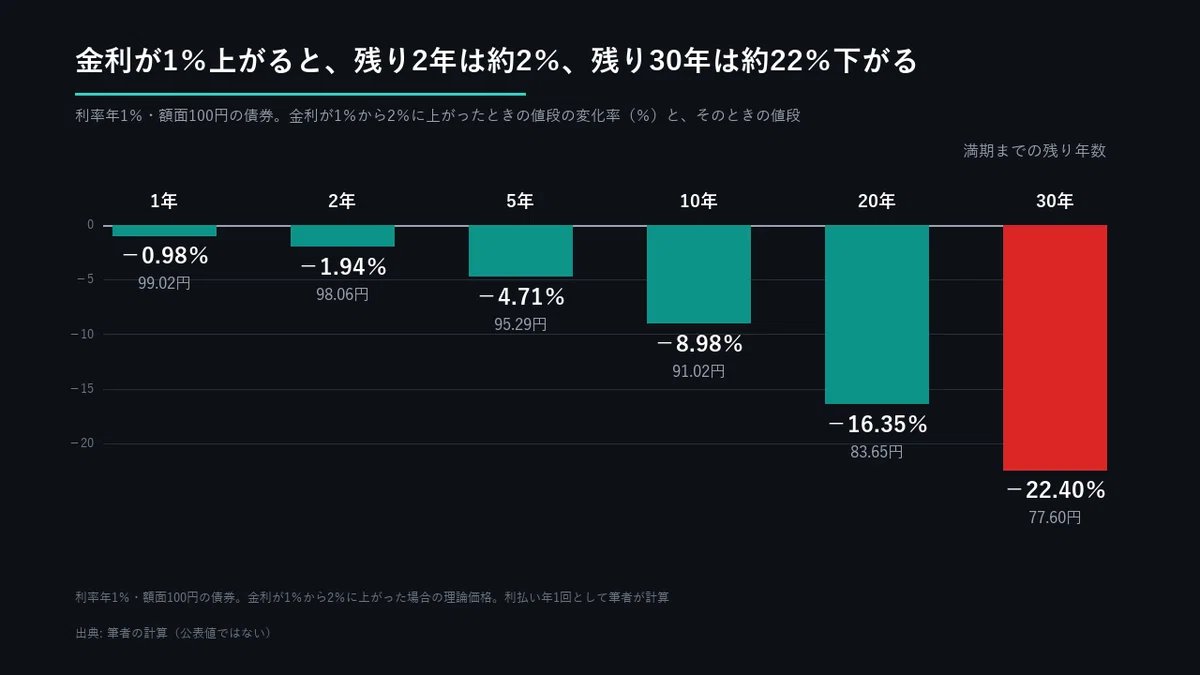
The reason lies in how many years’ worth of the aforementioned “10,000 yen less per year” disadvantage exists. If there are only 2 years remaining, the disadvantage ends after just 2 years. But if there are 30 years remaining, 30 years’ worth of disadvantage must be made up for in the current price.
The longer the maturity of the bond, the more drastically its price swings in response to interest rate movements. Even though they are both collectively called “government bonds,” 2-year and 30-year bonds are products with completely different magnitudes of price fluctuation.
🔍 In-Depth Note ② [Summary: When interest rates fall, longer-term bonds rise in price more substantially]
The mechanism works in reverse as well. If you hold a bond with an annual coupon rate of 2% and prevailing interest rates fall from 2% to 1% (calculated by the author assuming annual coupon payments):
-
2 years remaining: 101.97 yen (+2.0%)
-
10 years remaining: 109.47 yen (+9.5%)
-
30 years remaining: 125.81 yen (+25.8%)
A bond with 30 years remaining drops by about 22% when interest rates rise by 1%, and rises by about 26% when interest rates fall by 1%. The reason the gain on the upside is slightly larger comes down to a mathematical property called convexity (凸性, totsusei).
In other words, long-term bonds are by no means “safe, low-volatility” products. You could even say they are products that make a massive bet on the direction of interest rates.
Whether you gain or lose when selling mid-term is determined by which way interest rates moved after you bought
From this, it becomes clear what determines whether you make a profit or take a loss when selling before maturity.
It is not true that you will necessarily lose money if you do not hold until maturity. Looking at the yields published by the Ministry of Finance, the yield on 30-year Japanese government bonds fell from 2.065% on November 25, 2010, to 0.248% on July 28, 2016. Someone holding long-term government bonds during this period would have captured capital gains by selling midway.
However, over the past year, Japan has been on the opposite side. Comparing the daily government bond yields published by the Ministry of Finance with those from exactly one year ago:
-
10-year JGBs: 1.811% (November 25, 2025) → 2.713% (November 25, 2026)
-
30-year JGBs: 3.302% → 3.998%
Suppose someone bought a newly issued government bond at a face value of 100 yen one year ago, with a coupon rate identical to that day’s yield. Recalculating its price at current yields gives the following (roughly estimated by the author assuming semiannual coupon payments; one year’s worth of interest is pre-tax).
-
2-year bond (1 year remaining): Price 99.39 yen, interest received 0.98 yen → Total +0.4%
-
10-year bond (9 years remaining): Price 93.94 yen, interest received 1.81 yen → Total −4.2%
-
30-year bond (29 years remaining): Price 88.16 yen, interest received 3.30 yen → Total −8.5%
Even among those who similarly bought government bonds one year ago, someone who chose 2-year bonds gained by the amount of interest earned, whereas someone who chose 30-year bonds saw nearly a 10% decline even after receiving interest.
The statement “government bonds are safe” depends on which government bond you are talking about
Having heard this far, some might think, “But I heard Japanese government bonds for individuals never lose principal.” That is also true. Even among government bonds, the mechanism governing interim prices differs depending on the product.
Ministry of Finance materials (Study Group on Government Debt Management, May 26, 2026) explain the government bonds available to individual retail investors by dividing them into two categories.
-
Japanese Government Bonds for Individuals: In the event of early redemption, the government buys them back at face value. 100 yen per 100 yen of face value, which remains the same even upon early redemption.
-
New Over-the-Counter Government Bonds: Repurchase by financial institutions at market value. While they can be sold on the market at any time, “because it is done at the prevailing market price, capital gains or losses will occur.”
Japanese Government Bonds for Individuals experience no interim price fluctuations. Whether interest rates rise or fall, once one year has passed since issuance, the government will buy them back at face value.
However, there are two conditions.
-
In principle, they cannot be redeemed during the first year following issuance (according to the Ministry of Finance’s announcement, “early redemption is possible at any time after the second interest payment date [one year after issuance]”).
-
When you cash it in, an amount equal to the last 2 coupon payments (before tax) × 0.79685 is deducted. Since interest is paid semiannually, two payments equal roughly one year’s worth. Multiplying by 0.79685 gives the after-tax amount, so it is the same as “returning the last year’s worth of interest at the after-tax amount.”
On the other hand, as we have seen so far, the prices of new over-the-counter sales of government bonds and JGBs traded through brokerage firms fall when interest rates rise.
Therefore, if asked “Are government bonds safe?”, the answer differs depending on the product.
-
Cashing in retail JGBs after one year has passed since issuance → No fluctuations in price. What gets deducted is an amount equivalent to the after-tax interest of the most recent year (2 payments). As a general rule, they cannot be cashed in during the first year.
-
Selling new over-the-counter JGBs or market-traded JGBs before maturity → Sold at market price, so it can result in either a loss or a gain.
-
In both cases, you will get back the face value if you hold them until maturity.
How interest rates on retail JGBs are determined was examined in detail in the November 28 article: “The 10-Year Floating-Rate Retail JGB Is at 1.85% Annually, 0.66 Times the Base Rate of 2.80%—The 5-Year Fixed-Rate for the Same Month Is at 2.17%, Higher Than the 10-Year Floating-Rate.”
🔍 In-Depth Note ④ [Summary: The “deducted amount” for retail JGBs is approximately 15,000 yen per 1 million yen at 1.85% annually]
Let us calculate the amount deducted for early redemption of retail JGBs using an example.
Suppose you have a face value of 1 million yen, and the last 2 coupon payments were both at an annual rate of 1.85% (received semiannually):
-
1 coupon payment: 1,000,000 yen × 1.85% ÷ 2 = 9,250 yen
-
2 payments: 18,500 yen
-
× 0.79685 = approx. 14,742 yen (author’s calculation)
0.79685 is the after-tax ratio of the interest. In the Ministry of Finance announcement on November 6, “after tax: 1.4741725%” was written next to the 10-year floating rate of 1.85% annually, and 1.4741725 ÷ 1.85 = 0.79685 (author’s calculation). As described in the text, it is structured to return the last 2 payments (roughly 1 year’s worth) of interest at the after-tax amount.
When you will know the deducted amount varies depending on the type. For the 5-year fixed and 3-year fixed, the interest rate does not change until maturity, so you know it at the time of purchase. For the 10-year floating, the interest rate is revised every six months, so the deducted amount also changes based on the interest rates of the last 2 payments immediately before redemption.
In either case, the amount deducted is the size of “about 1 year’s worth of interest.” It is not a mechanism where the price itself drops due to interest rate movements, as is the case with market-traded government bonds.
The Current Price for Someone Who Bought at the 30-Year JGB Yield in 2020
From here, we return to the topic of government bonds priced in the market. Retail JGBs do not experience the price declines we are about to see. Let us look at a slightly longer time horizon.
On November 25, 2020, the yield on 30-year JGBs announced by the Ministry of Finance was 0.645%. Suppose someone bought a 30-year government bond with an interest rate of 0.645% on this day at a face value of 100 yen.
Now, 6 years later, this bond has 24 years remaining. If we recalculate the price at current yields (taking approximately 3.91%, between the 20-year yield of 3.635% and the 25-year yield of 3.984%), it becomes about 49 yen (author’s rough estimate; this is not the price of an actual issue).
Something bought at a face value of 100 yen is now worth roughly half that on the books.
Even so, if this person holds it until its maturity in 2050, the 100 yen will be returned as promised. They will also receive the 0.645 yen in annual interest, exactly as promised. Over these six years, none of the promises have changed. The only thing that has changed is “how much it would fetch if parted with right now.”
🔍 In-Depth Note ③ [Summary: Buying a bond whose price has fallen is the same as lending money at today’s interest rate]
Let’s look at this from the perspective of someone buying the same bond today for about 49 yen.
The annual interest they receive is 0.645 yen. Relative to the 49 yen paid, that is about 1.3%. On top of that, there is a difference of roughly 51 yen generated when the 100 yen is paid back at maturity. Dividing that by 24 years comes out to about 2.1 yen per year.
Running the precise numbers, this person’s yield comes out to roughly 3.9%, exactly matching today’s interest rate. That is because the price has dropped to the point where it does so.
This is what was meant at the beginning by “someone buying an older bond whose price has dropped gets a higher yield.” The prior price decline was absorbed by the person who held it up to that point. The person buying now is effectively starting to lend money at today’s interest rate. However, if interest rates rise further after the purchase, the price of this person’s bond will fall through the exact same mechanism. It is not the case that buying after a price drop makes you safe.
Bonds are “stable” in two specific use cases
To summarize up to this point, a bond priced by the market acts as a “stable asset” under the following two use cases.
1. The maturity date comes before the day you need the money, and you hold it until maturity
What comes into play here is the order of the maturity date and the date you spend the money.
If the maturity date is on or before the day you spend the money, the face value will be back in your hands by that day, no matter what the price does in the meantime. The interim price has no bearing on what that person actually walks away with.
If the maturity date is after the day you need the money, you will end up selling it at market value on that day. Depending on interest rates on that day, you could see a gain or a loss. For example, if you hold money you plan to spend in five years in a bond with 30 years remaining, your net proceeds in five years will be determined by the interest rates at that time.
2. Your objective is to receive annual interest payments
For someone who wants to receive a fixed amount of interest every year to supplement their pension, the interim price does not matter much. Even if the price falls, the amount of interest is just as written on the certificate.
However, there is one caveat here as well. With fixed-rate bonds, the interest you receive will not increase even if interest rates rise later on. For someone who bought at 0.645% in 2020, even if interest rates today are in the 3% range, what they receive remains at 0.645%. Prices fall because the market reflects this “unincreased interest” in the price.
When you hold bonds in a way that doesn’t fit these two cases—namely, “holding a long-term bond without deciding when to sell”—a bond is an asset whose price fluctuates. Even if not as volatile as stocks, when interest rates move, it will move without fail.
Why some people panic and sell upon seeing a drop in price on their screens
From here on, it is a matter of psychology, not mechanics.
On brokerage account screens, an “appraised value” is displayed for bonds just as it is for stocks. In months when interest rates rise, red numbers line up across that display.
“Why are government bonds, which are supposed to be safe, losing value?”
The more someone assumes bonds are things that “do not fluctuate in price,” the more shocked they are by this screen. Still startled and without understanding the reason, they are forced to decide whether to sell.
To those who understand how it works, the exact same screen looks like this:
-
Because interest rates rose, the price fell. The commitments (interest and face value) haven’t changed at all.
-
However, that reduced price is not just a paper matter on the balance sheet. The discrepancy of being locked into receiving interest lower than current market rates all the way until maturity is directly reflected in the price.
-
The available choices are to hold until maturity, or sell and move into an asset with today’s higher interest rates. In theory, either choice results in roughly similar total payouts by the maturity date (author’s assessment; differences will arise based on fees, taxes, and conditions of the destination asset).
-
What determines which choice to make is when you need the money, and how you intend to use the proceeds from selling.
What creates this difference is not personality, but whether you know why prices fluctuate.
Even under professional management, interim bond prices fall. According to flash reports from the GPIF, which manages pension reserve funds, the return rate for foreign bonds in the July–September quarter of 2026 was -6.52%, and the investment return amounted to -5,230.1 billion yen. In the reference indicators of the same publication, two movements are listed that could be the cause.
-
Overseas interest rates rose (the factor causing bond prices to fall): US 10-year Treasury yield rose from 4.47% at the end of June to 5.28% at the end of September; German 10-year bund yield rose from 2.86% to 3.59%
-
The yen appreciated (the factor causing loss in value when converting foreign-currency bonds into yen): USD/JPY moved from 162.53 yen to 157.14 yen; EUR/JPY moved from 185.82 yen to 178.48 yen
The report does not break down how much of the total negative return each of these two factors accounted for. The loss on foreign bonds includes both the decline in value due to interest rates and the reduction in value due to foreign exchange. The details were broken down in the November 19 article, “Pension Reserve Fund Management for July–September Saw a Deficit of 5,253.3 Billion Yen: Out of 8,135.5 Billion Yen Across Three Asset Classes in the Red, Foreign Bonds Accounted for 5,230.1 Billion Yen.”
The Weight of the Number: 1 in 4 People
Returning to our original question.
In the “Financial Literacy Survey 2025” (published March 27, 2026) by the Japan Financial Literacy and Education Promotion Organization, the proportion of people who correctly answered “Fall” to the question “What normally happens to bond prices when interest rates rise?” was 25.7%. While this is a slight increase from 23.6% in the previous survey (2022), it still represents only one in four people.
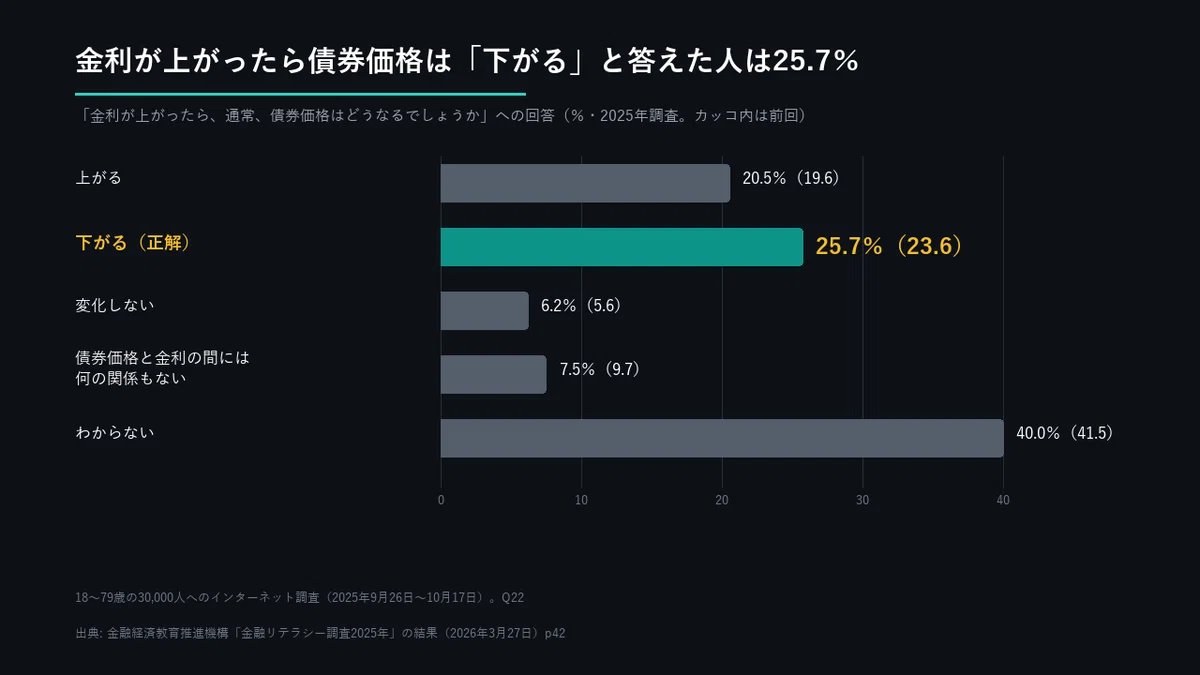
Looking at the breakdown of responses:
-
Rise: 20.5%
-
Fall (Correct): 25.7%
-
Stay unchanged: 6.2%
-
Have no relation: 7.5%
-
Do not know: 40.0%
What is noteworthy is the 20.5% who answered “fall.” Those who responded “do not know” at least recognize what they do not know. Those who answered “rise,” however, have remembered it backwards. If you buy long-term bonds during a period of rising interest rates expecting that “bonds will rise too,” you will get the opposite result of what you anticipated.
Summary: Three Key Takeaways for Today
-
When interest rates rise, the prices of existing bonds fall. This is because their lower interest payments compared to newly issued bonds are compensated for by a cheaper price.
-
The longer the bond’s maturity, the more dramatically its price fluctuates. If interest rates rise from 1% to 2%, a bond with a 1% coupon rate falls by approximately 2% with 2 years remaining, and by about 22% with 30 years remaining (author’s calculation).
-
Bonds are “stable” only when held to maturity or when the objective is to collect interest payments. If you sell halfway through, whether you gain or lose is determined by how interest rates move after your purchase. Japanese Government Bonds (JGBs) for Individual Investors are an exception: because the government will buy them back at face value once one year has passed since issuance, there are no price fluctuations in between (though an amount equivalent to the after-tax interest for the preceding year is deducted).
The statement that “bonds are safe” is not incorrect. However, that phrase omits the conditions: “if held until maturity” and “if it is this specific product.”
People who buy without knowing these conditions panic upon seeing red figures on days when interest rates rise. People who buy knowing these conditions can calmly compare whether to hold or reallocate on that same day by laying out the maturity date alongside the date they will need the money.
Today, you have learned the mechanics to answer a question that only one in four people could get right. The next time you hear the term “safe asset,” try asking back just once: “Does that assume holding it until when?”
Learn More (Financial Learning Space)
We explain what long-term interest rates are and the relationship between yields and government bond prices using data from the Ministry of Finance.
Next Preview
In the next installment on bonds (December 1), we will cover “corporate bonds,” which behave differently from government bonds despite being bonds. We will examine through primary sources how concerns about a company defaulting on repayment are reflected in prices.
*This article does not recommend the trading of specific issues or financial products, but is educational content designed to help readers understand the relationship between bond prices and interest rates. Numerical figures are based on the Ministry of Finance’s “Interest Rate Information on Government Bonds” (up to November 25, 2026), Ministry of Finance Study Group on Debt Management materials (May 26, 2026), the Japan Financial Literacy and Education Corporation’s “Financial Literacy Survey 2025” (published March 27, 2026), and the Government Pension Investment Fund’s (GPIF) “Fiscal 2026 Q2 Investment Results (Preliminary)” (published November 6, 2026). Bond price calculations are the author’s rough estimates assuming coupon rates and yields, not the actual prices of specific issues. Please make investment decisions at your own discretion.