

The semiconductor industry is experiencing unprecedented growth in 2024, with the global market expected to reach $617 billion by year-end — a significant 16.6% increase from 2023. This growth has largely been fueled by the rapid advancements in artificial intelligence (AI) and the insatiable appetite for high-performance computing. Advanced AI chips are now in high demand, with manufacturers scrambling to meet the skyrocketing needs of hyperscalers.
According to the latest industry data, global semiconductor sales surged 18.3% during the second quarter to reach $149.9 billion. That includes 42.8% growth in the Americas alone, according to the the Semiconductor Industry Association (SIA).
Plus, “quarter-to-quarter sales increas[ed] for the first time since the fourth quarter of 2023,” added John Neuffer, SIA president and CEO. Overall, industry sales rose 1.7% in June from the previous month.
For investors seeking to access this booming market, semiconductor ETFs are one way to tap into the expected growth in this industry, while tempering some of the risk associated with single-stock investments. However, not all chip ETFs are created – or weighted! – equally. Let’s dive into three top exchange-traded funds (ETFs) in the space to see which might be the best fit for your investment portfolio.
#1. VanEck Semiconductor ETF (SMH)
The VanEck Semiconductor ETF  SMH has emerged as a powerhouse in the semiconductor investment space, offering investors targeted exposure to the industry’s most liquid companies. SMH boasts an impressive $19.18 billion in assets under management (AUM), making it one of the largest semiconductor-focused ETFs in the market. This substantial asset base reflects the growing investor interest in the semiconductor sector, as well as SMH’s position as a go-to investment vehicle.
SMH’s performance has been impressive, up 44% over the past 52 weeks and 27% so far in 2024. That compares to returns of 18.6% and 11.3%, respectively, for the S&P 500 Index  SPX.
SPX.
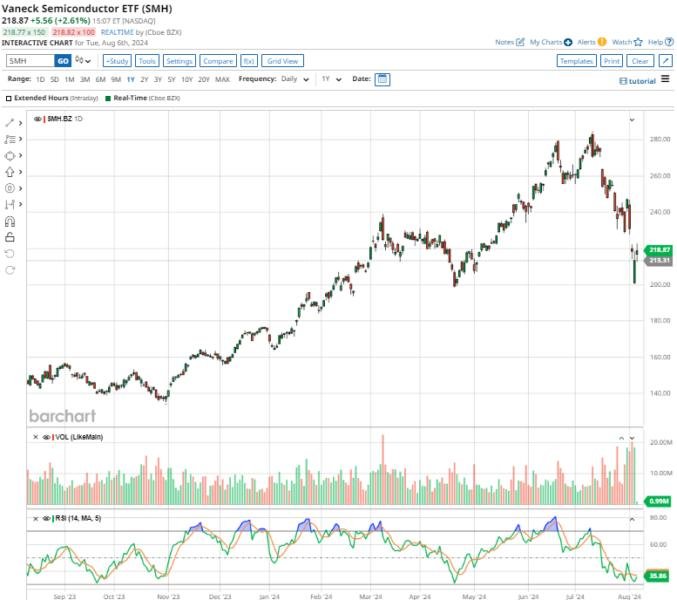
SMH tracks the MVIS US Listed Semiconductor 25 Index, focusing on the most liquid companies in the semiconductor industry and favoring larger, established players. This strategy has resulted in a concentrated portfolio, with the top 10 holdings constituting 72.76% of the ETF’s assets.
Key holdings include industry giant Nvidia  NVDA, at just under 20% of SMH’s weight; Taiwan Semiconductor Manufacturing
  TSM, at 13.39%; Broadcom
  AVGO, at 8.05%, Texas Instruments
  TXN, at 4.99%; and Advanced Micro Devices Inc.
  AMD, at 4.72%. This top-heavy concentration in AI market leaders has been a driving force behind SMH’s impressive performance over the past year, though it also leaves the ETF more vulnerable to weakness in its heaviest weightings.
While primarily focused on U.S.-listed companies, SMH also provides investors with some international exposure. The fund’s geographic breakdown shows a 79.3% allocation to the United States, 12.9% to Asian markets, 6.8% to the eurozone, and 1.1% to other European countries. This composition allows investors to gain exposure to both domestic and global leaders in the semiconductor industry.
Despite its strong performance, SMH maintains a competitive expense ratio of 0.35%, aligning with other similar ETFs in the space and ensuring that investors can capitalize on the fund’s gains without excessive fees eating into their returns. Additionally, SMH offers a dividend yield of 0.49%, with an annual dividend of $1.04 per share, providing investors with a modest income stream alongside capital appreciation.
#2. iShares PHLX Semiconductor ETF (SOXX)
The iShares Semiconductor ETF  SOXX is a well-regarded option for investors aiming to gain exposure to the semiconductor sector, particularly among U.S.-listed companies. With AUM totaling $12.8 billion, SOXX provides a well-rounded approach to semiconductor investing.
SOXX has gained 9.4% in 2024 and is up 22.8% over the past 52 weeks, not quite matching SMH’s impressive returns.
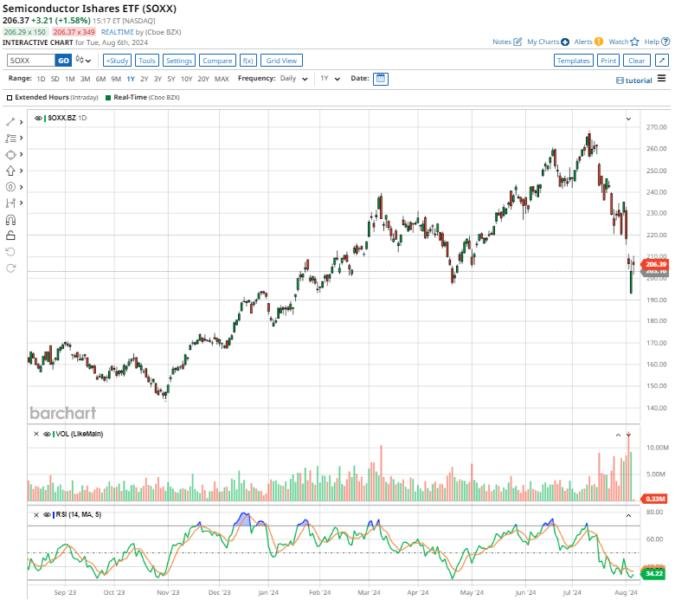
SOXX tracks the NYSE Semiconductor Index, composed exclusively of U.S.-listed equities in the semiconductor sector. This strategy results in a relatively concentrated portfolio, where the top 10 holdings account for 57.5% of the fund’s assets; however, unlike SMH, no one stock accounts for more than 10% of the fund.
SOXX’s top five holdings by weight are Broadcom, at 9.49%; Nvidia, at 8.54%; AMD, at 6.81%; Applied Materials  AMAT, at 6.20%; and Qualcomm
  QCOM, at 5.46%.
This diversified yet focused approach allows investors to tap into the growth potential of the semiconductor sector while managing the risks associated with individual stocks. By concentrating on U.S.-listed companies, SOXX offers a reliable way to invest in the semiconductor industry’s future, while minimizing some of the geopolitical risk associated with the niche.
In addition to its strong performance and strategic holdings, SOXX pays dividends quarterly. The most recent dividend was $0.3103 per share, paid on June 11. The current dividend yield is 0.72%, providing investors with a modest income stream alongside capital appreciation.
SOXX maintains a competitive expense ratio of 0.35%, consistent with other major semiconductor ETFs.
#3. SPDR S&P Semiconductor ETF (XSD)
Finally, the SPDR S&P Semiconductor ETF  XSD offers a unique equal-weighted strategy that distinguishes it within the semiconductor investing landscape. With total net assets of $1.32 billion, XSD aims to provide balanced exposure across the sector, making it an appealing option for investors seeking to avoid over-concentration in a few mega-cap stocks. This diversified approach can help mitigate volatility, especially in a sector known for its cyclical nature and occasionally wild price fluctuations.
As a result, XSD hasn’t exactly delivered the same gains as its semiconductor ETF peers. The fund is down more than 6% on a YTD basis, and is off 3.5% over the past 52 weeks.
XSD tracks the S&P Semiconductor Select Industry Index. This index is equal-weighted, meaning each stock in the index has approximately the same weight. This approach provides more balanced exposure to both large and small companies across the industry. As a result, XSD holds 39 different stocks, with the top 10 holdings accounting for roughly 34% of the total assets.
Currently, the top 5 holdings are Universal Display  OLED, at 3.62%; Semtech
  SMTC, at 3.57%; Skyworks
  SWKS, at 3.54%; On Semiconductor
  ON, at 3.42%; and Texas Instruments, at 3.41%. XSD’s equal-weighted strategy ensures that no single stock dominates the portfolio, which can be advantageous for investors seeking to diversify their risk. However, it also means the fund has largely missed out on the upside in semiconductor industry outperformers like Nvidia.
The expense ratio for XSD is 0.35%, which is standard among semiconductor ETFs, ensuring that investors can benefit from its strategy without incurring excessive costs. Additionally, XSD pays dividends quarterly, with the most recent dividend of $0.135 per share paid on June 24. The current dividend yield is approximately 0.26%, which is relatively low, but typical for growth-oriented technology ETFs.
Which Chip Stock ETF is the Best Buy?
So, which semiconductor ETF is right for your portfolio? If you’re a more aggressive investor with high hopes for AI-fueled growth, SMH might be your top pick, with its heavy exposure to names like Nvidia, TSM, and Broadcom. For a well-balanced mix with a healthy tilt toward the industry’s domestic AI leaders, SOXX offers a happy medium for many investors. Or, for investors who like a bargain and see significant upside potential for some of the industry’s undervalued players, XSD offers an equal spread of semiconductor exposure to buy and hold for the long haul.
On the date of publication, Ebube Jones did not have (either directly or indirectly) positions in any of the securities mentioned in this article. All information and data in this article is solely for informational purposes. For more information please view the Barchart Disclosure Policy here.