
Exchange-traded funds (ETFs) are an easy way to begin investing. They are fairly simple to understand and can generate impressive returns over the long term with minimal expense and effort. They are also easy to buy and sell. Here’s what investors should know about ETFs, how they work, and how to invest in them.
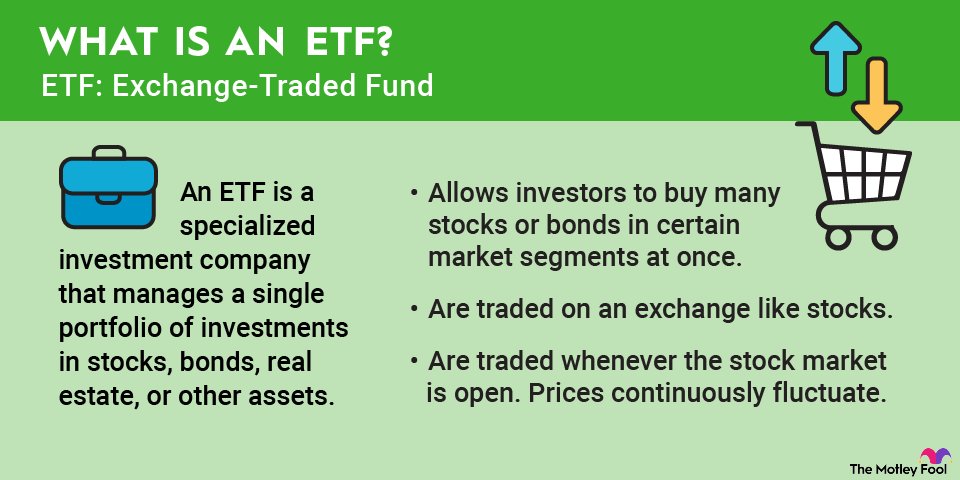
Image source: The Motley Fool.
What is an ETF?
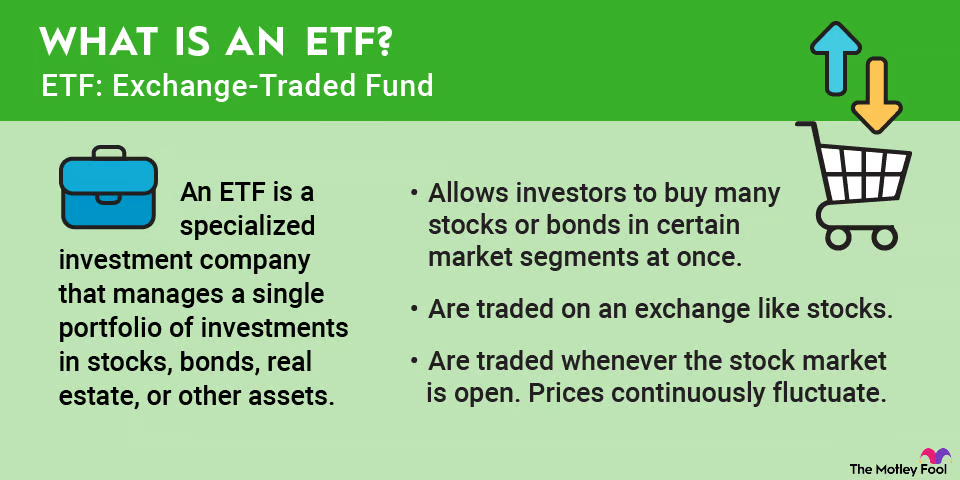
An ETF allows investors to purchase a diversified portfolio of stocks or bonds in a single transaction. People buy shares in ETFs, and the money is invested toward a specific objective. For example, if you buy an S&P 500 ETF, your money will be invested in the 500 companies in the S&P 500 index. As a result, your investment’s performance should roughly match the index’s over time.
How to start investing in ETFs
- Open your brokerage: Log in to your brokerage account where you manage your investments.
- Search for the ETF: Enter the ticker or ETF name into the search bar to bring up the ETF’s trading page.
- Decide how many shares to buy: Consider your investment goals and how much of your portfolio you want to allocate to this ETF.
- Select order type: Choose between a market order to buy at the current price or a limit order to specify the maximum price you’re willing to pay.
- Submit your order: Confirm the details and submit your buy order.
- Review your purchase: Check your portfolio to ensure your order was filled as expected and adjust your investment strategy accordingly.
ETFs vs. mutual funds
One common question is how ETFs differ from mutual funds, since their basic principles are the same. The key differences between these two types of investment vehicles have to do with how you buy and sell them.
- Mutual funds are priced once daily, and you typically invest a set dollar amount, such as $1,000. This isn’t the case with ETFs.
- Mutual funds can be purchased through a brokerage account or directly from the issuer.
- ETFs trade just like stocks on major exchanges such as the New York Stock Exchange (NYSE) or the Nasdaq stock exchange.
- Instead of investing a specific dollar amount in an ETF, you simply buy shares of the ETF like you would buy shares of any stock.
- ETF share prices continuously fluctuate throughout the trading day.
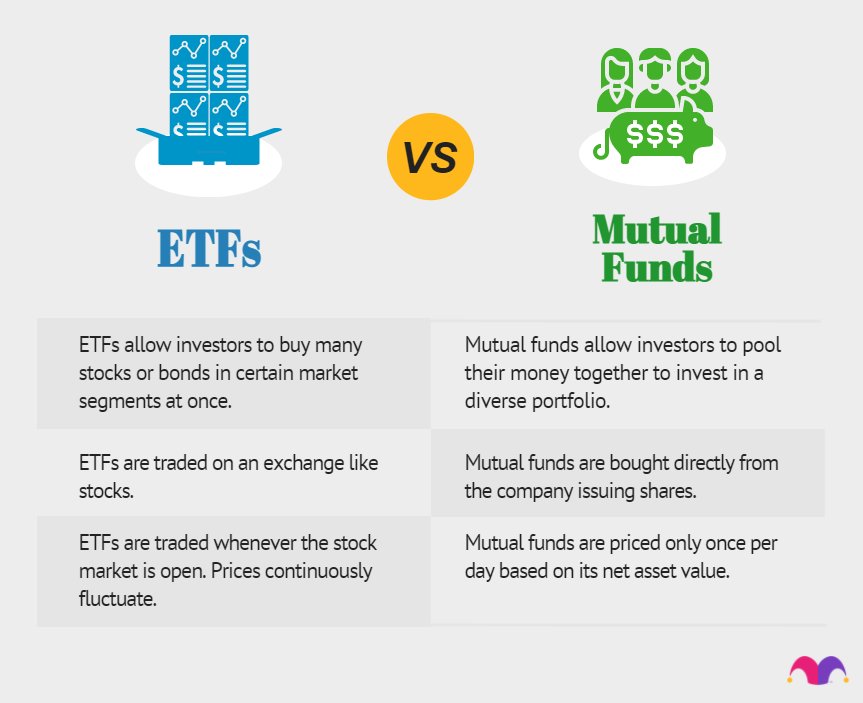
Image source: The Motley Fool.
Understanding ETF basics
Before we proceed, there are a few key concepts to understand before purchasing your first ETFs.
- Passive versus active ETFs: There are two basic types. Passive ETFs (also known as index funds) simply track a stock market index, such as the S&P 500. Alternatively, active ETFs employ portfolio managers to manage their investments. The key takeaway: Passive ETFs aim to match an index’s performance, while active ETFs want to beat it.
- Expense ratios: ETFs charge fees, known as expense ratios. You’ll see the expense ratio listed as a percentage. For instance, a 1% expense ratio means you’ll pay $10 in annual investment fees for every $1,000 you invest. To be clear, an ETF expense ratio isn’t a fee you have to pay. It is simply reflected in the ETF’s performance over time.
- Dividends and DRIPs: Many ETFs pay dividends and offer DRIPs. For example, an S&P 500 ETF receives dividends from many of the 500 stocks it holds and then distributes those to its investors regularly. You can choose to receive your dividends in cash or automatically reinvest them in additional shares of the same ETF through a dividend reinvestment plan (DRIP).
How ETFs work
Think of ETFs as having some features of stocks and some features of mutual funds.
ETFs trade just like stocks on major exchanges such as the NYSE and the Nasdaq. They have a share price that fluctuates throughout the trading day, and investors buy a certain number of shares.
Like mutual funds, ETFs pool investors’ money to invest for a common purpose. For example, an S&P 500 ETF would allocate its assets proportionally to the 500 companies that make up the popular benchmark index.
Understanding ETF taxes
If you buy ETFs in a standard brokerage account (i.e., not a retirement account), you should know that they could result in taxable income. Any gains you make from selling an ETF will be taxed according to capital gains tax rules, and any dividends you receive will likely be taxable as well.
If you invest in ETFs through an individual retirement account (IRA), you won’t have to worry about capital gains or dividend taxes. In a traditional IRA, money in the account is considered taxable income only after it is withdrawn, while Roth IRA investments aren’t taxable at all in most cases.
Pros and cons of ETFs
Let’s examine the pros and cons of investing in ETFs.
Pros:
- ETFs offer exposure to a diverse range of stocks, bonds, and other assets, typically at a low expense.
- ETFs eliminate the guesswork from stock investing. Many ETFs are index funds, which enable investors to track the performance of a specific benchmark index over time.
- ETFs are more liquid (i.e., easy to buy and sell) than mutual funds. Online brokers make it easy to buy or sell ETFs instantly with a simple click of the mouse.
- It can be extremely complicated to invest in individual bonds on your own, but a bond ETF can make the fixed-income portion of your portfolio very easy.
Cons:
- Since ETFs own a diverse assortment of stocks, they don’t have quite as much total return potential as individual stocks.
- ETFs are often low-cost, but they aren’t free. If you buy a portfolio of individual stocks on your own, you won’t have to pay any management fees.
Common ETF investing mistakes
When you invest in ETFs, there are some big mistakes to avoid. Just to name the most common:
- Over-trading: The average stock fund investor underperforms the S&P 500 over time. The biggest reason is over-trading. ETFs work best as long-term buy-and-hold investments. Moving in and out of ETFs tends to result in subpar performance.
- Following the crowd: Don’t buy an ETF just because everyone else is. Buy ETFs that best fit your investing goals and risk tolerance.
- Ignore fees: Shop around to find lower-cost ETFs that meet your specific objectives. A seemingly small difference in expense ratios can make a big difference, especially if you hold the ETF for many years.
- Leveraged and inverse ETFs: Some ETFs, known as leveraged ETFs, seek to amplify the daily returns of an underlying index or stock, or to deliver the opposite of the index’s performance. In simple terms, these are generally best left for short-term traders and aren’t good long-term investment vehicles.
Criteria to choose an ETF
There are literally thousands of ETFs available for investment right now. In fact, the number of ETFs recently surpassed the number of publicly traded stocks for the first time ever. So, how do you find the right ETFs for you?
Here are some things to consider:
- Investment objective: This is the most important consideration. Do you simply want passive exposure to the entire stock market? Do you want exposure to a certain sector? Do you want to invest in a specific trend such as artificial intelligence?
- Active versus passive: Do you want to simply track an index’s performance over time, or do you want fund managers who try to beat a benchmark index?
- Fees: You can find a basic S&P 500 ETF with a 0.03% expense ratio or a large-cap ETF with a similar portfolio that charges 1%. If you find an ETF that meets your needs, it’s worth checking whether there’s another that does essentially the same thing at a lower cost.
- Gross expense ratio: Some ETFs have temporarily lower fees, but you might see a different (and higher) gross expense ratio listed. This is important to know, as it’s the fee you would pay if there were no temporary discounts in place.
- Issuer: Be sure your ETFs are operated by a respected issuer with a long history in the industry. Vanguard, Schwab, and BlackRock (BLK +0.70%) are just a few examples of top-notch ETF issuers.
- Fund assets: There are ETFs with hundreds of billions in assets, and at the other end of the spectrum, some with just a few million. A fund’s assets tell you how much money other investors are entrusting to that specific ETF.
10 of the best ETFs for beginners
Data as of Nov 7, 2026. Showing 10 of 10 total entries.
- Vanguard S&P 500 ETF (VOO +0.30%): Large U.S. companies (The S&P 500 is often regarded as the best benchmark for the overall U.S. stock market).
- Schwab U.S. Mid-Cap ETF (SCHM +0.47%): Midsize U.S. companies between the S&P 500 and the Russell 2000 in terms of size.
- Vanguard Russell 2000 ETF (VTWO +0.95%): Smaller U.S. companies (The Russell 2000 is the most widely followed small-cap index).
- Schwab International Equity ETF (SCHF -0.34%): Larger non-U.S. companies.
- Schwab Emerging Markets Equity ETF (SCHE +1.88%): Companies from countries with developing economies, also known as emerging markets.
- Vanguard High-Dividend Yield ETF (VYM -0.45%): Stocks that pay above-average dividends, mostly large-cap stocks.
- Schwab U.S. REIT ETF (SCHH -0.59%): Real estate investment trusts (REITs), which own properties and tend to pay high dividends.
- Schwab U.S. Aggregate Bond ETF (SCHZ -0.09%): Bonds of all different varieties and maturity lengths.
- Vanguard Total World Bond ETF (BNDW +0.01%): Includes international bonds and U.S. bonds of various lengths and maturities.
- Invesco QQQ Trust (QQQ +1.40%): Tracks the Nasdaq-100 index, which is heavy on technology companies and other growth stocks.
You may notice that this list is heavily weighted towards Vanguard and Schwab. There’s a good reason — both are dedicated to offering easy access to the stock market at a minimal expense, so ETFs from both tend to be among the cheapest in the business.
Strategies for investing in ETFs
Before you start buying ETFs, there are a few strategies you may want to consider:
- Dollar-cost averaging: This refers to incrementally buying shares at set intervals over time. For example, instead of investing $10,000 all at once, you might invest $500 on the 1st day of each month until you’ve invested all your money. You’ll buy more shares when the ETF is cheap and fewer when it’s more expensive.
- Asset allocation: The Rule of 110 says that by subtracting your age from 110, you can determine what percentage of your assets should be in stocks, with the remainder in fixed-income investments. ETFs can help you achieve and maintain a proper asset allocation.
- Invest in the right accounts: High-dividend ETFs and fixed-income ETFs can be an ideal fit for retirement accounts like IRAs, while growth-oriented ETFs can be best-suited for standard (taxable) brokerage accounts.
Let your ETFs do the hard work for you
It’s important to keep in mind that ETFs are generally designed to be maintenance-free investments. Newer investors often check their portfolios excessively and react emotionally and on a knee-jerk basis to major market movements. In fact, the average fund investor significantly underperforms the market over time, and overtrading is the main reason.
So, once you buy shares of some great ETFs, the best plan is to leave them alone and let them do what they’re intended to do: produce excellent investment growth over long periods of time.
Related investing topics
Expert Q&A
Expert Q&A on ETFs
Beginner investing in ETFs: FAQ
Matt Frankel, CFP has positions in Vanguard Russell 2000 ETF and Vanguard S&P 500 ETF. The Motley Fool has positions in and recommends BlackRock, Vanguard High Dividend Yield ETF, and Vanguard S&P 500 ETF. The Motley Fool has a disclosure policy.