

On October 30, 2026, the Bank of Japan announced that it would accelerate the pace of selling the ETFs (Exchange Traded Funds) it holds.
It is said that the time required to complete the sales, which was previously estimated at about 112 years, will be shortened to about 43 years due to this decision.
Reading this news, I had a straightforward thought.
“Can’t that be distributed to the Japanese people instead of being sold?”
Of course, there are various constraints on monetary policy and the finances of a central bank.
Even so, the ETFs held by the Bank of Japan are worth approximately 94 trillion yen at market value.
Is it really best to just sell such a massive amount of assets into the market over several decades?
In this article, I would like to organize the facts about the Bank of Japan’s ETFs and consider the possibility of returning them to the public.
1. Why does the Bank of Japan hold 94 trillion yen in ETFs in the first place?
The Bank of Japan began purchasing ETFs in 2010 as part of its monetary easing policy.
Subsequently, under the unprecedented monetary easing initiated by Governor Haruhiko Kuroda in 2013, the scale of ETF purchases expanded significantly.
In 2016, with a policy of purchasing approximately 6 trillion yen annually, the Bank of Japan became a massive investment entity in the Japanese stock market.
Why did the central bank need to buy stocks?
The goal was to lower the risk premium in the stock market and boost economic activity for companies and households.
If stock prices stabilize, corporate financing environments improve, and positive effects on investment and consumption can be expected.
To escape from the long-standing deflation, the Bank of Japan adopted measures that went beyond conventional monetary policy.
As a result, the Bank of Japan’s ETF holdings as of the end of March 2026 reached the following scale.
Item Amount Purchase Cost (Book Value) Approx. 37 trillion yen Market Value Approx. 94 trillion yen Unrealized Gain Approx. 57 trillion yen
ETFs purchased for 37 trillion yen have grown to a value of 94 trillion yen.
By a simple calculation, an unrealized gain of approximately 57 trillion yen has been generated.
Of course, this is not yet a realized profit.
It will fluctuate depending on future stock prices.
Even so, there is no doubt that it is a very large asset on a national scale.
2. If distributed to the Japanese people, how much would each person get?
Here, let’s try a slightly bold calculation.
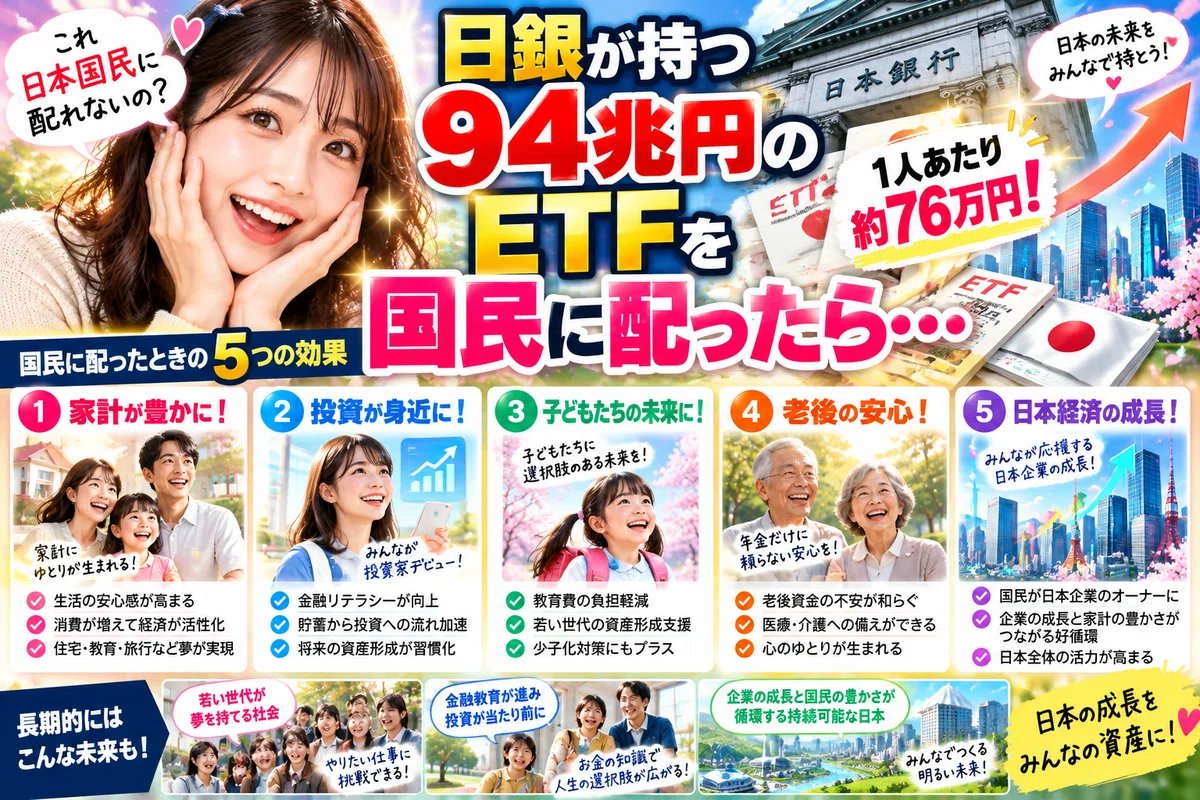
What would happen if the 94 trillion yen in ETFs held by the Bank of Japan were distributed equally to all Japanese citizens?
Calculating with Japan’s population at approximately 123 million,
94 trillion yen ÷ 123 million people = approximately 760,000 yen
is the result.
In other words,
-
about 760,000 yen for a single person living alone
-
about 1.53 million yen for a married couple
-
about 3.06 million yen for a family of four
is the amount of ETFs that could be received.
What do you think?
Isn’t that a fairly large amount?
Moreover, this is not cash, but ETFs.
If held for a long period and stock prices rise due to the growth of Japanese companies, it could potentially lead to future asset formation.
Of course, there is also the risk that stock prices could fall and the asset value could decrease.
However, I think there is great significance in a system where the Japanese people can feel the growth of Japanese companies as their own asset formation.
3. But, whose ETFs are the Bank of Japan’s in the first place?
An important question arises here.
“Are the ETFs held by the Bank of Japan not the property of the people?”
In conclusion, legally, the ETFs held by the Bank of Japan are not the shared property of each individual citizen.
The Bank of Japan is a central bank with a certain degree of independence from the government, and the ETFs it holds are the Bank of Japan’s own assets.
Also, the taxes collected from the public were not used directly to purchase the ETFs.
The Bank of Japan has supplied funds as a central bank and has purchased ETFs as part of its monetary policy.
However, that does not mean they are assets unrelated to the public.
There is a mechanism where the Bank of Japan’s profits, after necessary processing, are paid to the government as payments to the national treasury.
In other words, the Bank of Japan’s profits have an aspect of being returned to the public as a whole through the nation’s finances.
What I want to consider here is whether the massive financial assets held by the Bank of Japan can be more directly linked to the public’s asset formation.
4. Why is the Bank of Japan taking 43 years to sell them?
In the Bank of Japan’s recent announcement, a policy was indicated to increase the pace of ETF sales starting in January 2027.
Item Conventional After change Annual sales amount (book value) Approx. 330 billion yen Approx. 860 billion yen Annual sales amount (market value conversion) – Approx. 2.46 trillion yen Until sales completion Approx. 112 years Approx. 43 years
*The sales period is an estimate based on current holdings, etc. The actual sales amount and period will change depending on market conditions.
43 years.
It is a very long time.
The biggest reason for taking so much time is to suppress the impact on the stock market.
If the Bank of Japan sells a large amount of the ETFs it holds in a short period, it could create significant selling pressure on the stock market.
If stock prices fall, it could affect not only individual investors but also corporate financing and pension management.
Therefore, the Bank of Japan has adopted a policy of selling them off little by little within a range that the market can absorb.
Even after the acceleration of sales this time, the scale of sales per business day is set at approximately 10 billion yen on a market value basis.
Compared to the trading value of the entire market, this is a limited scale.
However, there is one thing I would like to consider here.
If the goal is to suppress the impact on the market, are there really no methods other than selling?
5. I thought about 3 ways to return it to the public
I believe that there are at least three policy proposals regarding the ETFs held by the Bank of Japan that are worth discussing.
Proposal 1: Distribute ETFs directly to all citizens
The simplest method is to distribute ETFs equally to all citizens.
If you divide the market value of 94 trillion yen by the population, it comes to about 760,000 yen per person.
A system could be considered where people open new securities accounts and are allocated a certain amount of ETFs.
However, there is a major problem.
If ETFs are distributed for free, the Bank of Japan’s assets would decrease significantly.
The Bank of Japan’s assets are also backed by liabilities such as current account deposits.
If you reduce assets alone by 94 trillion yen, it could have a serious impact on the central bank’s finances and trust in its monetary policy.
Also, if citizens sell the ETFs they received all at once, it could cause stock prices to fall.
Therefore, simple free distribution would be difficult in reality.
Proposal 2: Return the profits from selling ETFs to the public
The next method to consider is to return the profits obtained from selling the ETFs to the public.
As of the end of March 2026, the Bank of Japan’s ETFs hold approximately 57 trillion yen in unrealized gains.
If we were to divide this amount by the population,
57 trillion yen ÷ 123 million people = approximately 460,000 yen
is the result.
However, the 57 trillion yen is an unrealized gain at the current moment and is not a profit realized as cash.
It is also necessary to consider stock price fluctuations until the time of sale, the Bank of Japan’s profit and loss, taxes, and reserves.
Furthermore, there is no system in place to distribute profits earned by the Bank of Japan directly to the public.
To realize this, a mechanism involving payments to the national treasury or the national budget would be required.
Even so, the discussion of utilizing the profits obtained from the sale of ETFs for tax cuts, child-rearing support, or social security is certainly worth considering.
Proposal 3: Establish a National Asset Formation Fund
Personally, this is the method I am most interested in.
It is a concept where the ETFs held by the Bank of Japan are transferred to a fund aimed at the public’s asset formation under an appropriate system and consideration.
It is a mechanism where the fund holds the ETFs for a long period and returns the dividends obtained from them to the public.
For example, assuming that a cash dividend equivalent to 2% annually is obtained from the 94 trillion yen in ETFs,
it would amount to approximately 1.88 trillion yen per year.
Dividing this by a population of 123 million,
approximately 15,300 yen per person annually.
It is not something that can be guaranteed to be received every year, and the amount will fluctuate depending on the investment performance.
Even so, it can be thought of as a system where the public can benefit from corporate growth over the long term, rather than a one-time payment.
Of course, funding is required for the transfer from the Bank of Japan to the fund.
Establishing a fund does not mean that profits will be generated unconditionally.
However, from the perspective of long-term asset formation for the public, it may be worth considering.
6. Could it be combined with the Junior NISA?
Another point I would like to focus on is the transfer of assets to children.
In Japan, the declining birthrate and aging population are progressing, and the economic burden on the younger generation has become a major issue.
Education costs, housing costs, and child-rearing expenses.
Many families refrain from consumption and investment due to anxiety about the future.
Therefore, could we not consider a system that utilizes a portion of the profits generated from the Bank of Japan’s ETFs to support the asset formation of children?
For example, a mechanism where a certain amount of investment assets is granted when a child is born, and it is managed long-term until they turn 18.
If 500,000 yen were invested at birth and managed with compound interest at an annual rate of 3% for 18 years, it would become approximately 850,000 yen.
At an annual rate of 5%, it would be approximately 1.2 million yen.
Of course, this is merely a calculation, and investment returns are not guaranteed.
Even so, the idea of utilizing the long time until a child reaches adulthood for asset formation is attractive.
It could potentially be used as funds for education or as a starting fund for life as a working adult.
What is important is to establish a mechanism where future generations can receive the benefits of economic growth.
7. However, the idea that ‘distributing 94 trillion yen will make Japan wealthy’ is a mistake
I have been thinking about returning wealth to the public up to this point, but there is something to be careful about.
That is, even if the Bank of Japan’s 94 trillion yen in ETFs were distributed, it does not mean that 94 trillion yen of new wealth would suddenly be created for Japan as a whole.
ETFs are financial assets backed by the stocks of Japanese companies that already exist.
Even if their ownership were transferred from the Bank of Japan to the public, the production capacity or profits of Japanese companies would not immediately increase.
Furthermore, if the government were to purchase the ETFs from the Bank of Japan, it would also need the financial resources to do so.
If funds were raised by issuing government bonds, one would also have to consider the future fiscal burden and the impact on interest rates.
In other words, this is not a simple matter of cash handouts.
It is a question of how to manage the nation’s overall assets and liabilities, and to whom and in what form those profits should be distributed.
That is precisely why careful institutional design is necessary.
8. The Bank of Japan’s ETF sales should be a subject of greater public debate
In the recent news, attention has been focused on the fact that the Bank of Japan’s pace of ETF sales has been increased by approximately 2.6 times, and that the impact on the stock market is seen as limited.
Of course, this is an important decision from the perspective of normalizing monetary policy.
However, I would like to consider it from another perspective as well.
For many years, the Bank of Japan has purchased ETFs to support the Japanese economy.
As a result, massive unrealized gains have been generated.
And now, we have entered the stage of selling off those ETFs over several decades.
So, who will those profits ultimately be used for?
To support the nation’s finances?
To reduce the burden on future generations?
Or to boost the asset formation of each and every citizen?
All of these are possible options.
Of course, the independence and financial soundness of the Bank of Japan must not be compromised.
Stability in the financial markets is also important.
However, just because of that, I feel it is a bit of a waste to end the discussion by only talking about selling the ETFs on the market.
9. In Conclusion: Connecting the Growth of Japanese Companies to the Prosperity of the Japanese People
For many years in Japan, a large portion of household financial assets has been concentrated in savings and deposits.
On the other hand, with the spread of the new NISA, interest in asset formation through investment is also rising.
It is precisely because we are in such an era that perhaps we should also consider the ETFs held by the Bank of Japan from the perspective of the public’s asset formation.
I do not mean to argue that the Bank of Japan should continue to hold ETFs indefinitely.
Much less do I mean to say that they should be forcibly distributed to the public for free.
However, regarding the major policy of selling off 94 trillion yen in financial assets over 43 years, I would like to see a discussion that includes not only the impact on financial markets but also the perspective of returning value to the public.
Japanese companies grow.
That growth increases the value of stocks.
And the Japanese people can receive the benefits of that.
Couldn’t we make such a cycle even stronger?
The 94 trillion yen in ETFs held by the Bank of Japan.
How do you think it would be best to utilize them?
Selling them off little by little in the market.
Using the proceeds from the sales for tax cuts or social security.
Or, connecting them to the future asset formation of our children.
I don’t think there is only one answer.
However, regarding the fate of such a massive amount of assets, perhaps we, the public, should take more interest.
Reference Information
-
Nikkei Inc., “Bank of Japan Accelerates ETF Sales, Completion Time Reduced from 112 Years to 43 Years; Market View is ‘Absorbable'” (October 30, 2026)
-
Bank of Japan “Monetary Policy Meeting” related materials
-
Bank of Japan “Ten-Day Report” and “Financial Statements” related materials
*The ETF holdings, unrealized gains, and sales policies in this article are based on the figures published in the aforementioned Nihon Keizai Shimbun article.
*The distribution of ETFs to the public and the National Asset Formation Fund are policy ideas proposed by the author and do not represent systems that the government or the Bank of Japan have decided to introduce or are currently considering.
*The per-capita amounts and future investment figures are estimates based on assumptions. They do not guarantee actual distributable amounts or future investment results.