

For investors seeking exposure to the US equity market, the S&P 500 index is often the first port of call. However, beneath the surface of this familiar benchmark lies a crucial decision: should one track the index using a market-cap weighted exchange-traded fund (ETF) or opt for an equal-weighted alternative?
While both aim to mirror the performance of the same 500 companies, the construction methodology leads to markedly different outcomes – especially over time and across market cycles.
ADVERTISEMENT
CONTINUE READING BELOW
Understanding the two approaches
Market-cap weighted ETFs, like the SPDR S&P 500 ETF Trust (SPY) or iShares Core S&P 500 ETF (IVV), allocate more weight to companies with larger market capitalisations. This means tech giants like Apple, Microsoft, and Nvidia dominate the index.
Equal-weight ETFs, such as the Invesco S&P 500 Equal Weight ETF (RSP), assign the same weight to each constituent – 0.2% per stock – regardless of market capitalisation. This gives smaller firms a proportionally larger voice on performance.
Performance divergence: Cyclical vs structural
Historically, equal-weight ETFs have outperformed their market-cap counterparts during periods of broad-based economic recovery or when smaller-cap and value stocks rally. For example:
- 2003-2007: Equal-weight outperformed as cyclical sectors like industrials and financials surged.
- 2022: Equal-weight held up better during tech-led drawdowns, thanks to reduced concentration risk.
However, in momentum-driven bull markets – especially those led by mega-cap tech – market-cap weighted ETFs tend to shine. The 2020-2021 rally, dominated by Faang stocks*, is a prime example.
*Faang stocks is a collective name for Meta, Apple, Amazon, Netflix and Alphabet shares.
Concentration risk vs diversification
In theory, passive investing in the S&P 500 should offer broad exposure to the US economy. In practice, however, the index has become increasingly concentrated, raising questions about whether it still delivers the diversification investors expect.
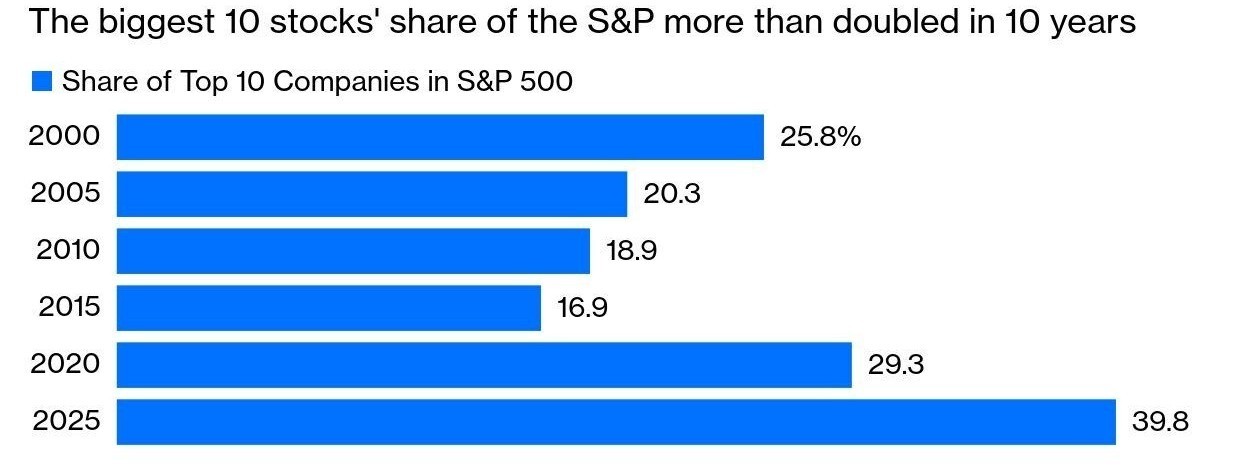
With the ten largest stocks now representing nearly 40% of the index’s market value – up from 30% five years ago, and 25% before the dotcom bubble, investors must ask: is a market-cap weighted tracker still the best vehicle, or is it time to consider the equal-weight alternative?
Source: Bloomberg
The rise of the “Magnificent Seven” – Nvidia, Microsoft, Apple, Amazon, Meta, Alphabet, and Tesla – has reshaped the S&P 500.
These seven stocks alone now account for over 34% of the index’s market value. Their dominance means that a market-cap weighted ETF, such as SPY or IVV, is heavily exposed to just a handful of companies. In fact, five stocks now represent 28% of the index, despite comprising only 1% of its constituents. This is reflected in the table below.

Source: Bloomberg
This creates a paradox: passive investors seeking diversification are, in effect, making a concentrated bet on a narrow slice of the market. A 5% move in Nvidia, for example, has eight times the impact on the index as a 5% move in Visa or Eli Lilly.
Equal-weighting spreads risk more evenly. While this can dilute the impact of high-flyers, it also cushions against sharp declines in any single stock or sector. For long-term investors concerned about systemic risk or sector bubbles, this broader diversification is a strategic advantage.
Other factors
ADVERTISEMENT:
CONTINUE READING BELOW
The choice between concentration risk and diversification is perhaps the most important factor to consider when choosing between market-cap and equal-weight ETFs. However, there are several other factors to take into account, as summarised in the table below.
| Factor | Market-cap ETF | Equal-weight ETF |
| Rebalancing and turnover – Cost considerations
|
Market-cap weighted ETFs are self-rebalancing: as stock prices change, so do their weights. Market-cap weighted ETFs often have lower fees due to their scale and simplicity. | Equal-weight ETFs require regular rebalancing to maintain equal allocations. This introduces higher turnover and, consequently, higher transaction costs.
|
| Factor exposure: Value, size, and volatility
|
Market-cap weighted ETFs lean into momentum and growth factors, especially in recent years as tech has dominated. This can lead to smoother performance in bull markets but may underperform in rotations toward value or cyclicals.
|
Equal-weight ETFs inherently tilt toward smaller-cap and value stocks. This gives them greater exposure to the “size” and “value” factors, which have historically delivered excess returns over long horizons. But this means higher volatility and drawdown risk during market stress.
|
| Sector impacts and economic sensitivity
|
Market-cap ETFs benefit during sector-led rallies as we have seen with tech. | Equal-weight ETFs tend to have more balanced sector exposure. This reduces sector-specific risk and aligns better with diversified macroeconomic themes.
|
Strategic use cases
So, which is better? The answer depends on your investment philosophy and market outlook.
- Market-cap weighted ETFs are ideal for passive investors seeking low-cost, broad exposure with minimal tracking error. They’re efficient and well-suited for long-term core holdings.
- Equal-weight ETFs appeal to those who believe in mean reversion, value investing, or want to hedge against concentration risk. They’re particularly useful for tactical allocations or as complements to a broader portfolio.
Final thoughts
Choosing between market-cap and equal-weight S&P 500 ETFs isn’t just a technical decision, it’s a reflection of your investment beliefs. Do you trust the market to allocate capital efficiently, or do you believe in the power of reversion and diversification? Are you chasing momentum, or seeking resilience?
Both strategies have merit. The key is understanding their mechanics, trade-offs, and how they fit into your broader portfolio goals. In a world where passive investing is becoming increasingly nuanced, even subtle choices – like index weighting – can have a meaningful impact on long-term outcomes.