

ETF investing has become a staple of portfolios around the world. At the end of September 2026, there was approximately $23.9 trillion invested in exchange-traded funds, or ETFs. This was up 20.7% from the previous year.
Net inflows, the amount of new money invested into ETFs over this time, were estimated to be $2.24 trillion.
Every year, more and more ETFs are launched with wide-ranging approaches.
There’s no question that since the first ETF was launched in Canada in 1990, soon followed by the State Street SPDR S&P 500 ETF Trust, the first US-listed ETF, in 1993, the vehicle has become a popular asset class for investors.
In the three decades since more than 14,000 ETFs have been created around the world.
So, how do you navigate the growing options? Well, our ETF analysis reports are a good place to start.
But not all ETFs are made equal, and some are more equal than they may seem. We’ll take you through some of the key considerations investors should consider when looking to invest in ETFs.
But first, let’s catch up with the latest news.
What happened in markets this week?
👮 CrowdStrike agrees to buy Zscaler in US$44 billion all-stock deal (AP)
- What happened: Cybersecurity company CrowdStrike is set to acquire cloud technology business, Zscaler, for $44 billion in an all-stock deal.
- How it impacts investors: The acquisition between two companies that have a large footprint in cybersecurity comes at a time when AI and geopolitical conflict are leading to a rising number of high-profile hacks. The deal will create a new giant in the industry but the all-stock deal could lead to dilution.
- Next steps: In an all-stock deal, the value of Zscaler shares becomes linked to CrowdStrike’s share price. Check where CrowdStrike trades against its fair value.
🔎 McKinsey sees challenges ahead for policymakers and central bankers (McKinsey)
- What happened: Powerful consultancy firm McKinsey, in its recent Global Economics Intelligence report, discusses how energy price surges, ongoing geopolitical tensions, and rising bond yields are shaping global policy decisions
- How it impacts investors: Interest rates and other macroeconomic variables play an important role in economic growth, consumer and market sentiment, as well as asset valuation. McKinsey’s observations could point to where future decisions regarding these metrics might head.
- Next steps: McKinsey flagged doubts over the debt-funded AI boom. Here are 25 strong businesses away from the AI trade.
🩸 Sanofi launches biggest pharmaceutical deal in three years (Yahoo Finance)
- What happened: French pharmaceutical giant, Sanofi, has agreed to acquire U.S. drugmaker, Insmed, for approximately $41 billion in cash, representing around $175 per share and a premium of 46% to Insmed’s closing price.
- How it impacts investors: This is another deal for Sanofi, which is looking for new sources of growth. The deal brings in established and experimental drugs being developed for serious lung diseases.
- Next steps: Sanofi needs growth beyond its biggest drug. See how fast analysts expect its earnings to grow.
🤖 Nvidia brings back Jensen Huang a week after his resignation (Reuters)
- What happened: After news of relationships with other Nvidia employees (and Alice Huang), Nvidia co-founder and CEO Jensen Huang had stood down from his post. That was until President Donald Trump contacted the board to tell them that there are no national security concerns, leading to Huang being rehired as CEO.
- How it impacts investors: The exit of Huang led to a significant fall in Nvidia’s share price, and his return saw Nvidia’s share price rise. It does, however, raise questions of succession.
- Next steps: The board’s investigation isn’t finished yet. Add Nvidia to your Watchlist to see what it finds.
💲 Fed’s Williams says inflation points to tighter policy, not cuts (Reuters)
- What happened: The president of the New York Federal Reserve said that persistently high inflation continues to point towards tighter monetary policy rather than interest rate cuts.
- How it impacts investors: Interest rates are a core input in the cost of debt, the valuation of assets, and weigh on a country’s ability to grow. Continued high inflation means that not only do things continue to get more expensive, but more pressure is placed on companies.
- Next steps: The Fed meets again on December 8-9. See how US stocks are valued heading in.
How do you assess diversification when investing in ETFs?
The selling point behind ETFs is that they provide investors with easy access to diversified, ready-made, managed portfolios compared to an investor needing to build these portfolios themselves.
Now, for years, investors have been told that diversification is a good thing, allowing them to minimize the impact of company-specific factors on a portfolio.
As such, it’s easy to believe that the more the merrier is not a bad mindset to have. This has led some investors to create a portfolio of ETF holdings, each ETF itself owning as many as a hundred, perhaps more, stocks inside it.
There is nothing necessarily wrong with this approach. But it does lead to the first thing to consider: overlap.
Take the below example.
Using the Simply Wall St ETF comparison tool, we have compared the following three ETFs:
The Vanguard S&P 500 ETF (VOO), which tracks the S&P 500 Index, one of the most popular indices in the world. The Invesco Nasdaq 100 ETF (QQQM), which tracks the 100 largest companies on the Nasdaq exchange. Finally, the iShares Core S&P Total US Stock Market ETF (ITOT), which provides broader US-market exposure across all market cap sizes.
All three aim to provide investors exposure to a diversified, broad range of US-listed stocks.
Below, our comparison tool highlights some of the key figures between the three funds, including management fees and the total number of stocks held in each ETF.
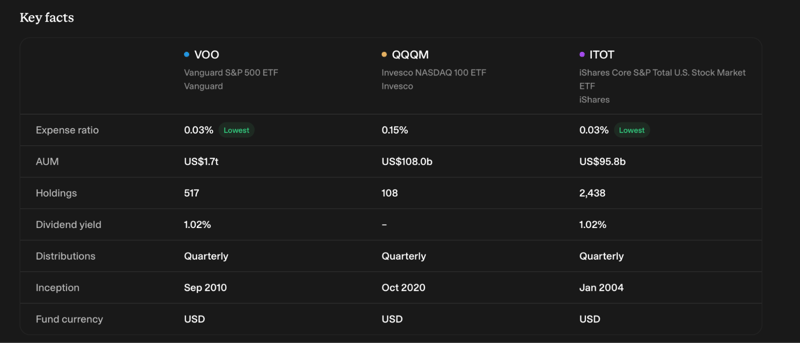
As you can see, each fund has a very different number of total stocks.
An investor who might be interested in diversification might look at the 2,438 companies owned by the iShares ETF as an advantage. But drilling into the actual makeup of the portfolio highlights something worth considering.

As shown above, despite owning around 666 more companies than the Vanguard S&P 500 ETF, around 89% of the portfolio is invested in the exact same way. This means that it is highly correlated with the much smaller S&P 500 ETF, which only owns around 499 companies based on the most recent data.
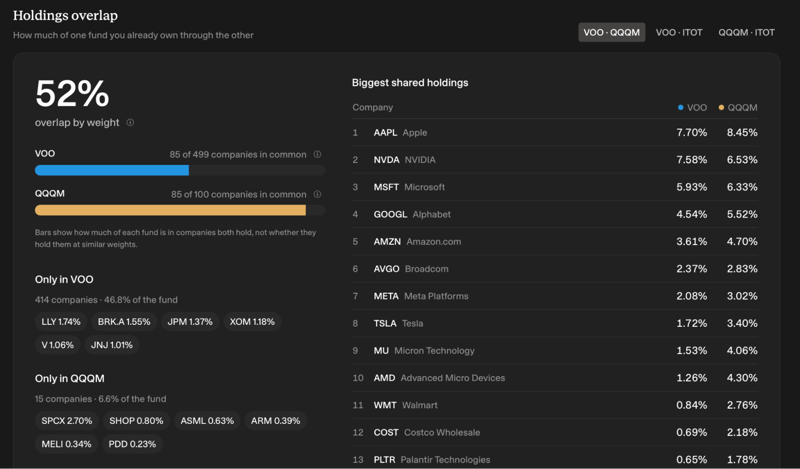
Comparing the Vanguard S&P 500 ETF with the Invesco NASDAQ 100 ETF also highlights this.
Despite the Nasdaq 100 ETF only owning 108 companies compared to the 499 of the S&P 500 ETF, and the Nasdaq 100 being extremely tech-heavy, there is still 52% overlap. This is also very highly concentrated in each fund’s largest holdings, which drive a significant part of the portfolio’s value.
This means that the factors that benefit or hurt one portfolio are still very likely to benefit or hurt the other. Buying both does not give you more diversification; it arguably gives you more exposure to the same companies.
👉 There is a wide universe of ETFs out there. Use our ETF comparison tool to help you analyse what each ETF is giving you and how each ETF might be similar.
Reviewing the risk from correlated holdings
Another question to consider when thinking about diversification is not just what stocks might be shared across ETFs but also the composition of the portfolio in each ETF.
Diversification does not simply mean owning lots of different stocks or other assets. Instead, diversification only works when stocks are uncorrelated with each other. The idea behind this means that the fall in one company’s share price might be offset by the rise of another.
If a company is made up of companies all exposed to the same industry or economic factors, then something that harms one company is likely going to impact the others regardless of how many companies you have inside the portfolio.
The Nasdaq 100 is a perfect case in point.
Below breaks down the sectors and industries that make up the portfolio behind the Invesco Nasdaq 100 ETF.

Almost 60% of the index, and therefore the ETF, are information technology companies and, digging even deeper, around 28% of the portfolio is exposed to the semiconductor industry alone.
Regardless of the implicit level of diversification, if something negative impacts the semiconductor industry, it is highly likely that the portfolio will be hit negatively, meaning that company-specific risk is still significant.
It also means that if you were investing in an ETF like the Nasdaq 100 ETF and wanted to add another ETF, you would possibly want to look for a company with a low exposure to technology.
👉 Wondering how concentrated your own ETF is? See the sector breakdown behind the Nasdaq 100 ETF.
How to decide which ETFs are worth investing in
So far, we have only discussed the diversification element of ETFs, but as is always the case with investments, value also matters.
Typically, an ETF will trade close to the net asset value of its portfolio.
For example, if you multiply the share price of each company by the portfolio weighting and then add it up, you should get a very close total, if not slightly below, the unit price listed on markets.
There is a good reason for this.
Because if an ETF unit price was $80 but the underlying holdings were worth $100, you could in theory make more money by selling the stocks individually. This is one part of the value question.
But there is a flaw in this thinking, as it assumes that the stocks that are in an ETF portfolio are fairly valued. This is not always the case.
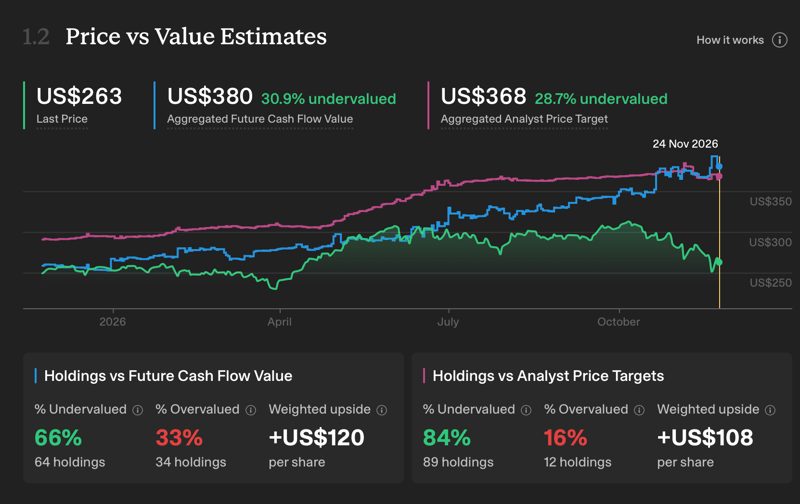
If an ETF is correctly valued at close to its net asset value, but all the stocks that make up that ETF are overvalued, then this does not necessarily mean you are buying at a fair price; you can still be overpaying. The opposite is also true if all the stocks in an ETF portfolio are undervalued.
The above image is taken from the Invesco Nasdaq 100 ETF report. It shows the ‘Price vs Value’ estimate between what the unit price of the ETF is and compares this to an estimated unit value based on a discounted cash flow valuation of each holding or the analyst price targets of those stocks, both adjusted for portfolio weighting.
This can help identify if you are buying an ETF at a fair price, wonderful price, or poor price.
As Warren Buffett said, “price is what you pay, value is what you get”, regardless of whether it is an ETF or direct stocks, the aim is to maximize value.
👉 Price is what you pay. Find your ETF among more than 5,000 funds, then check its price vs value.
The insight: An ETF investing checklist
So, how to approach investing in an ETF?
There are some logical steps that, when followed, will help you avoid some pitfalls that other investors in ETFs can make, which is aided by the Simply Wall St platform.
Step 1: Look at the top holdings
Although an ETF might be made up of as many as 1,000 stocks, it will usually be dominated by its top holdings.
For example, around 37% of the S&P 500 is concentrated in its ten largest holdings. For the Nasdaq 100, this is more like 46.5%. Either way, a large driver of the portfolio value will be these companies, so you should be familiar with what they are.
Step 2: Check the overlap with your existing portfolio, including any ETF or fund you own
To truly benefit from diversification, you need to ensure that your portfolio isn’t all pointed in the same direction.
If the major holdings of an ETF already make up a considerable percentage of your portfolio, including being major holdings in ETFs you already own, If they are, you are not adding to your portfolio; you are just increasing the bet on existing companies.
Step 3: Check the value, not just the price
Of course, you should check that the unit price of the ETF’s net asset value. Usually this will be the case.
But as we discussed, this is only part of the equation. If a share price of a company can be significantly above or below its intrinsic value, and an ETF is a portfolio of companies, it is possible that the current price of the ETF could be significantly above or below the intrinsic value of the portfolio.
Step 4: Know the rules
It is also important to understand how the ETF is structured. Some ETFs can include things like leveraged exposure to companies, essentially magnifying your bet on the movement in share prices, inverse bets on companies or industries, short selling, or even just specific rules like the level of volatility required to make it into a portfolio and the themes that a company needs to fit into.
Investing is not just a case of whether something is cheap or expensive. It is important to know what you are actually investing in.
Step 5: Compare fees
Let’s assume you are looking at two different ETFs by reputable providers, both of which are the same portfolio, as they track, for example, the S&P 500.
The only difference is that one offers a management fee of 0.3% and another 0.6%.
How do you decide? Is the other one able to charge 0.3% more because it is better? If it simply follows an index, most likely not. Fees can have a significant impact on investment returns, and in many cases, such as passive ETFs which track indexes, finding a reputable low-fee provider should be an important factor.
Key events next week:
Monday
- 🇨🇦 Canada GDP growth rate
- 📈 Forecast: 1.5%, Previous: 3.3%
- ➡️ Why it matters: A sharp slowdown could suggest Canada’s economy is losing momentum, potentially giving the Bank of Canada a reason to consider interest rate cuts, while also weighing on the Canadian dollar.
- 🇩🇪 German inflation rate
- 📈 Forecast: 3.0%, Previous: 2.8%
- ➡️ Why it matters: As Europe’s largest economy, German inflation can offer an early indication of broader price pressure across the EU. A further increase could complicate the EU Central Bank’s efforts to bring inflation under control.
- 🇮🇳 Indian GDP growth rate
- 📈 Forecast: 7.5%, Previous: 7.8%
- ➡️ Why it matters: India remains one of the world’s fastest-growing economies. The reading will offer a fresh indication of whether domestic demand and business activity are holding up, with implications for investor confidence in Indian equities.
Tuesday
- 🇪🇺 EU inflation rate YoY Flash
- 📈 Forecast: 4.3%, Previous: 4%
- ➡️ Why it matters: The EU Flash inflation rate provides an early preliminary annual percentage change in consumer prices. The rate moving further above the 2% target could sway how the EU Central Bank thinks about interest rates.
Wednesday
- 🇺🇸 JOLTS job openings
- 📈 Forecast: 7.3m, Previous: 7.523m
- ➡️ Why it matters: Job openings provide an indication of how much demand there is for workers in the U.S. A further decline would suggest the labour market is cooling.
- 🇦🇺 Australian GDP growth rate
- 📈 Forecast: 0.5%, Previous: 0.4%
- ➡️ Why it matters: The Reserve Bank of Australia recently increased interest rates again. This is likely to put pressure on economic activity. This reading could show if previous interest rate rises are starting to do just that.
Friday
- 🇺🇸 US unemployment rate
- 📈 Forecast: 4.2%, Previous: 4.1%
- ➡️ Why it matters: A rising unemployment rate could signal that the U.S. labour market is weakening, strengthening the case for interest rate cuts, but also highlighting potential weakness in the economy.
- 🇺🇸 US non-farm payrolls
- 📈 Forecast: 82.0k, Previous: 165k
- ➡️ Why it matters: Monthly job creation is one of the most closely watched indicators of U.S. economic health. A sharp slowdown could raise some concerns about economic growth.
- 🇨🇦 Canada unemployment rate
- 📈 Forecast: N/a, Previous: 6.7%
- ➡️ Why it matters: Canada’s labour market will provide another indication of how much momentum remains in the economy and be another input in how the Canadian Central Bank is thinking about interest rates.
On top of these macroeconomic announcements, some of the individual companies that will be reporting earnings next week include technology companies like CrowdStrike (CRWD), MongoDB (MDB), Salesforce (CRM) and Veeva Systems (VEEV), as well as retail businesses like Ulta Beauty (ULTA), amongst others.
👉 Have an opinion on these earnings results or how economic news might impact a listed company? Share your thoughts with the Simply Wall St Community.
Have feedback on this article? Concerned about the content? Get in touch with us directly. Alternatively, email editorial-team@simplywallst.com