
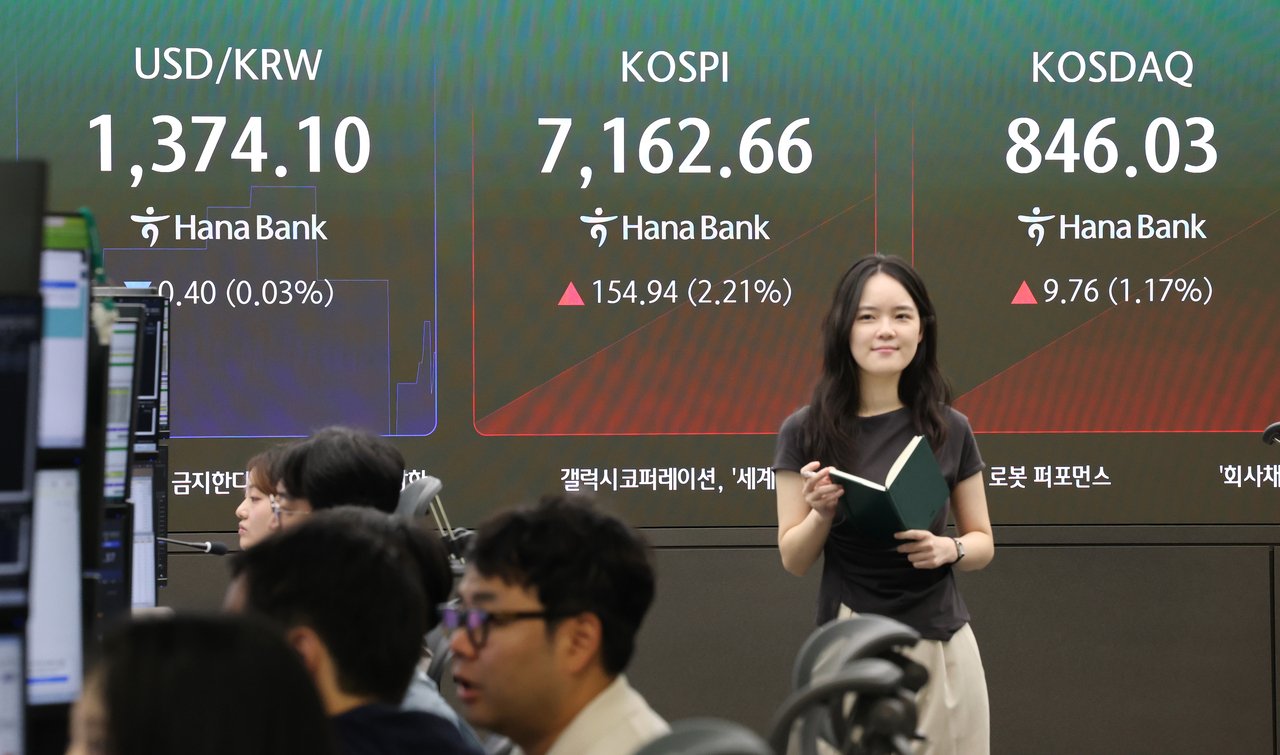
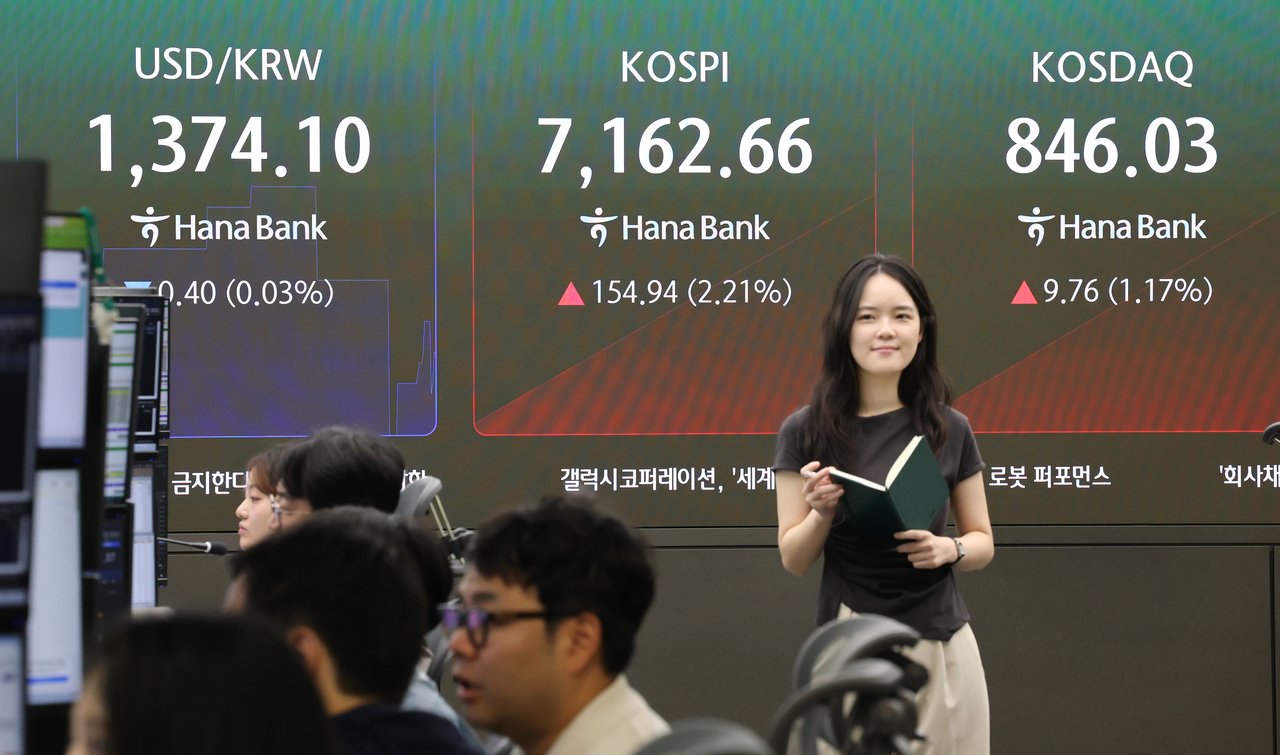
As of 9:01 a.m. Tuesday, the Kospi was up 153.89 points, or 2.20%, at 7,161.61, while the Kosdaq had risen 9.98 points, or 1.19%, to 846.25.
Kosdaq active ETFs have outperformed both the Kosdaq index and major thematic ETFs over the past month. With the Kosdaq largely range-bound, share price divergence among individual semiconductor materials, parts and equipment stocks has put a spotlight on the stock-selection and weighting capabilities that define active ETFs.
According to Koscom ETF Check data released Tuesday, the DS Kosdaq Active ETF posted the highest one-month return among all domestically listed ETFs at 20.46%. The TIGER Kosdaq Active and PLUS Kosdaq 150 Active ETFs also gained 13.48% and 12.03%, respectively. Five of the six active ETFs investing broadly in the Kosdaq delivered returns of more than 10%.
While the Kosdaq index itself rose just 4.28% over the same period, the vast majority of Kosdaq active ETFs far exceeded that gain. Strength in semiconductor materials, parts and equipment stocks provided a common tailwind, but divergent performance within the sector meant that which stocks a fund held — and how much weight it assigned them — made all the difference.
A look at the holdings of leading products reveals notable differences in the degree of concentration in IT and semiconductor stocks. Of the roughly 40 holdings in the DS Kosdaq Active ETF, excluding won-denominated cash, 37 are IT-related names such as semiconductor, equipment and electronic components stocks. The TIGER Kosdaq Active ETF, by contrast, holds about 70 stocks, of which 44 are IT-related, reflecting broader diversification than DS. Even within the same Kosdaq active ETF category, the degree of concentration in specific sectors and stocks varies considerably.
Even among the same semiconductor materials, parts and equipment stocks, price movements diverged sharply. Among DS Kosdaq Active’s holdings, Semcns surged about 40% since July 14, EO Technics rose about 27% and ISC climbed about 24%, while Tes fell about 26%. The fund adjusted its weightings accordingly: Semcns was raised from 3.4% to 8.4% and Simtech from 4.1% to 7.8%, while Tes was trimmed from 8.5% to around 3%.
The weak performance of biotech-focused Kosdaq active ETFs illustrated that active management alone cannot overcome sector-wide headwinds. The ACE Bio Kosdaq Active ETF posted a one-month return of minus 13.92%, a period during which the Kosdaq pharmaceutical sector fell more than 14%.
Industry analysts say the degree of exposure to IT and semiconductor materials, parts and equipment stocks — the market’s recent outperformers — was the key driver of performance differences across products.
Ha Jae-seok, a researcher at NH Investment & Securities, said the DS Kosdaq Active ETF “invests in semiconductor materials, parts and equipment stocks at in effect a 100% weighting, making it the most concentrated product among the major Kosdaq active ETFs.” He added that Kosdaq active ETFs as a category carry higher weightings in IT and industrials and lower weightings in healthcare and biotech than passive ETFs tracking the Kosdaq 150, giving them a differentiated profile.
Ha said the Kosdaq has a relatively high proportion of companies with weak fundamentals, including loss-making firms, making earnings-driven share price divergence more likely. “Particularly in the IT sector centered on semiconductor materials, parts and equipment, earnings momentum stands out compared with other sectors,” he said, adding that active ETFs may prove more effective than passive ones for investing in the Kosdaq.

kacew@heraldcorp.com
This content was produced with the assistance of AI translation services.