

Last time, we compared how to buy Philippine stocks from Japanese and local securities companies.
I started investing in Philippine stocks in 2019 and still use the local brokerage AB Capital Securities today.
As of September 2026, you can trade common stocks, preferred stocks, REITs, and ETFs on the PSE. Since market prices fluctuate for all of them and some products offer dividends, these four products can be difficult to distinguish by name alone.
Even if they look similar, the four differ in terms of ‘what you own.’ The mechanisms for generating profit and the documents you need to read first also differ.
Before memorizing stock names or tickers, let’s first learn to distinguish their contents.
▍Four products listed in the same account
At first, it is enough to understand the following differences:
-
Common stocks: Stocks that focus on a company’s business and growth
-
Preferred stocks: Stocks with special conditions regarding dividends and liquidation treatment
-
REITs (Real Estate Investment Trusts): Stocks of REIT companies that own income-generating real estate
-
ETFs (Exchange Traded Funds): Products that hold multiple securities collectively and track a specific index
The fact that they look similar is the first stumbling block.
Common stocks and preferred stocks are similar in that you are investing in a single company. However, the rights held by shareholders and the conditions for dividends are not necessarily the same.
REITs are also company stocks, but their core profit comes from rent or facility usage fees earned from the real estate they own. With ETFs, you look at the entire portfolio of assets rather than the business of a single company.
First, let’s look at common stocks and preferred stocks issued by the same company.
▍Even for the same company, common stocks and preferred stocks are different things
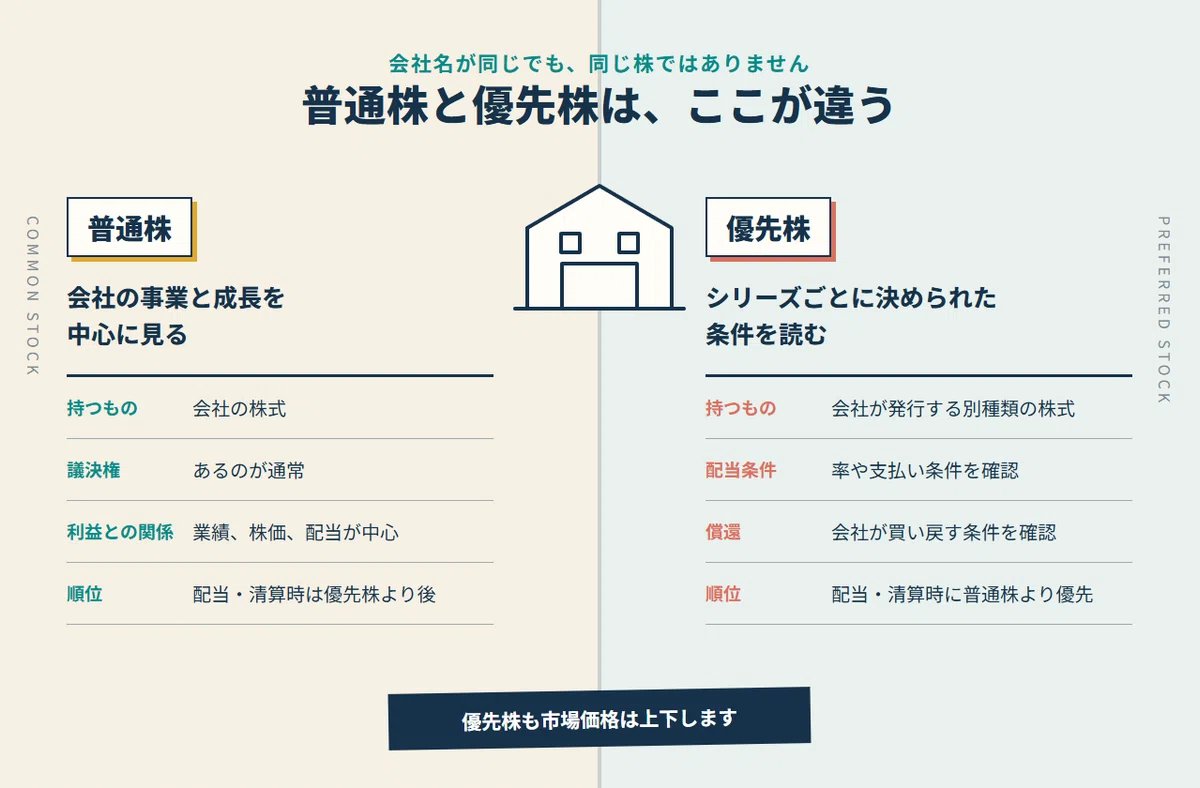
Even if common stocks and preferred stocks of the same company appear in your securities account, the details you need to check are different.
For common stocks, the focus is on what the company does and how much profit it is making. If the business grows and the stock price rises, it leads to capital gains, and if the company decides to pay dividends, shareholders receive them.
Usually, there are also voting rights at the general meeting of shareholders. This is the right to vote on important company decisions. In terms of dividends or distribution during company liquidation, they rank lower than preferred stocks.
You cannot grasp the contents of preferred stocks by the company name alone. Even if issued by the same company, dividend rates, interest rate adjustments, redemption conditions, and liquidation priorities differ by series. Even in series where voting rights are restricted, voting rights remain for major matters such as company mergers or dissolutions.
The term “preferred” here refers to the priority regarding dividends and liquidation as defined in the issuance terms. Since market prices fluctuate, there is no guarantee that your overall profit or loss, including capital losses, will be positive even if you receive dividends.
I have personally experienced a significant drop in the value of stocks I held for their high dividends. Even with preferred stocks, you must look at dividend conditions and market prices separately.
Start by checking the company name, the series name of the preferred stock, and an overview of the dividend conditions. If you want to research it in detail as a potential purchase, proceed to the latest prospectus and issuance terms.
▍The “90%” of REITs and the “Index” of ETFs
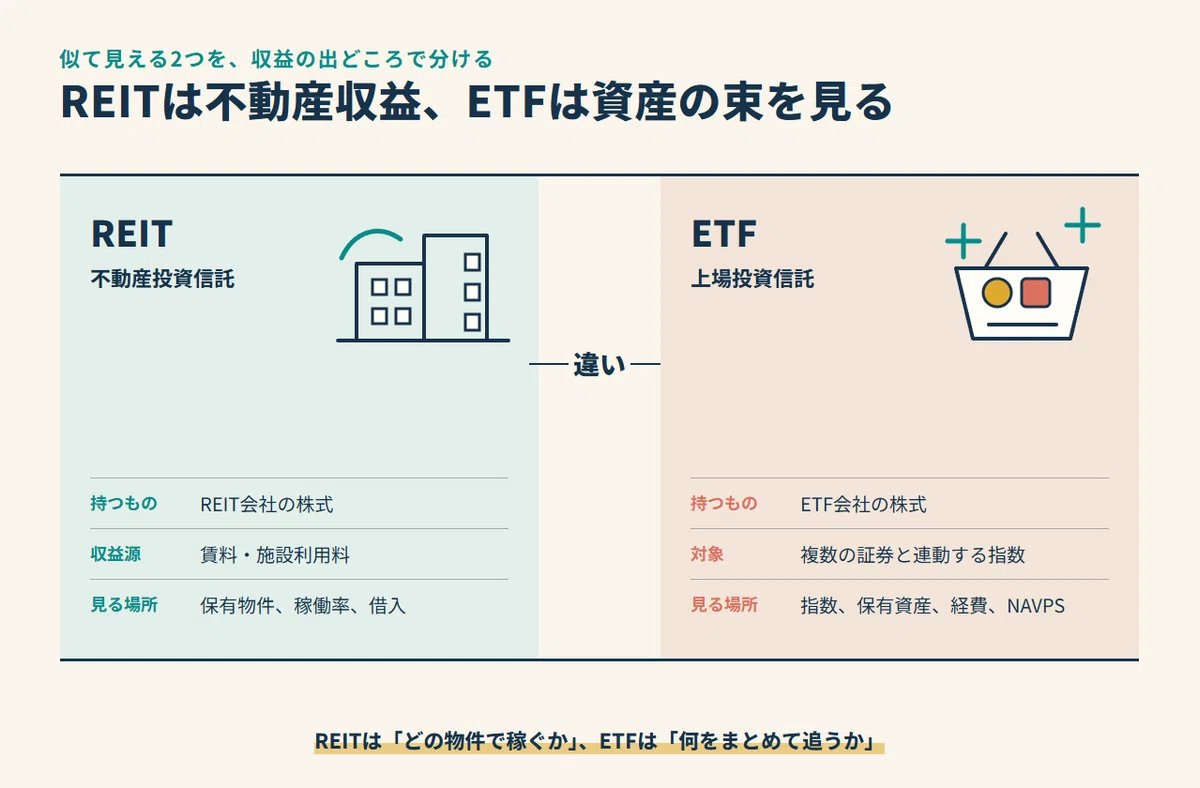
A figure that is easy to notice in REIT explanations is “90%.” Distributable income is the profit that will be allocated to dividends for shareholders in that year.
If a Philippine REIT generates distributable income, it distributes at least 90% of its annual distributable income to shareholders.
What investors hold is not a room in a building, but shares of the REIT company. Both the way earnings are received and the rights involved differ from owning property directly.
An investor’s yield changes based on the relationship between the actual dividend amount and the price at which the stock was purchased.
Occupancy rates of held properties falling, contract terms changing, or debt burdens increasing—these changes affect the distributable profit. When buying shares of a REIT company, you are looking at more than just the name of the building.
ETFs incorporate multiple stocks and aim for price movements close to a specific index. Currently, what investors hold in ETFs tradable on the PSE are not the shares of the individual companies that make up the index, but shares of the ETF company.
An index is a benchmark that summarizes the price movements of multiple stocks.
Apart from the market price traded on the exchange, there is a Net Asset Value Per Share (NAVPS) calculated from the assets held. Differences arise between market price and NAVPS, and between the movements of the ETF and the index, due to operating expenses, cash holdings, and dividend processing.
▍Check the category first, then look at detailed documents
Beginners do not need to read prospectuses or annual reports from start to finish right away. First, look at the stock name and company name in your brokerage account to confirm which category it belongs to.
For common stocks, start by grasping the nature of the business from company information. Proceed to financial statements and annual reports at the stage where you are researching it in detail as a potential purchase.
For preferred stocks, check the series name in addition to the company name. If you want to check dividend rates, interest rate reviews, treatment of unpaid dividends, and redemption timing, open the prospectus and issuance terms. “Redemption,” where the company buys back shares under certain conditions, varies in existence and timing depending on the series.
For REITs, look at the REIT company name and its main properties first. For ETFs, the fund name and the linked index are the entry point. When researching further from there, proceed to disclosure documents containing occupancy rates and debt for REITs, and to prospectuses or operational materials containing held assets, expenses, and NAVPS for ETFs.
You can separate the stage of just wanting to know the category from the stage of researching in detail as a potential purchase. When proceeding to the latter, use the latest official documents.
Even if they are listed in the same account, the figures to compare change if the product category changes.
The category is the starting point for your research. Checking this before looking at prices or yields will help you narrow down the information you need to look at next.
Next time, we will cover how brand names, listed company names, and tickers are linked on the screen.