

Income investors, particularly those who hold bonds, may feel like they are looking for yield in all the wrong places. Rising yields on government bonds have made headlines over the past several weeks. That only happens when there is a perceived problem.
The bond market’s rumbling has had a ripple effect across a range of income-producing assets. Rising yields for one type of bond, particularly for bonds with higher credit quality, can create competition for other income-producing assets.
Exchange-traded funds (ETFs) serve as a reasonable proxy to demonstrate what is occurring. The two charts included in this week’s commentary use the following ETFs, which are among the largest in their respective groups.
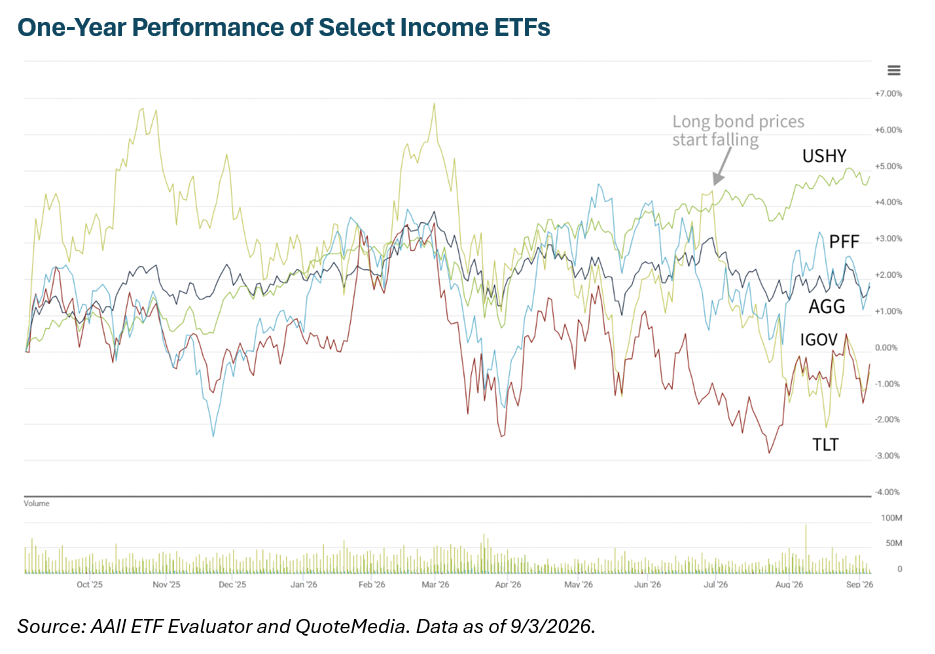
The returns of all five ETFs have overlapped during the past 12 months. The note toward the right side of the chart flags the point when iShares 20+ Year Treasury Bond set a short-term top before dropping in price. It is also when yields on the 20- and 30-year Treasury bonds rose back above 5%. Since bond prices fall when yields rise, the net asset value (NAV) of these funds has decreased.
The comparative outperformance of iShares Broad USD High Yield Corporate Bond is likely due to its short effective duration of 2.98 years. Duration indicates a bond or bond portfolio’s sensitivity to interest rate moves. The fund’s duration indicates that investors should anticipate an approximate 3% change in its price for every one percentage point move in interest rates.
iShares 20+ Year Treasury Bond has an effective duration of 15.04 years. As such, it should be expected to incur an approximate 15% change in its price for every 1% move in interest rates.
I included iShares Preferred and Income Securities in the chart above because preferred stocks tend to trade more like bonds than like stocks. Furthermore, the rise in long-term bond yields has caused preferred stock prices to fall.
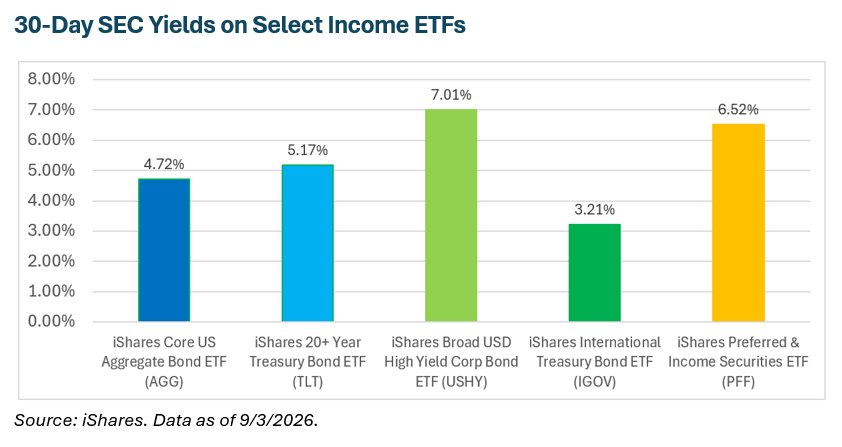
I used 30-day SEC yields in the chart above to provide an up-to-date representation of what these funds are paying. This yield reflects the interest earned during the most recent 30-day period after expenses have been deducted.
iShares Broad USD High Yield Corporate Bond has the highest yield. This is due to the higher credit risk it incurs. Investors demand higher yields from the bonds the ETF invests in as compensation for the increased risk of default.
Concerns about fiscal deficits are being cited as one of the primary reasons why yields on developed-country sovereign bonds have risen. Though deficits present long-term risks, sovereign issuers can expand the money supply. Companies do not have this option.
Preferred stocks mostly pay fixed dividends. This results in a bond-like return characteristic even though these securities represent equity ownership in a company. The lack of dividend growth leads to comparisons with bonds by income investors.
While fiscal debts, inflation, the ongoing Iran war, issuances of new bonds to fund the construction of data centers and new Federal Reserve chair Kevin Warsh are all being cited as reasons for the yields on U.S. Treasury bonds rising this summer, there has not been a single clear catalyst. The bond market can suddenly start rumbling just like the stock market can. When either does so, commentators and strategists start looking for things to point their fingers at even though correlation is not the same as causation.
Those of you who hold high-quality individual bonds can look past the current volatility. You have a guaranteed return until the bond matures or is called.
Investors in traditional bond or preferred stock ETFs, mutual funds and closed-end funds will see their returns fluctuate with the bond market. The decision to continue holding onto them is one of allocation. Hold steady if that is what your allocation calls for.
If you are tempted to look for possible bargains, consider whether closed-end funds are a fit. Several preferred stock closed-end funds are trading at discounts to their NAVs. The same may be true for bond funds. If you do decide to hunt for potential investment ideas among income generators, be clear about why you are targeting such securities.
Next Week’s Schedule
The U.S. financial markets and the AAII office will be closed on Monday, September 7, in observance of Labor Day. On behalf of everyone at AAII, have a safe and enjoyable holiday weekend.

Pessimism among individual investors about the short-term outlook for stocks decreased in the latest AAII Sentiment Survey. Meanwhile, optimism and neutral sentiment increased.
Bullish sentiment, expectations that stock prices will rise over the next six months, increased 6.8 percentage points to 39.7%. Bullish sentiment is above its historical average of 37.5% for the first time in seven weeks. Bullish sentiment was last higher on July 16, 2026 (44.9%).
Neutral sentiment, expectations that stock prices will stay essentially unchanged over the next six months, increased 0.1 percentage points to 22.7%. Neutral sentiment is unusually low and is below its historical average of 31.0% for the 26th consecutive week.
Bearish sentiment, expectations that stock prices will fall over the next six months, decreased 6.9 percentage points to 37.6%. Bearish sentiment is above its historical average of 31.5% for the 30th consecutive week.
The bull-bear spread (bullish minus bearish sentiment) increased 13.7 percentage points to 2.2%. The bull-bear spread is below its historical average of 6.5% for the seventh consecutive week.
This week’s special question asked AAII members whether rising long-term Treasury yields have led them to alter their allocations.
Here is how they responded:
-
I’m allocating more to cash or shorter-term bonds: 26.3% -
I’m allocating more to stocks: 6.0% -
I’m allocating more to longer-term bonds: 3.0% -
More than one of the above: 4.5% -
No, they have not: 59.4%