
Close Menu
Fund Focus News
    Facebook X (Twitter) Instagram
    Trending
    • Index Funds vs Active Funds: Which one should you choose
    • Fosun Pharma sells 6% stake in Gland Pharma for ₹2,800 crore; three mutual funds pick up shares
    • Want Rs 1 crore retirement corpus by 50? Monthly SIP you need to make at 30, 35 and 40 years of age
    • Sebi Proposes Net Settlement Of Cash Market Trades For Mutual Funds
    • The Only Account the IRS Never Taxes Going In, Growing, or Coming Out: 3 ETFs That Belong Inside It
    • Sebi proposes net settlement of funds for mutual fund cash market trades
    • Kotak Multi Asset Allocation Fund in Focus as Multi-Asset Strategies Gain Attention Amid Changing Markets
    • SEBI proposes net settlement of funds for mutual fund cash-market trades
    Facebook X (Twitter) Instagram
    Fund Focus News
    • Home
    • Bonds
    • ETFs
    • Funds
    • Investments
    • Mutual Funds
    • Property Investments
    • SIP
    Fund Focus News
    Home»ETFs»These Monthly Dividend ETFs Pay Like Clockwork (Up to 8% Yields)
    ETFs

    These Monthly Dividend ETFs Pay Like Clockwork (Up to 8% Yields)

    February 16, 2026


    Whether you are a beginner or a retiree, generating passive income can be your primary investing goal. No matter where you are in your investment journey, a consistent stream of income can help build wealth. To do this, many prefer to invest in dividend stocks. While they make quarterly payments, there’s never a guarantee that the dividends will continue. If you want to reduce risk and generate a passive source of income, consider exchange-traded funds (ETFs). 

    They are professionally managed funds that invest in hundreds of dividend-paying stocks. Many of these top ETFs pay monthly dividends, generating steady passive income for you. They look for stocks with a steady payout, strong financials, and high yields. Some also generate additional income by selling call options. Here are three well-diversified ETFs that pay monthly dividends like clockwork with a yield up to 8%. 
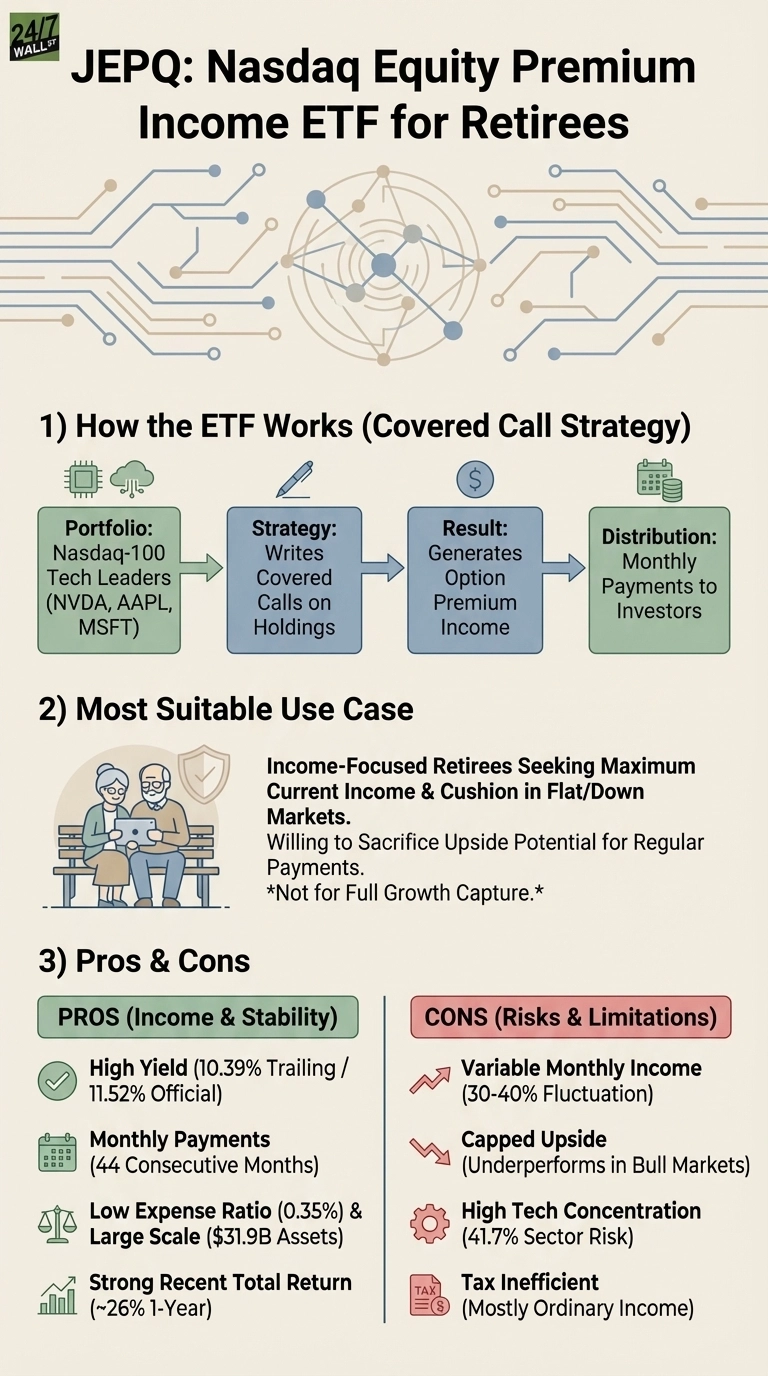
    An infographic titled "JEPQ: Nasdaq Equity Premium Income ETF for Retirees." The top features a blue and brown circuit board pattern. Section 1, "How the ETF Works (Covered Call Strategy)," is a horizontal flow diagram. It starts with a green box "Portfolio: Nasdaq-100 Tech Leaders (NVDA, AAPL, MSFT)," arrow to a blue box "Strategy: Writes Covered Calls on Holdings," arrow to a blue box "Result: Generates Option Premium Income," arrow to a green box "Distribution: Monthly Payments to Investors." Section 2, "Most Suitable Use Case," shows an illustration of two retirees on a bench and text describing "Income-Focused Retirees Seeking Maximum Current Income & Cushion in Flat/Down Markets," "Willing to Sacrifice Upside Potential for Regular Payments," and "*Not for Full Growth Capture*." Section 3, "Pros & Cons," is divided into two columns. The green column, "PROS (Income & Stability)," lists: High Yield (10.39% Trailing / 11.52% Official), Monthly Payments (44 Consecutive Months), Low Expense Ratio (0.35%) & Large Scale ($31.9B Assets), and Strong Recent Total Return (~26% 1-Year). The red column, "CONS (Risks & Limitations)," lists: Variable Monthly Income (30-40% Fluctuation), Capped Upside (Underperforms in Bull Markets), High Tech Concentration (41.7% Sector Risk), and Tax Inefficient (Mostly Ordinary Income).

    24/7 Wall St.

    JPMorgan Equity Premium Income ETF

    The JPMorgan Nasdaq Equity Premium Income ETF (NYSEARCA:JEPQ) is a unique ETF offering an excellent yield of 11.42%. A popular choice amongst dividend investors, the fund generates income by investing in blue-chip stocks and selling options. This unique strategy generates a premium for the ETF, which helps maintain the high yield. 

    It invests in stocks in the Nasdaq 100 index and picks the companies that have low volatility. This helps offer downside protection to the investors. It then sells call options and generates a premium on them. The fund has $32 billion in assets under management. It has generated a 3-year return of 89.11%.


    JEPQ has an expense ratio of 0.35% and pays monthly dividends. It has increased dividends for 3 consecutive years and recently announced a dividend of $0.465 per share. While the yield won’t be consistent month to month, you can count on it being higher than other dividend ETFs.

    The ETF invests in 108 stocks, with the highest concentration in the technology sector at 41%. This is followed by communication services at 12% and consumer discretionary at 10.4%. Since it is a tech-heavy fund, the top 10 holdings are the Magnificent Seven, including Nvidia, Meta Platforms, Amazon, Apple, Alphabet, and Microsoft.

    JEPQ is a solid income vehicle and a king when it comes to dividend ETFs. 
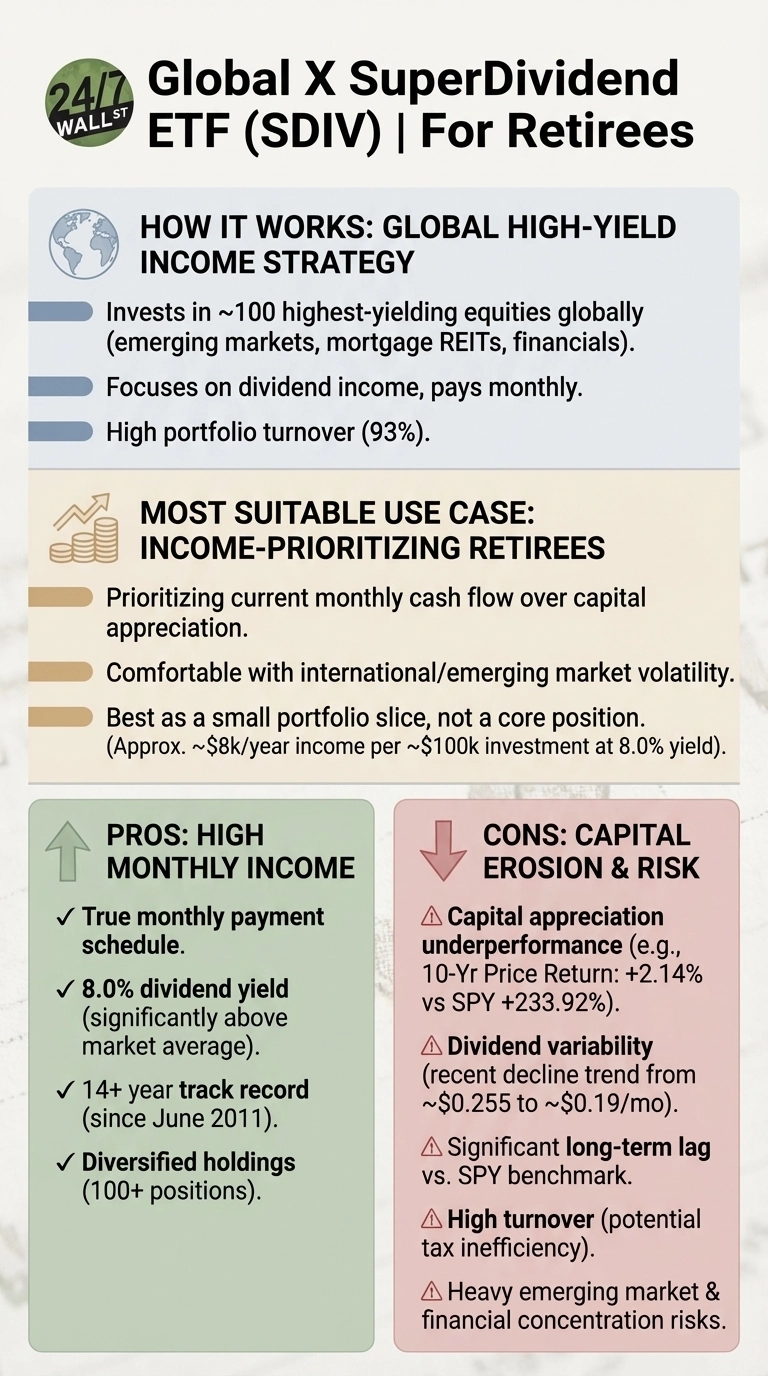
    An infographic titled 'Global X SuperDividend ETF (SDIV) | For Retirees' with a '24/7 WALL ST' logo. It is structured into sections: 'HOW IT WORKS: GLOBAL HIGH-YIELD INCOME STRATEGY' which mentions investing in ~100 highest-yielding global equities, focusing on dividend income, monthly payments, and high 93% turnover. 'MOST SUITABLE USE CASE: INCOME-PRIORITIZING RETIREES' describes prioritizing cash flow, comfort with volatility, and using it as a small portfolio slice (approx. $8k/year income per $100k at 8.0% yield). Below are two contrasting boxes: 'PROS: HIGH MONTHLY INCOME' in green, listing a true monthly payment schedule, 8.0% dividend yield, 14+ year track record, and 100+ diversified holdings. Opposite is 'CONS: CAPITAL EROSION & RISK' in red, detailing capital appreciation underperformance (+2.14% 10-Yr vs SPY +233.92%), dividend variability (decline from $0.255 to $0.19/mo), significant long-term lag vs. SPY, high turnover (tax inefficiency), and heavy emerging market & financial concentration risks.

    24/7 Wall St.

    Global X SuperDividend ETF 

    The Global X SuperDividend ETF (NYSEARCA:SDIV) will give international exposure to your portfolio. The fund invests in 100 of the highest dividend-paying stocks in the global market. SDIV has a yield of 8.88% and selects stocks from the Solactive Global SuperDividend Index. It announced a dividend of $0.19 in January. 

    The fund pays monthly dividends and has paid dividends for 14 straight years. It has an expense ratio of 0.58%. With regard to the sectors, it invests 31% in financials, 17% in the energy sector, and 15% equally in materials and real estate. Country-wise, it has the highest allocation in the United States (28.8%), Brazil (14.2%), and Britain (10.5%). 


    While the fund holds only 106 stocks, no stock has a weightage higher than 2%. It invests in the highest-yielding stocks in the world and doesn’t look at the dividend history or sustainability. 

    SDIV has generated an average annualized return of 28.27% in a year and 11.43% in 3 years. If you’re looking to build a globally diversified portfolio by investing in an industry away from tech, this is the ETF to choose. 

    An investment of $100,000 in the ETF can generate about $8,800 in annual dividends. It prioritizes regular income over capital appreciation and is trading for $25 as of writing. 

    Amplify CWP Enhanced Dividend Income ETF

    An actively managed fund, the Amplify CWP Enhanced Dividend Income ETF (NYSEARCA:DIVO) invests in dividend-paying stocks and writes covered calls on them. It aims to deliver steady monthly income by ensuring low volatility. Ideal for low-risk investors, DIVO has a yield of 4.81%. It has also delivered impressive performance and generated an average annualized return of 15.30% in a year and 14.11% in 3 years. 


    The ETF has an expense ratio of 0.56% and invests in only 40 stocks. It lays emphasis on investing in high-quality large-cap companies that have shown a strong dividend history and earnings growth. It is heavily concentrated on financials (26.98%), technology (16.46%), and consumer discretionary (14.12%). 

    Its top 10 holdings include RTX Corp, Caterpillar Inc., Home Depot, American Express, Apple, Microsoft, Visa, and CME Group. These are companies that have remained strong even during market uncertainties. While DIVO uses a covered call strategy, it doesn’t go all-in on the income component. It holds a part of the portfolio and uses a covered call strategy on just a portion of the portfolio. It allows the fund managers to capture the upside while maintaining security for investors. This helps generate income, maintain dividends, and reduce volatility. 

    DIVO has gained 9.78% in the past year and is exchanging hands for $46.59. 

    If You have $500,000 Saved, Retirement Could Be Closer Than You Think (sponsor)

    Retirement can be daunting, but it doesn’t need to be.

    Imagine having an expert in your corner to help you with your financial goals. Someone to help you determine if you’re ahead, behind, or right on track. With SmartAsset, that’s not just a dream—it’s reality. This free tool connects you with pre-screened financial advisors who work in your best interests. It’s quick, it’s easy, so take the leap today and start planning smarter!

    Don’t waste another minute; get started right here and help your retirement dreams become a retirement reality. (sponsor)


    Source link

    Share. Facebook Twitter Pinterest LinkedIn Tumblr Telegram Email

    Related Posts

    The Only Account the IRS Never Taxes Going In, Growing, or Coming Out: 3 ETFs That Belong Inside It

    September 4, 2026

    Treasury ETFs aren’t bleeding out, they’re reshuffling: what the flows actually tell us

    September 4, 2026

    Wall Street just poured nearly $900 million into Bitcoin and Ethereum ETFs

    September 4, 2026
    Leave A Reply Cancel Reply

    Top Posts

    The Shifting Landscape of Art Investment and the Rise of Accessibility: The London Art Exchange

    September 11, 2023

    Charlie Cobham: The Art Broker Extraordinaire Maximizing Returns for High Net Worth Clients

    February 12, 2024

    Index Funds vs Active Funds: Which one should you choose

    September 5, 2026

    The Unyielding Resilience of the Art Market: A Historical and Contemporary Perspective

    November 19, 2023
    Don't Miss
    Mutual Funds

    Index Funds vs Active Funds: Which one should you choose

    September 5, 2026

    Investing in mutual funds can be a way to build a diversified portfolio, but different…

    Fosun Pharma sells 6% stake in Gland Pharma for ₹2,800 crore; three mutual funds pick up shares

    September 4, 2026

    Want Rs 1 crore retirement corpus by 50? Monthly SIP you need to make at 30, 35 and 40 years of age

    September 4, 2026

    Sebi Proposes Net Settlement Of Cash Market Trades For Mutual Funds

    September 4, 2026
    Stay In Touch
    • Facebook
    • Twitter
    • Pinterest
    • Instagram
    • YouTube
    • Vimeo
    EDITOR'S PICK

    Telangana’s green energy policy attracts significant investments: Bhatti

    March 17, 2025

    Publicly listed markets are ‘losing out on compelling investments’ – London Business News

    July 24, 2025

    Should You Use Your Name, a Trust, or a Company? Here’s What to Consider

    July 24, 2025
    Our Picks

    Index Funds vs Active Funds: Which one should you choose

    September 5, 2026

    Fosun Pharma sells 6% stake in Gland Pharma for ₹2,800 crore; three mutual funds pick up shares

    September 4, 2026

    Want Rs 1 crore retirement corpus by 50? Monthly SIP you need to make at 30, 35 and 40 years of age

    September 4, 2026
    Most Popular

    🔥Juve target Chukwuemeka, Inter raise funds, Elmas bid in play 🤑

    August 20, 2025

    💵 Libra responds after Flamengo takes legal action and ‘freezes’ funds

    September 26, 2025

    ₹9000 monthly SIP can help you retire at 45 with ₹2 lakh monthly pension

    May 5, 2026
    © 2026 Fund Focus News
    • Get In Touch
    • Privacy Policy
    • Terms and Conditions

    Type above and press Enter to search. Press Esc to cancel.