
The first four months of the year have offered a valuable reminder of diversification’s benefits. After years of underperformance from non-US stocks and bonds relative to US growth equities, a reversal in market trends has rewarded investors who stayed the course with a diversified approach even when it tested their patience.
Taking a global approach to equities and relying on high-quality bonds as diversifiers might feel old-fashioned, but it’s a strategy that has proved effective during periods of stress for US stocks, rare though those have been over the past 15 years. Still, investors continue to be drawn to newer, more complex strategies, such as those using options to manage risk.
Defined-outcome exchange-traded funds, for example, drew a net $1.2 billion from April 1 to April 28, as market uncertainty peaked and then began to ease. In fact, defined-outcome ETFs haven’t had a month of net outflows since February 2021, and they now have more than $120 billion in total assets, or about $10 billion more than digital asset ETFs, which include the popular bitcoin funds.
How Defined-Outcome ETFs Work
Defined-outcome ETFs, also known as buffer ETFs, use call and put options to define a range of outcomes over a set period, typically limiting losses while capping gains. This structure appeals to risk-averse investors seeking equity exposure with built-in buffers. For example, iShares Large Cap Moderate Buffer ETF IVVM aims to track S&P 500 returns up to a cap—6% in the second quarter of 2025—while shielding the first 5% of losses. Buffer ETFs may reset monthly, quarterly, semiannually, or annually, and they must be held through the full term to realize their benefits. Investors have done well using these funds, as my colleague Jeffrey Ptak covers here.
Defined-outcome ETFs can help manage risk, but for investors focused on diversification, there may be more effective options. While it may seem like a pedantic distinction, understanding a fund’s role within the broader portfolio is essential to maximizing its benefits. When aiming to improve diversification, the goal should be to either increase expected returns without increasing risk (typically measured by standard deviation) or maintain expected returns while reducing risk.
Buffer ETFs generally cap upside in exchange for downside protection, which can mute return potential over longer periods. And because they tend to be highly correlated with their underlying indexes, often the S&P 500, their ability to enhance diversification by offering differentiated exposure is also limited.
Conservative investors may find comfort in the defined range of outcomes buffer ETFs offer, but when it comes to managing overall portfolio risk, simpler tools like cash can be just as effective and often more straightforward. Ultimately, diversification isn’t just about limiting downside; it’s about making sure every part of the portfolio is pulling its weight.
Morningstar’s recently published 2025 Diversification Landscape report examines portfolio diversification from the perspective of a broad range of asset classes, including other options-based strategies, like covered calls that prioritize income over total returns.
What Are Derivative Income ETFs?
Derivative income strategies sell call options, put options, or both to generate income that is distributed to shareholders. A call option gives the buyer the right to purchase shares at a specific price, and a put option allows the buyer to sell a security at a specified price. Sellers receive a premium for taking the other side of the trade, and that’s what is distributed to shareholders as income. The trade-off for shareholders is that they are giving away potential upside from the equity portfolio.
For example, say a fund owns a stock that’s worth $100. If the managers sell a call option on that stock that’s 2% above the current price (referred to as out-of-the-money) and the stock price rises to $105, the shareholders make the first $2 of additional return, but the remaining $3 of profit goes to the owner of the call option. If the stock doesn’t rise above $102 before the call option expires (typically three months), the fund keeps the premium.
Selling puts is less common because it’s inherently riskier and with limited upside. A put option allows the owner to buy a security at a set price, and the seller is obligated to honor that deal. Selling a $98 put on our previous $100 stock would net a premium, but if the stock were to fall to $50 before the option expires, that’s a loss of $48, less whatever the premium was. Equity-hedged strategies will typically sell call options to be able to fund buying a put option that protects the portfolio from losses beyond a certain threshold.
Options-Based ETFs’ Performance and Diversification Value
Options allow investors to get exposure to a security with less upfront money than buying the security outright. When interest rates are higher, this makes buying a call option more attractive since the remainder of the security’s price can sit in cash, earning interest. Therefore, it’s more lucrative for derivative income strategies to sell call options when rates are higher than lower. That’s helped these strategies generate higher income since 2022, when the Federal Reserve started making a series of interest-rate hikes. However, selling call options limits the upside potential for a stock portfolio, and in a strong bull market, like 2023 and 2024, that will cause these strategies to lag market-cap-weighted benchmarks.

In 2024, the CBOE S&P 500 BuyWrite Index, which replicates selling call options on stocks on the S&P 500, gained 20%, slightly behind the S&P 500’s 25% return. The CBOE S&P 500 PutWrite Index gained 18% (put prices tend to decline when interest rates are high and volatility is low).
Funds in the equity-hedge category will typically sell a call option and use the premiums to fund the purchase of a put option. These “collar” strategies cap the upside of a portfolio as well as its downside. The CBOE S&P 500 95-110 Collar Index replicates selling call options at 110% of the index’s value and buying puts that protect against declines of more than 5%. In 2024, the index gained 21%.
The performance of options-based strategies is directionally similar to the broader stock market (or whichever universe they use as the foundation of the strategy). The rolling three-year correlations of options-based strategies have been consistently high over the long term. Options can help generate income or define a range of outcomes, but over longer periods, their fortunes will follow the underlying asset.
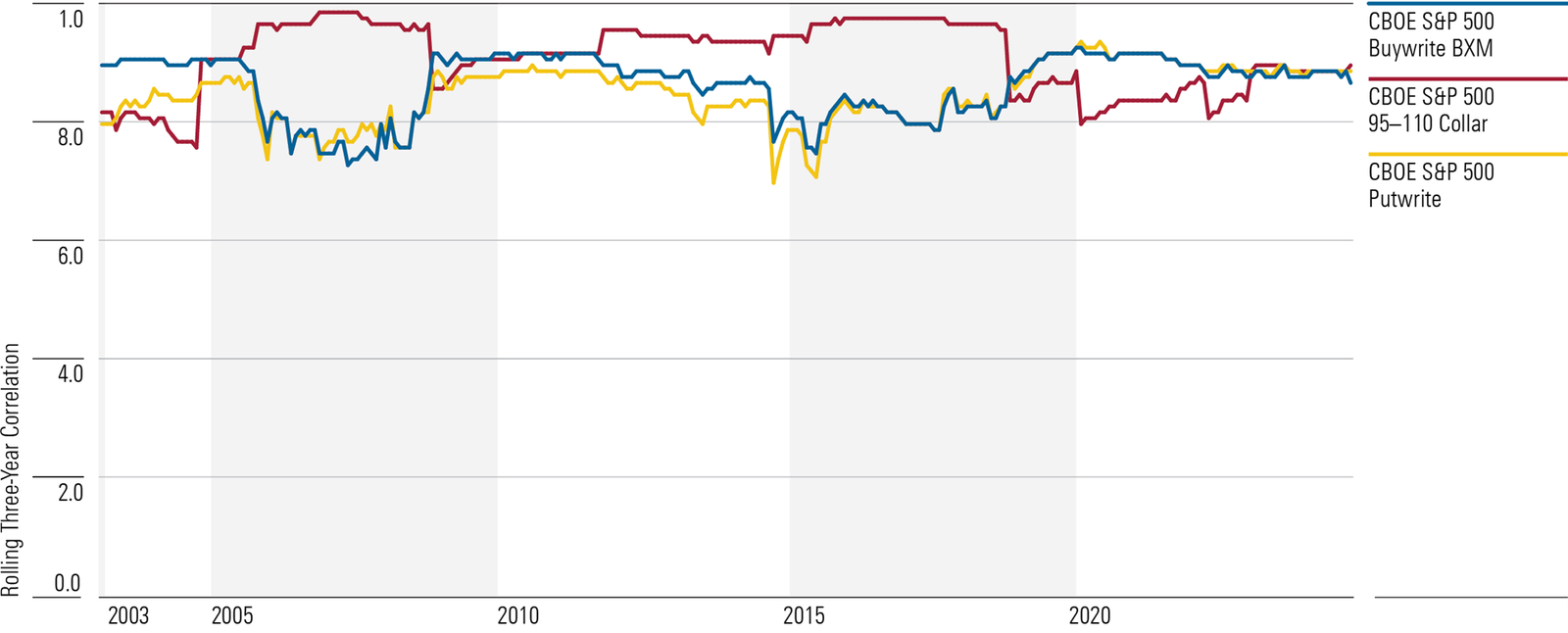
They aren’t perfectly correlated, however. In bull markets, selling call options will generally lead to lower returns, and in bear markets, these strategies may hold up slightly better thanks to the option premium. For an extreme example, investors can look at the global financial crisis. Between 2007 and 2009, the maximum drawdown of the CBOE S&P 500 Buywrite Index declined 35%, while the S&P 500 fell 50%. During the bull market that ranged from March 2009 through the end of 2024, the Buywrite index captured 60% of the S&P 500’s downside and 56% of its upside.
The Role of Defined-Outcome ETFs and Other Options-Based Strategies in an Investment Portfolio
The high correlations exhibited by options-based strategies dull their appeal as a diversifier. Although they do tend to have attractive downside characteristics, those come at the cost of the potential upside from investing in the asset class. Even with high income distributions, derivative income strategies are likely to underperform their underlying asset class over a full market cycle. For income-focused investors, the distributions are taxed as 60% long-term gains and 40% short-term gains. It would be more tax-efficient to focus on total return strategies and sell shares with long-term gains to generate income.