
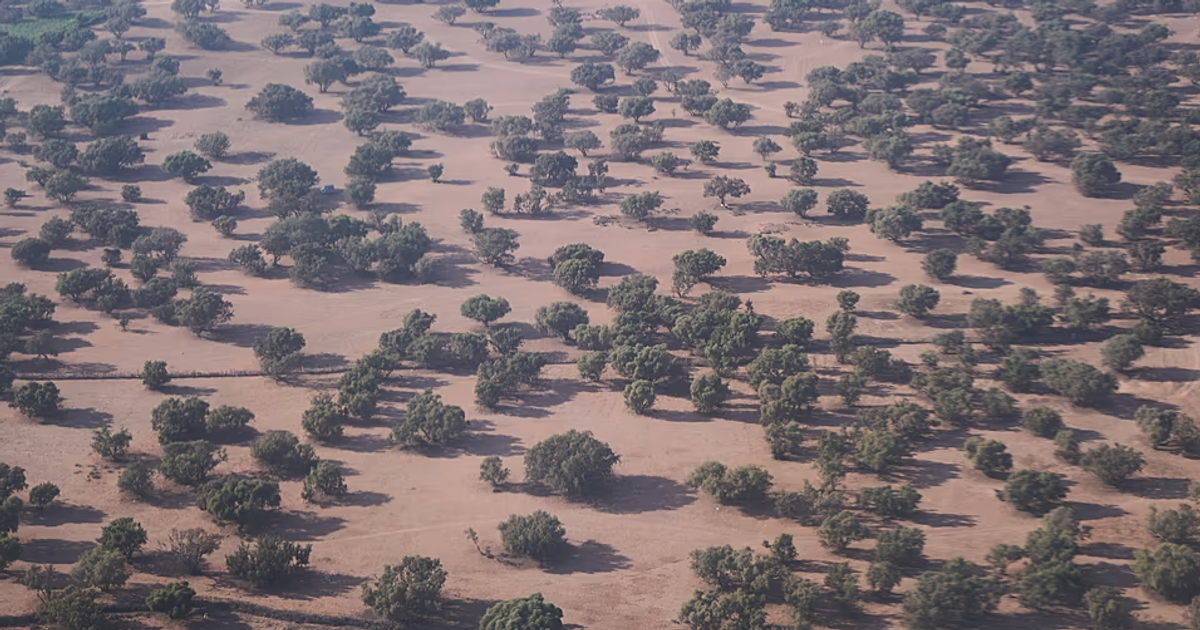
The project will be implemented through a partnership with Morocco’s National Agency for Water and Forests (ANEF), which will provide the technical expertise and local support needed to carry out the programme.
Beyond expanding the country’s argan forests, the initiative is designed to protect an increasingly vulnerable ecosystem from drought and climate change while preserving the natural resources and rural livelihoods supported by the argan industry.
Fighting drought with technology
Under the agreement, Al Mada Foundation will provide the funding, while ANEF will contribute its technical expertise and local knowledge to implement the programme.
One of its key features is the introduction of the Waterbox system, an ecological technology designed to help trees survive in arid environments with limited water resources.
The device collects rainwater, dew and moisture from condensation, gradually releasing the water around the roots while limiting evaporation. The approach is expected to improve the survival and growth of young argan trees while reducing their water requirements.
Protecting a valuable Moroccan industry
The argan tree is native to Morocco and plays an important role in preventing desertification, protecting soil and preserving biodiversity. Its forests also support an important rural economy, particularly through traditional argan oil production, which provides income for many women.
However, the growing global demand for the oil, often described as ‘liquid gold’, is adding to the pressures on an already fragile ecosystem. Once covering more than 14,000 square kilometres, Morocco’s argan forests have lost nearly 40% of their area in recent decades, with recurring droughts and climate change further threatening their survival.
The industry also faces concerns over sustainability and the distribution of its economic benefits.In 2025, some cooperatives raised concerns that harvesting argan fruits before the proper season could damage the trees and compromise oil quality. Workers also say they receive little of the profits from an international market where argan oil prices have surged from about $2.50 to $60 per litre over the past three decades.
Morocco’s argan trade has also faced setbacks in international markets. Exports are projected to reach around 526 tonnes in 2025, down from more than 1,500 tonnes in 2019.
Against this backdrop, the new restoration programme is aimed at reversing the decline of the argan ecosystem, protecting a globally recognised natural resource and sustaining the rural communities whose livelihoods depend on it.