
Unlock the Editor’s Digest for free
Roula Khalaf, Editor of the FT, selects her favourite stories in this weekly newsletter.
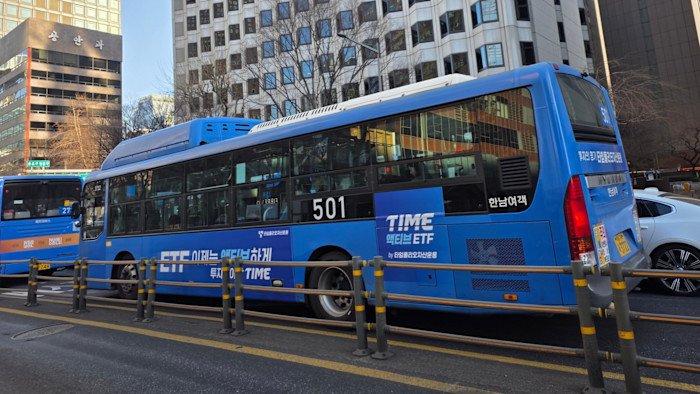
On the bustling streets of Seoul, it is common to see buses with adverts on their sides for exchange traded funds, encouraging people to put their retirement savings into versions of these normally vanilla investment products that are often complex and speculative.
They have a receptive audience. After many missed out on the South Korean stock market’s world-beating 76 per cent rally last year, and with markets powering ahead again, retail traders — commonly known as “ants” — are flocking to these funds, particularly leveraged ones that amplify moves in the prices of the assets they track.
That can mean turbocharged profits — or losses — for investors.
The fast-growing craze for leveraged ETFs is part of a rush by Korea’s citizens, strongly encouraged by the government, into the booming domestic stock market after years of favouring US equities. But some analysts worry that retail investors may not be fully aware of the risks such products involve.
“The market has become speculative,” said Jongmin Shim, Korea equity strategist at CLSA. “Retail investors are driven by fear of missing out, paying less attention to risk management.”
He added that “performance-sensitive mom and pop traders . . . love leveraged ETFs” because they are “pretty aggressive and highly speculative”.
A senior government official said leveraged ETFs were not a cause for concern and that Korean retail investors were familiar with the risks involved as they were used to trading them on markets in the US and Hong Kong.
Retail investors have bought a net Won6.3tn ($4.3bn) of locally listed stocks since the start of 2026, according to Korea Exchange, the country’s securities market operator. In addition, they have pumped Won13tn into Korean ETFs, helping boost the benchmark Kospi by 35 per cent this year and making it one of the world’s best-performing stock market indices for the second year running.
While the share of passive fund assets held in leveraged vehicles is small — they hold just 3.7 per cent of assets in Korean ETFs — they account for almost a fifth of all trading in ETFs on the Korea Exchange this year.
Albert Yong, managing partner at Seoul-based hedge fund Petra Capital Management, says the government has “played a role in the ETF craze”.
Officials have urged retail investors to bring their investments home from overseas exchanges and prioritise domestic stocks over investing in real estate, where a speculative bubble has put house prices beyond the reach of many ordinary Koreans.
In a sign of authorities’ tolerant approach to risky products, the government has said it will authorise leveraged single-stock ETFs tracking blue-chip companies such as Samsung and SK Hynix, in addition to the leveraged index funds available since 2010.
Park Sun-hong, a 45-year-old businessman, is a firm ETF fan. He recently sold half of his holdings in US stocks to invest in the Kodex Leverage ETF, which tracks the Kospi.
“It has gone up much more than expected since I bought it,” he said. “If there is a leveraged Samsung ETF product, I’ll definitely buy it.”
Shim at CLSA said the government’s bid to encourage investment in stocks rather than property appeared to be paying off. His father had recently tried to sell a house in the countryside after the government announced plans to raise taxes on multiple-home owners. But no farmer wanted to buy — any capital they had was tied up in stocks, he said.
The number of individual active stock trading accounts in Korea topped 100mn for the first time last month — the equivalent of roughly two accounts for every member of the population. Deposits held at retail brokerages, reserved for stock purchases, hit a record Won103tn this month, up from Won87tn at the end of last year. Margin balances (the funds investors have borrowed from brokerages to buy stocks) have also surged to a record at Won31.5tn.
President Lee Jae Myung, elected last year partly on a promise to boost the stock market, has focused on corporate governance reforms to tackle the significantly lower valuations of Korean stocks compared with overseas peers. Company directors, for example, now have a legal duty to consider the interests of all shareholders, rather than just the company.
Lee’s administration is also keen to counter the won’s sharp depreciation against the dollar in the second half of last year, partly as a result of the retail craze for US equities. In December it announced plans to give tax breaks to people who sell stocks held overseas and put the proceeds into the domestic market.
Such initiatives are only part of the picture, according to ChaiWon Lee, chair of Seoul-based Life Asset Management, who pointed to “the semiconductor supercycle” and “abundant global liquidity”.
He added: “The biggest reason for the recent retail money move is that Korea’s stock market is now much hotter than the US.”