
September 26, 2025
4 min read
NIH Funds New Autism Studies on Genes and Environment as Trump Focuses on Tylenol
The National Institutes of Health is investing $50 million into research on genetic and environmental factors underlying autism—news that was eclipsed by President Donald Trump’s recent controversial claims about acetaminophen
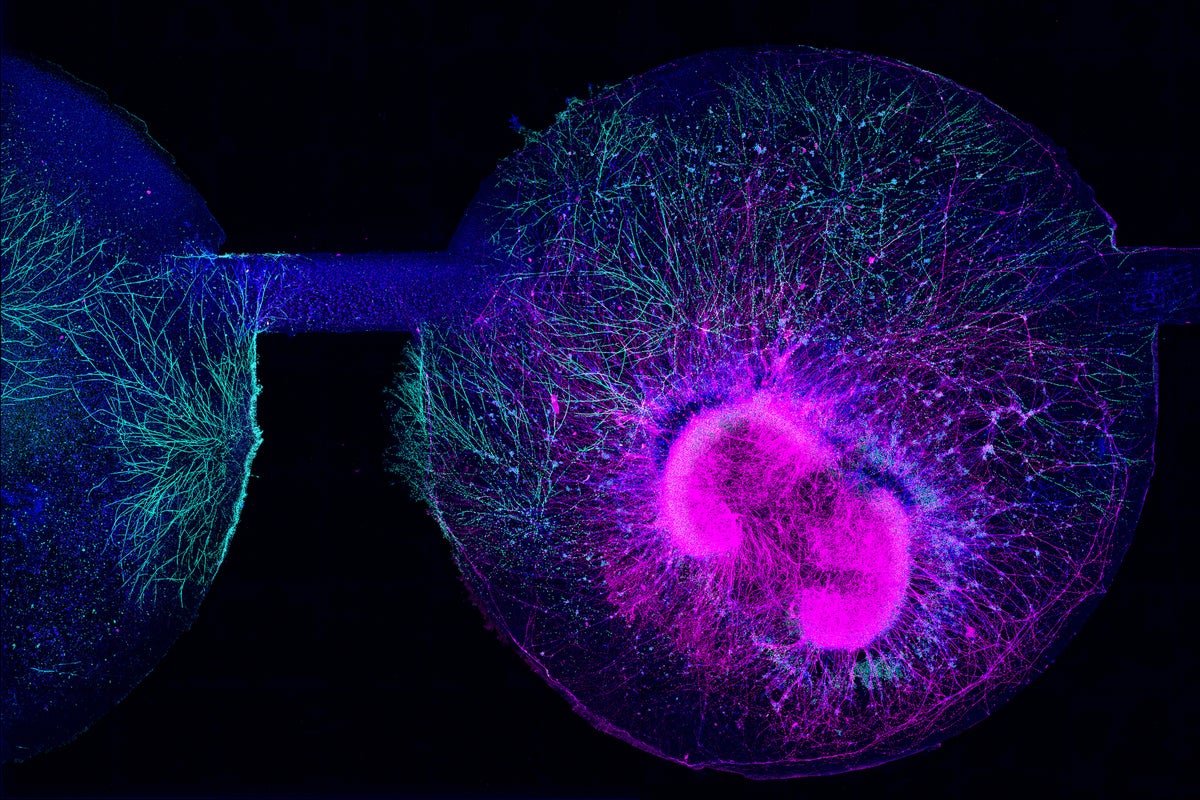
Confocal light micrograph of a synaptic conjugation between three dimensional (3D) human embryonic stem cell (hESC)-derived brain organoids grown on an organ-on-chip (OOC) system. An OOC is a multi-channel 3D microfluidic cell culture. Organoids are miniature, simplified versions of organs grown in the laboratory. These organoids are being grown to study neural tube formation and neuronal development.
Arthur Chien/Science Source
Scientists moved a step closer to understanding the complex causes of autism this week. Although all of the headlines went to US President Donald Trump’s poorly evidenced statements that the painkiller acetaminophen is linked to the neurodevelopmental condition, his White House autism event brought welcome — and largely overlooked — news to scientists: the US National Institutes of Health (NIH) is investing US$50 million in an unusual autism-research effort.
Trump and Jayanta Bhattacharya, director of the NIH, announced on 22 September that 13 research groups will receive funding under the Autism Data Science Initiative (ADSI), a Trump administration programme to fund studies that explore how interacting genetic and environmental factors contribute to autism. “This is where the field needs to be going in searching for the complex causes of autism,” says Helen Tager-Flusberg, who studies autism at Boston University, Massachusetts.
The funded projects range from studies on environmental exposures during pregnancy to experiments on brain cells. Funding was also awarded to efforts to replicate the projects’ results and so ensure that they are robust.
On supporting science journalism
If you’re enjoying this article, consider supporting our award-winning journalism by subscribing. By purchasing a subscription you are helping to ensure the future of impactful stories about the discoveries and ideas shaping our world today.
Researchers, although pleased by the aims of the funded work and the rigour of the methods, have some concerns about the project. Several ADSI-funding recipients say that they are expected to complete their projects relatively quickly — within three years instead of the usual five — and some say that they are alert to political interference with their results. Trump prompted fierce pushback from scientists with his statements about acetaminophen earlier this week, given the lack of convincing evidence to support a link with autism. “We should wait until the research happens before announcing an answer,” says Jason Stein, a neuroscientist at the University of North Carolina, Chapel Hill, who received an ADSI grant.
“This is not political interference, but rather a bold, science-driven effort to deliver meaningful answers more quickly,” said a spokesperson for the US Department of Health and Human Services (HSS), which oversees the NIH.
Quick turnaround
The NIH announced the ADSI in May and invited researchers to submit grant applications for research into the causes of autism, its growing prevalence and potential interventions. Some researchers expressed concern that applicants had only a month to submit proposals — much less time than usual — and it was unclear who was reviewing the grants and with what criteria. Some worried that the funding would be channelled to researching the discredited idea promoted by Trump’s health secretary Robert F. Kennedy Jr that vaccines are linked to autism. “Some people thought: maybe we should steer clear of this,” says Judith Miller, a psychologist who studies autism at the Children’s Hospital of Philadelphia in Pennsylvania.
In the end, nearly 250 research teams applied, and no awards were granted to projects that focus explictly on autism and vaccines.
Several of the projects will involve exposomics: the study of the array of environmental factors to which a person is exposed. Miller is leading a three-year, $4.3-million project combining genome and exposome data to seek factors associated with autism. The project will draw on previously collected data on more than 100,000 children, including about 4,000 autistic children, and connect those to maternal-health records. The research team plans to use information on where participants live to add in data on air quality, access to green spaces and other environmental markers. “We haven’t been able to bring this type of data all together in a clinical population,” before, Miller says.
Replication requirement
Stein and his team, by contrast, are examining autism using brain organoids grown from the stem cells of autistic and non-autistic children. The researchers plan to expose the tissue to substances that epidemiological studies have linked to autism — such as valproic acid, a drug used to treat epilepsy — and examine how this affects gene activity.
The team expects to be asked by the NIH to look at acetaminophen or other substances too, says Joseph Piven, a psychiatrist at University of North Carolina, Chapel Hill, who is also working on the organoid project. “As long as they have some detectable level of epidemiological evidence, I think that’s a valid question to go forward,” he says.
The ADSI is building in replication efforts from the start. Judy Zhong, a population-health scientist at Weill Cornell Medicine in New York City, has received around $5 million from the ADSI for a centre that will require other ADSI-funded investigators to hand over their computer models so that their results can be independently replicated. “It is very unusual,” Zhong says.
Collaborative approach
But researchers are still worried about political interference in autism research. Some point to the announcement earlier this month that the HHS would award a contract to Rensselaer Polytechnic Institute in Troy, New York, to search for an association between vaccines and autism in databases. “Is this the best use of funds to support another investigation, on what appears to be a largely settled question?” says Craig Newschaffer, an autism researcher at Pennsylvania State University in University Park.
Some researchers would like to see more funding for research that helps autistic people to lead healthy and fulfilling lives — a primary focus of only 2 of the 13 ADSI grants. Katharine Zuckerman, a paediatrician at Oregon Health & Science University in Portland, will be using her $4.25-million grant to look for factors in childrens’ lives — such as regular doctor’s visits or attending quality schools — that correlate with outcomes that autistic people say are important to them, such as sleep or good mental health. Like the other ADSI projects, this will be done in consultation with the autism community.
“Looking at the cause of autism is important, but I think that it’s also important that we address the concerns of autistic people who are here today and what we could do to improve their lives,” Zuckerman says.
This article is reproduced with permission and was first published on September 26, 2025.
It’s Time to Stand Up for Science
If you enjoyed this article, I’d like to ask for your support. Scientific American has served as an advocate for science and industry for 180 years, and right now may be the most critical moment in that two-century history.
I’ve been a Scientific American subscriber since I was 12 years old, and it helped shape the way I look at the world. SciAm always educates and delights me, and inspires a sense of awe for our vast, beautiful universe. I hope it does that for you, too.
If you subscribe to Scientific American, you help ensure that our coverage is centered on meaningful research and discovery; that we have the resources to report on the decisions that threaten labs across the U.S.; and that we support both budding and working scientists at a time when the value of science itself too often goes unrecognized.
In return, you get essential news, captivating podcasts, brilliant infographics, can’t-miss newsletters, must-watch videos, challenging games, and the science world’s best writing and reporting. You can even gift someone a subscription.
There has never been a more important time for us to stand up and show why science matters. I hope you’ll support us in that mission.