
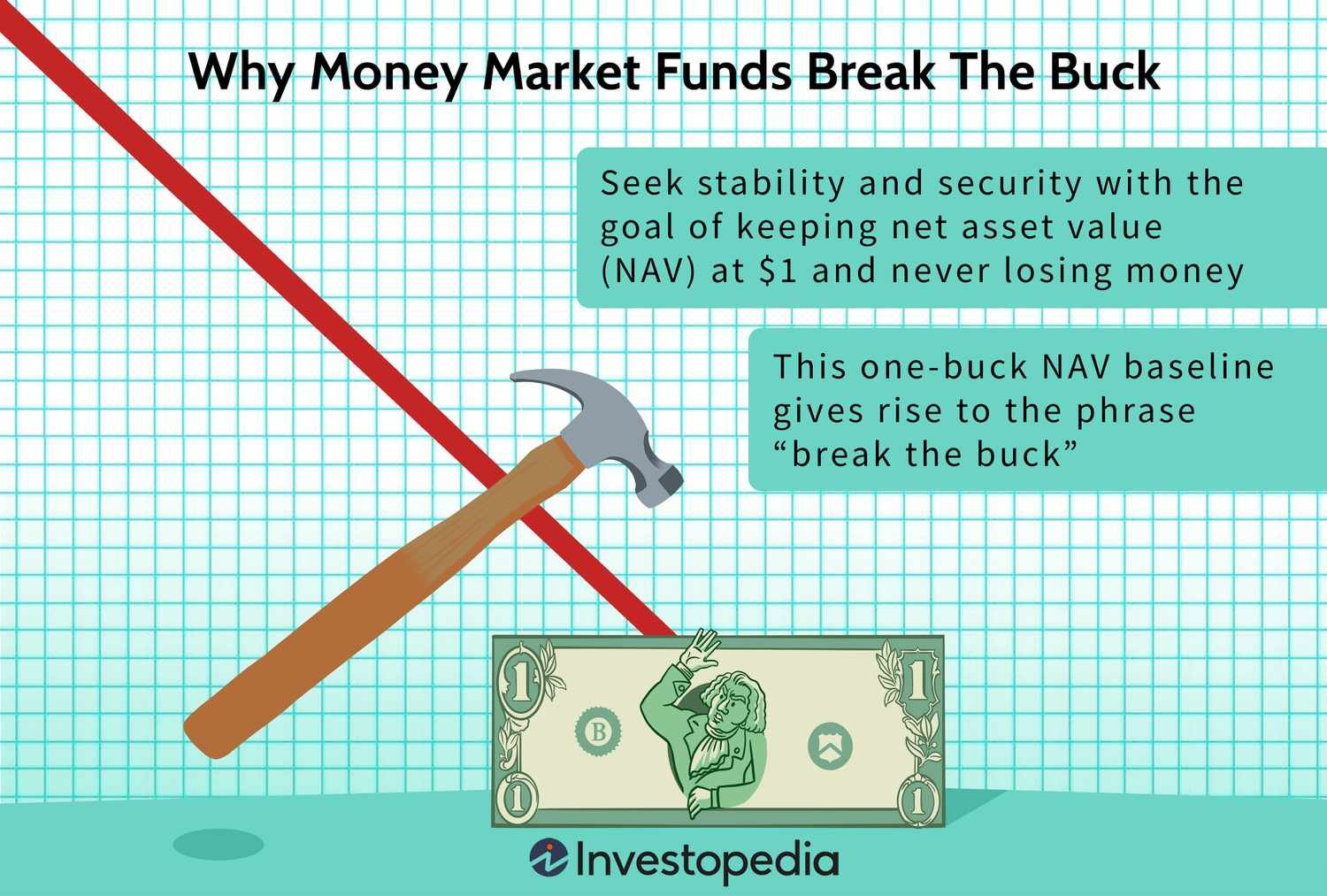
Money market funds are designed to offer stability and easy access to cash, often viewed as a safe place to park short-term money. When a fund’s value drops below $1 per share, it signals a loss for investors. This is a rare event known as “breaking the buck,” and has only happened a few times, including in 1994 and the 2008 financial crisis. It reminds investors that no investment is entirely risk-free.
Key Takeaways
- Money market funds aim to maintain a $1 NAV to prevent investor losses.
- Money market funds are not FDIC-insured, unlike money market deposit accounts.
- Portfolio managers reduce risk by investing in short-term, high-credit-quality debt.
- Rare events like the 2008 financial crisis challenge the safety of money market funds.
- Larger firms may have more stability in managing money market funds.
Investopedia / Ellen Lindner
Understanding Money Market Fund Risks
While investors are typically aware that money market funds are not as safe as a savings account in a bank, they treat them as such because, as their track record shows, they are very close. But given the rocky market events of 2008, many did wonder if their money market funds would break the buck.
In the history of the money market, dating back to 1971, less than a handful of funds broke the buck until the 2008 financial crisis. In 1994, a small money market fund that invested in adjustable-rate securities got caught when interest rates increased and paid out only 96 cents for every dollar invested. But as this was an institutional fund, no individual investor lost money, and 37 years passed without a single individual investor losing a cent.
In 2008, however, the day after Lehman Brothers Holdings Inc. filed for bankruptcy, one money market fund fell to 97 cents after writing off the debt it owned that was issued by Lehman. This created the potential for a bank run in money markets as there was fear that more funds would break the buck.
Shortly thereafter, another fund announced that it was liquidating due to redemptions, but the next day the United States Treasury announced a program to insure the holdings of publicly offered money market funds so that should a covered fund break the buck, investors would be protected to $1 NAV.
Important
Many brokerage accounts sweep cash into money market funds as a default holding investment until the funds can be invested elsewhere.
Why Money Market Funds Are Considered Safe
There are three main reasons that money market funds have a safe track record.
- The maturity of the debt in the portfolio is short-term (397 days or less), with a weighted average portfolio maturity of 90 days or less. This allows portfolio managers to quickly adjust to a changing interest rate environment, thereby reducing risk.
- The credit quality of the debt is limited to the highest credit quality, typically ‘AAA’ rated debt. Money market funds can’t invest more than 5% with any one issuer, except the government, so they diversify the risk that a credit downgrade will impact the overall fund.
- The participants in the market are large professional institutions that have their reputations riding on the ability to keep NAV above $1. With only the very rare case of a fund breaking the buck, no firm wants to be singled out for this type of loss. If this were to happen, it would be devastating to the overall firm and shake the confidence of all its investors, even the ones that weren’t impacted. Firms will do just about anything to avoid breaking the buck, and that adds to the safety for investors.
Preparing for Money Market Fund Volatility
Although the risks are generally very low, events can put pressure on a money market fund. For example, there can be sudden shifts in interest rates, major credit quality downgrades for multiple firms, and/or increased redemptions that weren’t anticipated.
Another potential issue could occur if the fed funds rate drops below the expense ratio of the fund, which may produce a loss to the fund’s investors.
To reduce the risks and better protect themselves, investors should consider the following:
- Review what the fund is holding. If you don’t understand what you are getting into, then look for another fund.
- Keep in mind that return is tied to risk—the highest return will typically be the riskiest. One way to increase return without increasing risk is to look for funds with lower fees. The lower fee will allow for a potentially higher return without additional risk.
- Major firms are typically better funded and will be able to withstand short-term volatility better than smaller firms. In some cases, fund companies will cover losses in a fund to make sure that it doesn’t break the buck. All things being equal, larger is safer.
Differentiating Money Market Funds From Deposit Accounts
Money market funds are sometimes called “money funds” or “money market mutual funds,” but should not be confused with the similar-sounding money market deposit accounts offered by banks in the United States.
The major difference is that money market funds are assets held by a brokerage, or possibly a bank, whereas money market deposit accounts are liabilities for a bank, which can invest the money at its discretion—and potentially in (riskier) investments other than money market securities.
If a bank can invest the funds at higher rates than it pays on the money market deposit account, it makes a profit. Money market deposit accounts offered by banks are FDIC insured, so they are safer than money market funds. They often provide a higher yield than a passbook savings account and can be competitive with money market funds, but may have limited transactions or minimum balance requirements.
The Bottom Line
Money market funds have historically been considered safe and resilient, making them popular for conservative investors who want a safe and liquid investment option. While these funds are generally reliable, the rare instances of “breaking the buck” show that they’re not entirely risk-free. During the 2008 financial crisis, U.S. government actions helped restore investor confidence, but such support shouldn’t be assumed in the future. Overall, money market funds remain a practical option for short-term investing, provided investors understand the small but real risks involved.