
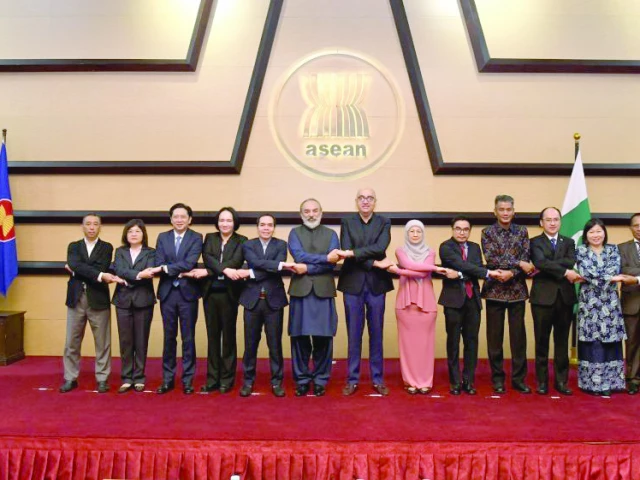
Appreciating Pakistan’s hospitality, the envoys agreed on the need to accelerate bilateral trade and investment flows, including through religious tourism, skills exchanges, and supply-chain partnerships. Photo: file
LAHORE:
Despite the government’s efforts to lure foreign direct investment (FDI) to stabilise a fragile economy, industry stakeholders believe that short-term inflows will remain episodic unless deep-rooted structural reforms are implemented to ensure long-term, innovation-based growth.
Local industry experts argue that the recent influx of investment pledges from China, the UAE and Belarus are encouraging, but not necessarily transformational. They say these new ventures are largely capital-intensive, not innovation-driven, and fail to compensate for the exit of multinational giants that set high benchmarks for research, development and corporate governance in the country.
“New investments from Chinese industrial ventures and the UAE banking interests are welcoming, but the loss of R&D and high-standard corporate practices from firms like Sanofi and P&G carries a long-term institutional cost, not offset by short-term FDI inflows,” said SM Ishtiaq, CEO of SM Engineering.
“We should not confuse movement with momentum. We have a long list of policy failures – from taxation inconsistency and delayed refunds to ad hoc import restrictions and weak contract enforcement.”
In recent years, Pakistan has witnessed the exit or downsizing of several multinational corporations, including Sanofi, Procter & Gamble (P&G) and GlaxoSmithKline Consumer Healthcare from the pharmaceutical and fast-moving consumer goods (FMCG) sectors, while telecom and tech players like Telenor and Careem have also pulled out of the Pakistani market. According to the State Bank of Pakistan, FDI inflows stood at around $1.84 billion in FY25, a slight fall if compared with the FY24 figure of $1.9 billion, which is a reflection of the uncertain business climate and shrinking investor confidence.
Ishtiaq added that most of the recent foreign investments, particularly those in the energy and financial sectors, were state-driven or linked to bilateral projects like the China-Pakistan Economic Corridor (CPEC). “These are not purely market-driven investments,” he said. “They do not necessarily translate into technology transfer, local innovation or sustainable job creation.”
Industry insiders argue that the exodus of major pharmaceutical companies is not merely a result of high taxes, but also due to structural inefficiencies such as stringent price controls and weak intellectual property protection. In the telecom sector, retrenchments are being seen as part of global portfolio optimisation strategies rather than Pakistan-specific rejections, but they still signal limited investor confidence in the local regulatory and market stability.
Senior market analyst Muhammad Salman, while commenting on the trend, said that Pakistan’s FDI policy framework still lacked predictability and sector-specific depth. “We are stuck in a cycle of reactive policymaking. Governments offer incentives for entry but fail to provide a stable business environment for retention,” he noted. “Unless Pakistan ensures consistent policies, transparent taxation and a strong legal enforcement mechanism, it will continue to attract short-term capital but lose long-term institutional investors.”
Experts also emphasise that while the government has been focusing on state-to-state partnerships, what is truly needed is a credible environment for private, innovation-led investment. Pakistan’s high energy costs, exchange rate volatility and political uncertainty are also major deterrents to reinvestment.
“Foreign investors need visibility, not just opportunity,” Salman added. “Without a predictable and credible regulatory environment, investors will continue to view Pakistan as a short-term play rather than a long-term destination.”
Many government institutions claim that they are currently engaged with multiple countries for sector-specific FDI in energy, infrastructure and manufacturing. However, the inflow patterns suggest that the focus remains on large capital projects rather than knowledge-driven sectors such as information technology or pharmaceuticals, where innovation can create sustainable economic impact.
“Pakistan has tremendous potential in manufacturing and exports,” said another industry expert. “But unless macroeconomic volatility and exchange rate swings are addressed through consistent policies, the rotation of investors will remain episodic rather than transformational.”
Economists and industrialists agree that foreign capital alone cannot rebuild investor confidence. Instead, it must be supported by a reform-driven governance framework, improved ease of doing business and stronger protection of investor rights. Without these pillars in place, Pakistan’s attempts to attract new investors will continue to be cyclical, offering brief upticks in inflows but no meaningful, lasting economic transformation.