

The Indian mutual fund industry’s assets under management (AUM) grew 20 per cent year-on-year to ₹80.8 lakh crore as of January 31, 2026, from ₹67.3 lakh crore a year earlier. The expansion was powered largely by robust net inflows of ₹9.4 lakh crore across categories. Equity schemes led with ₹3.7 lakh crore of net inflows, followed by debt funds at ₹1.9 lakh crore and hybrid funds at ₹1.7 lakh crore.
Against this backdrop, portfolio holdings across asset classes also witnessed meaningful shifts. This analysis compares month-end disclosures between January 2025 and January 2026 to assess how allocation preferences evolved.
For the one year ended February 25, 2026, benchmark returns remained divergent: Nifty 100 TRI gained 15 per cent, Nifty Midcap 150 TRI rose 20 per cent, while Nifty Smallcap 250 TRI and Nifty Microcap 250 TRI returned 12 per cent and 6 per cent, respectively.
Large-cap stocks
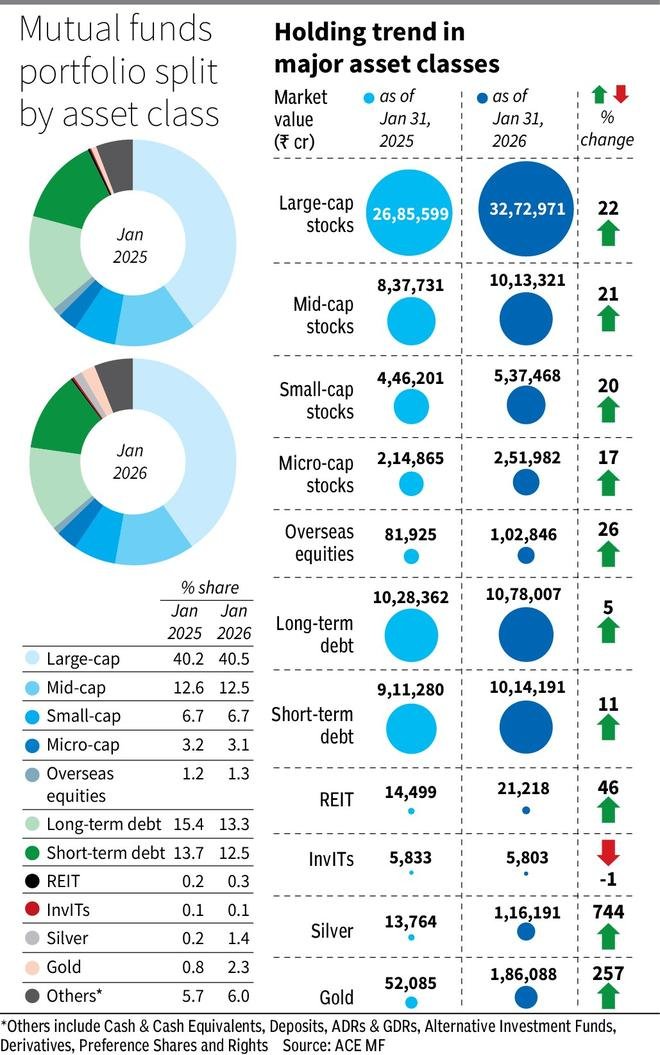
Mutual fund large-cap holdings rose 22 per cent to ₹32.7 lakh crore in the year ended January 2026, the strongest growth among market-cap segments. Amid volatility and valuation concerns in broader markets, fund managers gravitated toward large caps offering earnings visibility and relative valuation comfort.
Notably, large caps were the only market-cap segment to increase their share in overall MF equity exposure, from 40.2 per cent to 40.5 per cent.
HDFC Bank, ICICI Bank and Reliance Industries remained the top allocations at ₹3.3 lakh crore, ₹2.6 lakh crore and ₹1.8 lakh crore, respectively. In contrast, IRFC, Mazagon Dock Shipbuilders and Lodha Developers saw relatively lower MF exposure.
Mid-cap stocks
Mid-cap exposure expanded 21 per cent to ₹10.1 lakh crore, broadly mirroring the 20 per cent return delivered by the Nifty Midcap 150 TRI. Allocation growth remained measured rather than aggressive, suggesting disciplined positioning despite strong index performance.
Funds increased exposure past year to improving mid-sized industrial, financial and capital goods names including Indian Bank, Nippon Life India AMC, GE Vernova T&D India, SAIL, APL Apollo Tubes, NALCO and Laurus Labs.
Top mid-cap holdings include The Federal Bank, Max Financial Services and Persistent Systems, with exposure ranging between ₹21,000 crore and ₹27,000 crore.
Small- and micro-cap stocks
Small-cap holdings rose 20 per cent to ₹5.37 lakh crore, despite the Nifty Smallcap 250 TRI delivering a relatively moderate 11.7 per cent return. SIP inflows continued to support allocations, though fresh positioning remained selective.
Micro-cap exposure increased 17 per cent to ₹2.52 lakh crore, even as the Nifty Microcap 250 TRI returned just 6 per cent. Stocks ranked beyond top 500 by AMFI are considered as microcaps.
Compared with large- and mid-caps, the small- and micro-cap segments saw relatively slower growth, reflecting valuation fatigue, liquidity tightening and rising risk aversion.
Among small caps, Cholamandalam Financial Holdings, Radico Khaitan and KPR Mill saw fresh scheme additions. In micro caps, Equitas Small Finance Bank, Metropolis Healthcare and Ujjivan Small Finance Bank feature prominently in portfolios.
Overseas equities
Domestic mutual funds’ overseas holdings expanded 26 per cent to ₹1.03 lakh crore from ₹81,925 crore a year ago, outpacing most domestic equity segments. The rise, however, largely reflects mark-to-market gains rather than incremental capital deployment, given the industry-wide $7 billion overseas investment cap.
For the year ended February 25, 2026, global markets delivered strong returns — S&P 500 rose 16 per cent (USD), Shanghai Composite gained 26 per cent (CNY), and Nikkei 225 surged 54 per cent (JPY).
Importantly, the RBI cap applies to capital deployed and not to market value, allowing AUM to appreciate without breaching limits.
Debt
Long-term debt allocations increased a modest 5 per cent to ₹10.8 lakh crore, while money market instruments and short-term debt grew 11 per cent to ₹10.1 lakh crore.
The divergence reflects a duration recalibration. Early 2025 positioning was tilted toward longer duration to capture anticipated rate cuts. As easing expectations moderated and bond price gains were largely realised, managers rotated toward shorter-tenor instruments to lock in accrual yields with lower volatility.
Gold and Silver
Precious metals emerged as standout performers. Gold holdings surged 257 per cent to ₹1.9 lakh crore alongside an 81 per cent rise in the MCX Gold Index. Silver allocations soared 744 per cent to ₹1.2 lakh crore, supported by a 172 per cent rally in the MCX Silver Index.
Both price appreciation and fresh ETF launches drove growth, particularly in silver from a low base.
Gold retained its status as a strategic hedge amid global uncertainty and central bank buying, while silver gained traction as a tactical play benefiting from both precious and industrial demand themes.
REITs and InvITs
MF exposure to REITs climbed 46 per cent to ₹21,218 crore, aided by both mark-to-market gains and incremental allocations. Embassy Office Parks REIT, Brookfield India Real Estate Trust and Mindspace Business Parks REIT delivered 21–33 per cent returns over the past year.
SEBI’s decision to classify REITs as equity for mutual fund scheme categorisation expands their eligibility within equity schemes, potentially improving liquidity and institutional participation.
In contrast, InvIT holdings remained flat at ₹5,803 crore. Although select trusts such as Cube Highways Trust, IndiGrid Infrastructure Trust and Nexus Select Trust generated healthy market returns, InvITs continue to be treated as hybrid assets, limiting broader equity scheme participation.
Cash
Cash levels in active equity funds declined in percentage terms from 5.7 per cent to 4.9 per cent, even though absolute cash rose marginally, as sustained SIP inflows of nearly ₹28,000 crore flowed into equity-oriented funds every month. Heightened market volatility provided staggered entry opportunities, reducing the need to hold idle liquidity.
Published on February 28, 2026