

Why demat matters
Years ago, investing was a paper-heavy affair. Share certificates were physical documents, and losing one meant a world of trouble. Then came dematerialisation—the process of converting physical certificates into electronic records. This shift was a game-changer, offering investors security, convenience, and a streamlined way to manage their portfolios.
Mutual funds followed a similar path. While fund houses today provide you with SOAs, the industry gradually introduced the option to hold mutual fund units in demat form. Think of it as having your investments in a format that’s easier to manage and track, just like shares and bonds. Holding mutual fund units in your demat account provides a centralized view of all your investments and simplifies transactions.
How to dematerialise MF units
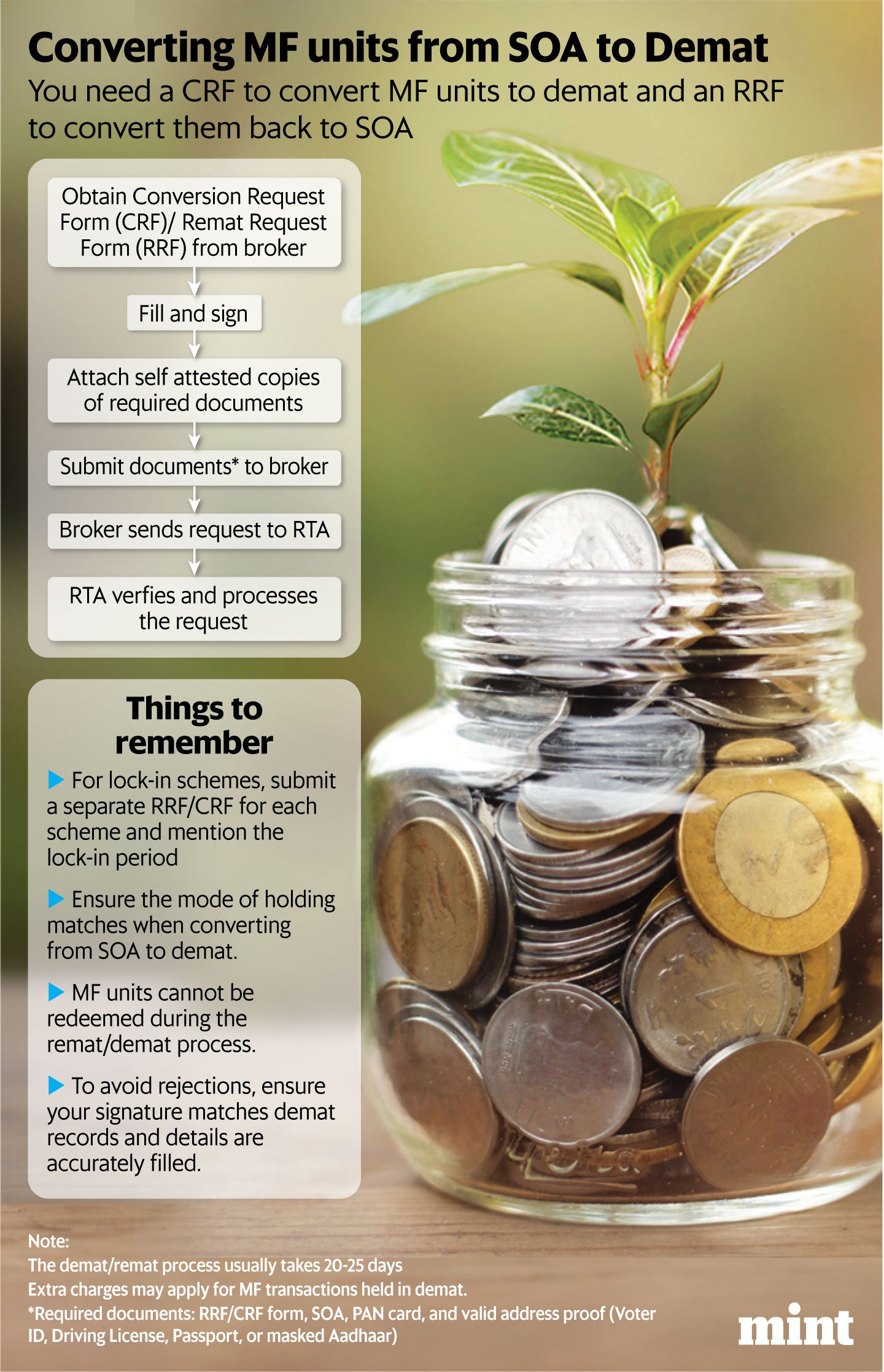
If you’re considering making the switch, the process isn’t as daunting as it might seem. Here’s a step-by-step guide to help you navigate the transition:
Open a demat account: If you don’t already have a demat account, this is your first step. It’s similar to setting up an online account—simple, straightforward, and usually done with a depository participant (DP) such as a bank or brokerage firm.
Obtain a conversion request form (CRF) from your broker: Your DP acts as the intermediary between you and the financial markets. You can easily get a CRF from them, either online or from their branch.
Fill the CRF and sign it: Ensure your signature matches the one your DP has on record. This is crucial for the process to proceed without hitches.
View Full Image
Ensure the holding pattern matches: The names on your SOA should exactly match the names in your DP account. For example, if Mr. A is the first holder and Mrs. A is the second in your DP account, the SOA must reflect the same order.
Submit the CRF along with a self-attested copy of your SOA: Submit the filled CRF and a self-attested copy of your SOA to your broker. The CRF must be submitted physically to the broker.
Mention the correct folio number: Enter the folio number from your SOA accurately into the CRF. This ensures the correct units are converted.
DP sends the CRF to the registrar and transfer agent (RTA): Your DP will forward the CRF details to the RTA, along with your client master copy, which contains your account details.
RTA verifies and confirms the conversion: After verification, the RTA will process the conversion request. Once approved, your mutual fund units will be credited to your demat account.
The entire process of converting your mutual fund units to demat may take 20-25 days.
Dematerialising lock-in funds
Before dematerialising lock-in schemes, such as equity-linked savings schemes (ELSS) or retirement funds, it’s crucial to stop or pause any ongoing SIPs. If you don’t, investments will continue in physical or non-demat mode and can only be tracked through the RTA or the asset management company (AMC).
If you have units in lock-in schemes with different lock-in dates, you’ll need to fill out separate CRFs for each scheme and lock-in date. Your broker will generate a demat request number (DRN) for each purchase date.
For SIP investments in lock-in schemes, dematerialisation charges apply to each installment. For example, if you have 10 monthly SIPs in a lock-in scheme and place a dematerialisation request, charges will be incurred for each individual SIP installment.
Key considerations
Converting units from SOA to demat may involve charges that vary from broker to broker. Dematerialisation charges are deducted from the broker account balance and can be viewed on the funds statement.
However, there are times when you might want to convert those units back to physical mode, also known as rematerialisation. This could be due to personal preference, reduced costs, or simply for maintaining a separate record.
Switching back to SOA
Rematerialisation is the process of converting your mutual fund units from electronic (demat) form back to physical form, which means they are issued as a SOAs. If you’re considering this switch, here’s a straightforward guide to help you with the process.
Obtain and fill the remat request form (RRF): The first step in rematerialising your mutual fund units is to approach your broker, request, and fill out the RRF for each international securities identification number (ISIN), fund, or folio that you wish to rematerialise. Ensure that the details you provide match your DP’s records, including your name, folio number, and other relevant information. Filling out this form accurately is crucial to avoid any delays in processing.
Submit the form and documents to your broker: Along with the RRF, you need to submit a set of self-attested documents to support your request. These documents include:
Address proof: A self-attested copy of any one of the following documents: voter ID, driving licence, passport, Aadhaar card (ensure that the Aadhaar number is masked—only the last four digits should be visible), or bank statement.
PAN: A self-attested copy of your Permanent Account Number (PAN) card is also mandatory.
Broker forwards the request to AMC/RTA: After verifying your request, your DP will forward the RRF and supporting documents to the respective AMC or RTA. The AMC or RTA will process your rematerialisation request.
Processing and issuance of SoA: Once the AMC or RTA receives your request, they will initiate the rematerialisation process. After successful verification, your mutual fund units will be converted back to physical form, and you will receive an SOA, reflecting your holdings. This document will serve as the official record of your mutual fund investments.
Final thoughts
If you hold multiple mutual funds or investments across different folios, you will need to submit a separate RRF for each. The entire process can take a few weeks, depending on the AMC or RTA’s processing time, and the accuracy of the information you have provided. It’s important to follow up with your DP if you do not receive your SOA within the expected timeframe.
While the rematerialisation process has no underlying charges, some DPs might charge a nominal fee for handling the request. It’s advisable to check with your DP about any associated costs.
Also Read: KYC Maze: Investors, distributors face updating hurdles with NDML & DotEx KRAs
That said, whether you choose SOA or switch to demat would depend on how you prefer to manage your investments. Understanding the trade-offs helps you make the best choice for your financial journey.