
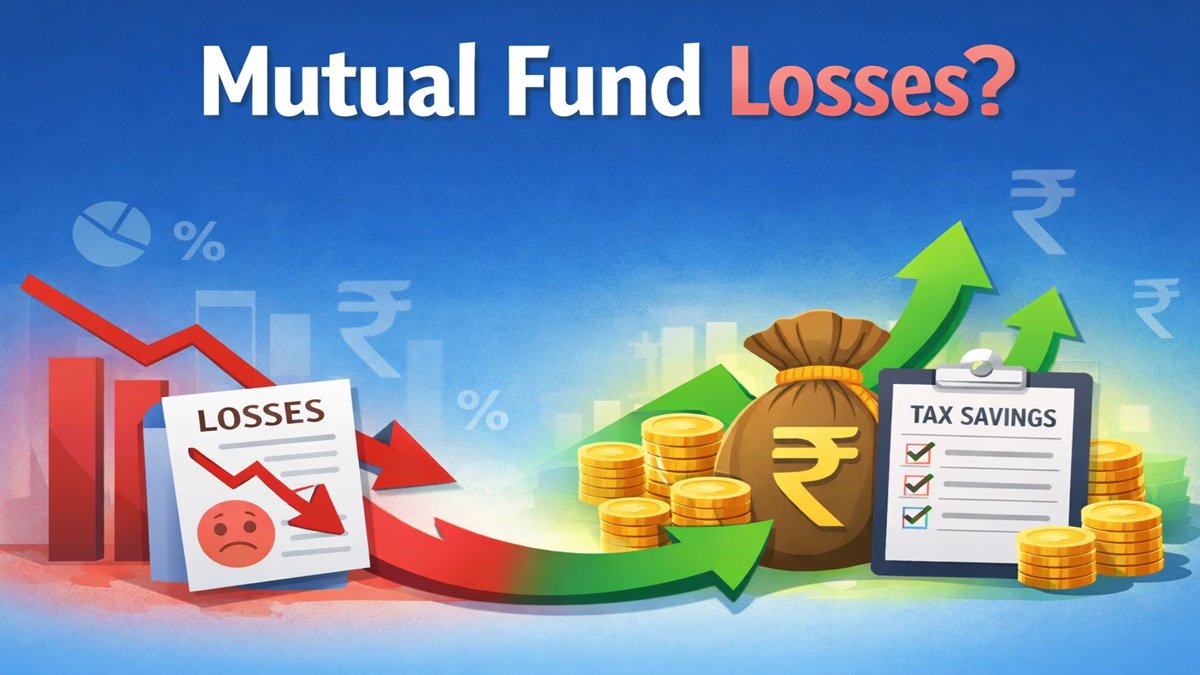
The market behavior in 2025–26 has not been easy to deal with for equity investors. The mid-cap and small-cap segments witnessed a decline; many equity mutual funds dropped by 10–20%, and the portfolios of millions of investors took a massive hit. However, hidden within this downturn lies an opportunity—that of tax-loss harvesting.
Investors often tend to view a loss as nothing more than a loss and simply sit on it. Yet, with the right strategy, this very loss can transform into an opportunity for tax savings. This is the most crucial aspect of this story: attempting tax-loss harvesting without a clear understanding of short-term and long-term capital losses could prove to be an incomplete decision.
What is tax-loss harvesting by mutual fund investors?
Simply put, tax-loss harvesting involves selling mutual fund units that are currently trading below their original purchase price. The goal is to “book” that loss and use it to offset other capital gains you may have realized.
CA Niyati Shah explains this concept with great clarity: “A loss on paper, when used smartly, becomes real money back in your pocket.”
In other words, a loss that currently exists only on paper can be converted into actual tax savings if utilized at the right moment.
“You are not abandoning the investment as you can reinvest immediately in a similar fund. What you are doing is converting a notional loss into a legitimate tax shield,” she added.
This means you are not abandoning your investment altogether; rather, you are merely optimizing it from a tax perspective.
Short-term vs. Long-term: This is where the real game lies
The most critical component of tax harvesting is understanding the nature of the loss.
Short-Term Capital Loss (STCL)
Holding Period: Less than 12 months
This can be set off against both STCG and LTCG.
Long-Term Capital Loss (LTCL)
Holding Period: 12 months or more
This can only be set off against LTCG.
CA Niyati Shah states: “Short-term losses can be offset against both STCG and LTCG, but long-term losses can only be offset against LTCG.”
This is the very rule that, if overlooked, causes investors to lose out on potential tax savings.
Why is it important to understand tax rates?
You will only reap the benefits of tax harvesting if you have an accurate understanding of the applicable tax rates:
STCG (Less than 12 months) → 20% Tax; No exemption
LTCG (More than 12 months) → 12.5% Tax; however, no tax is levied up to Rs 1.25 lakh
This implies that if your LTCG is less than Rs 1.25 lakh, performing ‘loss harvesting’ will yield no tax benefit.
In other words, this decision is now driven not by “emotion,” but by mathematics.
Let’s understand this with an example
Suppose you have earned an LTCG of Rs 2 Lakhs from a particular fund. Simultaneously, you have booked a long-term loss of Rs 1.5 lakh in a different fund.
Now, your Net LTCG stands at Rs 50,000 — which falls well within the exemption limit of Rs 1.25 lakhs.
Result: Your tax liability could drop to zero.
As the expert observes: “Effectively, your tax outgo hits zero… this is precisely the kind of planning the Income Tax Act enables.”
Timing also plays a crucial role
Tax-loss harvesting is effective only when executed at the right time. If you wish to show a loss in the current financial year, the transaction must be completed before March 31st. After this date, you cannot claim a loss for that specific year.
Additionally, here is another crucial point: A ‘Switch’ is also considered a ‘Redemption.’
This means that taxes are applicable even when you move from one fund to another.
These mistakes can wipe out your potential gains:
Ignoring the exit load: If a 1% exit load applies, it could completely negate your tax savings.
Resetting the Holding Period: When you sell a fund and subsequently repurchase it, the holding period resets. If you sell prematurely, you may be liable to pay a 20% Short-Term Capital Gains (STCG) tax.
Harvesting losses without realized gains: It adds value only when you have real taxable gains to offset. If you do not have any taxable gains to begin with, harvesting losses serves no purpose.
The benefit of ‘carry forward’
Even if you are unable to fully utilize your losses this year, there is no need to worry. You can carry forward these losses for up to 8 years. However, to avail of this benefit, it is mandatory that you file your Income Tax Return (ITR) on time.
Is this necessary for everyone?
No. Tax-loss harvesting is not a magic trick. Tax-loss harvesting does not improve investment returns… it simply changes the tax outcome. In other words, it does not boost your investment returns; it merely reduces your tax liability.
This strategy proves most effective when you have taxable capital gains to offset, your losses can be set off against gains in a beneficial manner, and the resulting tax savings outweigh the associated costs.
Summing up…
A weak market environment—such as that of 2025–26—does not bring only losses; it also presents an opportunity.
If you act prudently: Even your “red portfolio” (showing losses) can turn “green” (profitable) in your tax returns.
But remember — this is a strategic decision that requires careful consideration and understanding. Attempting to harvest losses without fully grasping the distinction between short-term and long-term losses is akin to setting out on a journey without a map.
Disclaimer: This article is for informational purposes only and does not constitute professional tax advice. Tax laws and regimes are subject to frequent changes by the government. Readers should verify details with official Income Tax Department notifications or consult a Chartered Accountant before making any financial decisions.