

Passively managed investment products in defined contribution retirement plans have steadily increased their market share at the expense of actively managed products, according to recent research by ISS Market Intelligence.
The trend toward passive in-plan investments is similar to the steady market share the strategy has made in overall investment management. The growth is particularly of note in DC plans, which usually lag the broader market, noted report authors Alan Hess and Liam Stewart in ISS MI’s “Q2 Windows Into Defined Contribution Plans,” released August 20. ISS MI, like PLANADVISER, is owned by ISS STOXX.
“While product trends in the defined contribution space often trail those of the retail and intermediary markets, data from the ISS MI BrightScope Defined Contribution Plan database demonstrates that passive strategies took a majority of managed assets even earlier among retirement plans, driven strongly by movement into collective investment trusts,” the authors wrote.
Passively managed DC mutual funds and collective investment trust long-term assets stood at $2.7 trillion in 2022, the latest data available, as compared with $2.1 trillion for active strategies. That builds on a lead passively managed products took in this set of assets, starting in 2020.
The data cited were sourced from Form 5500 filings with the Department of Labor, filings made by retirement plans with at least 100 participants.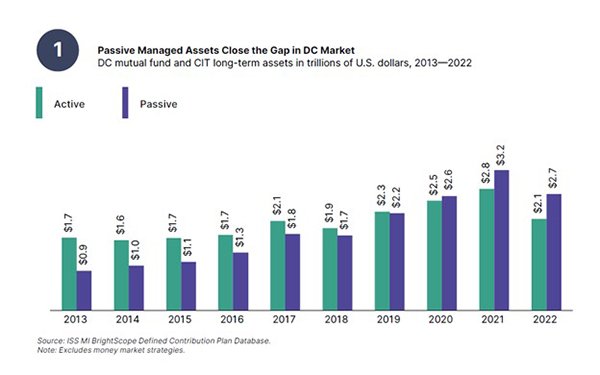
In the broader investment space, assets under management in passive index products surpassed those of active strategies in the long-term mutual fund and exchange-traded-fund market in December 2023, driven in part by the lower cost of the options and popularity of index investing, according to the authors. Similar trends have also likely driven growth in the DC space, according to Hess and Stewart.
“The importance of cost is raised within the retirement space, where concerns about high costs can more easily lead to litigation,” the report stated. “Assets in passive mutual funds and CITs have witnessed strong growth throughout the last decade, closing the market share gap with active funds on DC plans.”
While the trend has happened across DC investment vehicles, CITs have led the charge as often lower-cost investment options for plan sponsors.
“The vehicle, like ETFs, has been able to build on passive’s cost advantage via structural features, eliminating the costs of registering with the SEC and offering customized fee schedules,” the authors wrote. “CITs have accounted for a majority of passive DC assets since 2014 and grew to 61% by the end of 2022 for a total of $1.6 trillion in AUM.”
The CIT push started off with large plan sponsors who have more power to negotiate down fees; but they have moved down-market over the years. Data in the report show that passively managed CITs held more assets than actively managed mutual funds as of 2022.
Staying Active
Brad Long, chief investment officer at Fiducient Advisors, notes that “passive” captures much of the flow in DC investing “because passive target date portfolios command a large percentage of target date funds, and target date funds are a large portion of DC assets.”
Taking that into account, he goes on to say that there are good moments for passive management, as well as active management, and the reality is that “there will be cyclicality of success when it comes to active vs. passive investing.”
Long notes that the rise and focus on the “Magnificent 7” stocks has created misunderstanding in the market, as performance is often measured just by those stocks—but of course, when and if they drop, then you are also going to be looking at “just that basket.”
“Now is as prudent a time as ever to be thoughtfully diversified,” he says. “The concentration in the index among those stock interestingly may make active by comparison a ‘diversified’ option.”
In Fiducient Advisors’ view, long-term investors—such as 401(k) participants—should not be “lured into equities” due to recent performance, Long says, particularly when they may not be getting strong enough return to “offset the risks.” He notes that, in the firm’s most recent market outlook published in July, Fiducient Advisors reaffirmed its stance at the start of the year advocating for fixed-income exposure that has benefitted from the Fed rate hikes.
“Boring is beautiful,” Long says. “We have to take on magnitudes more risk in equity to achieve the relative value today. [Investors] should be thoughtful about utilizing portfolio construction and investing in fixed income in balancing the risk.”
The ISS MI authors also noted that active mutual funds are still a “worthy aggregate contender,” in part due to their use in small and midsized plans, the authors wrote. Active management has maintained a lead in other asset classes outside of equities, such as taxable bonds, and has “continued opportunities” in areas such as small-cap equity strategies.
“The divide between core and more focused strategies emphasizes the opportunities for active managers that can target narrower parts of the market, where their research and security selection can produce the most rewarding results,” the authors wrote.
Bond Bailout
While alternative asset investing may be another advantage for active managers, they remain limited in DC plans. A more realistic area may be within bond allocation strategies, which may be bolstered by a shift in demographics toward older, more conservative savers.
“Given the strong role active funds have retained within fixed income, inside and beyond the DC market, those demographic shifts could serve as a prolonged boost to active management,” the authors wrote.
Meanwhile, the interest rate environment will continue to shift how investors approach both the short- and long-term markets.
On Friday, in remarks made at Jackson Hole, Wyoming, Federal Reserve Chairman Jerome Powell signaled it is time to start bringing rates down. That tracks with Long and Fiducient Advisors’ forecasting from the start of the year, as the Fed tries to manage a “soft landing” for the economy. But the firm also does not see inflation necessarily sticking to the ideal 2% target set by the Fed.
“It is becoming apparent that a 2% inflation target may be overly ambitious,” Long and colleagues wrote. “A structurally higher inflation rate, closer to 3%, isn’t necessarily detrimental, but the markets will need time to adjust. Importantly, modest inflation still aligns with our thesis of multiple pathways to lower rates, which remains constructive for fixed income going forward.”