

Close Menu
Fund Focus News
    Facebook X (Twitter) Instagram
    Trending
    • Rs 5,000 SIP vs Rs 5 Lakh Fixed Deposit: Which Delivers Bigger Returns
    • Moneycontrol to host fifth Mutual Fund Summit in Mumbai
    • What Is the Federal Funds Rate?
    • Axis Greater China Equity FoF vs Edelweiss Greater China Equity Offshore Fund: Risks, returns and portfolio compared
    • Best Nippon India funds: Top 3 schemes with over 20% XIRR in 10 years; Rs 10,000 SIP turns into up to Rs 40 lakh – Mutual Funds News
    • Value of Prize Bonds sold last year rises to 365m reversing four years of decline 
    • Exits from gold ETFs last week surged to year’s highest
    • ICICI Prudential MF bets on diversification with new equity, debt, gold and silver fund
    Facebook X (Twitter) Instagram
    Fund Focus News
    • Home
    • Bonds
    • ETFs
    • Funds
    • Investments
    • Mutual Funds
    • Property Investments
    • SIP
    Fund Focus News
    Home»Mutual Funds»Should You Pick Mutual Funds Based On 1-Year Or 3-Year Returns? What A 20-Year Study Tells Investors | Savings and Investments News
    Mutual Funds

    Should You Pick Mutual Funds Based On 1-Year Or 3-Year Returns? What A 20-Year Study Tells Investors | Savings and Investments News

    October 3, 2025


    Last Updated:October 03, 2025, 15:50 IST

    HDFC Securities’ 20-year study finds picking mutual funds based on recent 1-year or 3-year returns does not predict future success, urging investors to avoid 1-Year Return Trap.


    font
    Mutual Fund Investment

    Mutual Fund Investment

    A 20-year study by HDFC Securities has demystified the major inclination or behaviour of investors in picking up mutual funds based on their previous 1-year or 3-year returns. HDFC Securities in its analysis spanning mutual fund data from 2005 to 2025, finds that a fund’s recent stellar performance especially to its 1-year return is often a misleading boost that inflates its overall record and doesn’t reliably predict future success.

    The 1-Year Return Trap

    HDFC Securities warns investors to avoid investing on a particular mutual fund on the basis of “purple patch”, a period of excellent, recent outperformance.

    In other words, a strong rally in the last year can inflate the 3-year or 5-year averages, even if earlier performance was average.

    It has shown the idea with an illustration: 
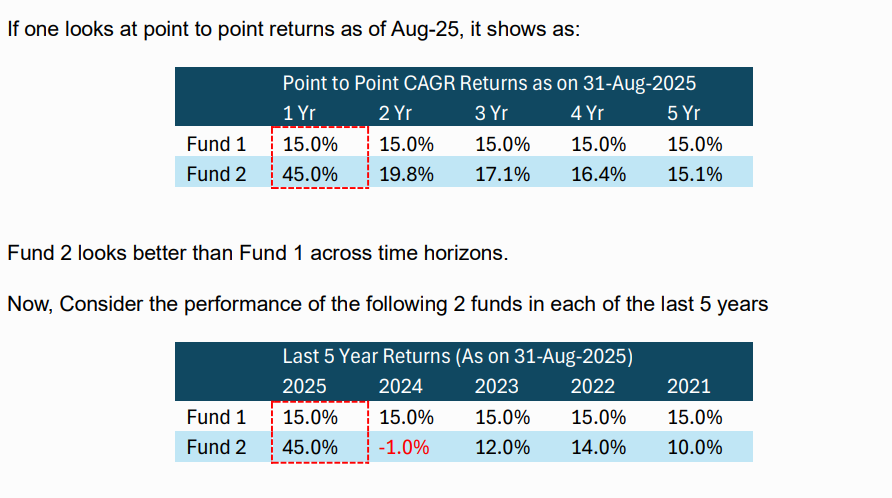
    Though Fund 2 looks better than Fund 1 across time horizons. However, we know that fund 1 has been more consistent, HDFC Securities adds.

    First Test For 1-Year Investing

    HDFC Securities did two tests to find the answer. In the first test, it had ranked 32 large-cap mutual funds each year based on their 1-year performance, starting from 2005, and had invested annually in the fund that was ranked 1st in the previous year. So basically, they redeemed the investment at the end of the each calendar year and reinvested the proceeds into the top-ranked fund based on the prior 12-month return.
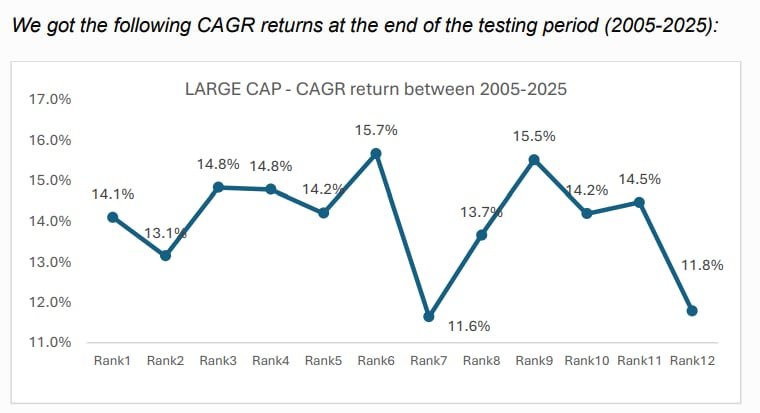
    In the findings, HDFC Securities concludes, next year’s performance has no relation with last year’s performance.

    Selecting the #1 ranked fund each year resulted in a CAGR of 14%. Interestingly, consistently choosing the #6 ranked fund each year delivered a higher CAGR of 16%, it adds.

    Second Test To Understand Long-Term Investing

    In the second test, HDFC Securities extended the analysis to evaluate 3-year returns of the selected funds.
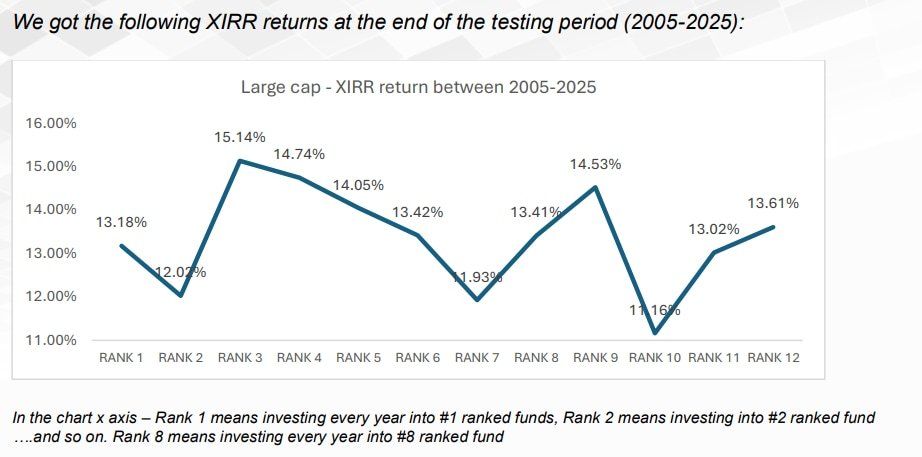
    Each year, ₹100 was invested into the fund that ranked #1 based on the previous year’s 1- year performance, and this investment was held for next 3-year period.

    To simplify, they are comparing 3-year performances of the funds based on last 1 year ranking.

    In the findings, HDFC Securities concludes, that long term performance has no relation with last year’s performance.

    Choosing #1 ranked fund each year gives a XIRR of 13%. Whereas, if one had invested in #3 ranked fund, it would have generated higher returns of 15% XIRR!,” it adds.

    In conclusion, recent outperformance of any fund will fold into periodic returns (2yr, 3yr, and 5yr). Higher periodic returns do not imply consistency in fund’s performance, argues HDFC Securities in its study, adding that selecting funds on basis of recent outperformance does not ensure future outperformance.

    Varun Yadav

    Varun Yadav

    Varun Yadav is a Sub Editor at News18 Business Digital. He writes articles on markets, personal finance, technology, and more. He completed his post-graduation diploma in English Journalism from the Indian Inst…Read More

    Varun Yadav is a Sub Editor at News18 Business Digital. He writes articles on markets, personal finance, technology, and more. He completed his post-graduation diploma in English Journalism from the Indian Inst… Read More

    Click here to add News18 as your preferred news source on Google, Stay updated with all the latest business news, including market trends, stock updates, tax, IPO, banking finance, real estate, savings and investments. Get in-depth analysis, expert opinions, and real-time updates. Also Download the News18 App to stay updated!
    First Published:

    October 03, 2025, 15:50 IST

    Disclaimer: Comments reflect users’ views, not News18’s. Please keep discussions respectful and constructive. Abusive, defamatory, or illegal comments will be removed. News18 may disable any comment at its discretion. By posting, you agree to our Terms of Use and Privacy Policy.

    Read More


    Source link

    Share. Facebook Twitter Pinterest LinkedIn Tumblr Telegram Email

    Related Posts

    Moneycontrol to host fifth Mutual Fund Summit in Mumbai

    June 29, 2026

    Axis Greater China Equity FoF vs Edelweiss Greater China Equity Offshore Fund: Risks, returns and portfolio compared

    June 29, 2026

    Best Nippon India funds: Top 3 schemes with over 20% XIRR in 10 years; Rs 10,000 SIP turns into up to Rs 40 lakh – Mutual Funds News

    June 29, 2026
    Leave A Reply Cancel Reply

    Top Posts

    The Shifting Landscape of Art Investment and the Rise of Accessibility: The London Art Exchange

    September 11, 2023

    Charlie Cobham: The Art Broker Extraordinaire Maximizing Returns for High Net Worth Clients

    February 12, 2024

    The Unyielding Resilience of the Art Market: A Historical and Contemporary Perspective

    November 19, 2023

    Rs 5,000 SIP vs Rs 5 Lakh Fixed Deposit: Which Delivers Bigger Returns

    June 29, 2026
    Don't Miss
    SIP

    Rs 5,000 SIP vs Rs 5 Lakh Fixed Deposit: Which Delivers Bigger Returns

    June 29, 2026

    New Delhi: A monthly SIP of Rs 5,000 or a one-time fixed deposit of Rs…

    Moneycontrol to host fifth Mutual Fund Summit in Mumbai

    June 29, 2026

    What Is the Federal Funds Rate?

    June 29, 2026

    Axis Greater China Equity FoF vs Edelweiss Greater China Equity Offshore Fund: Risks, returns and portfolio compared

    June 29, 2026
    Stay In Touch
    • Facebook
    • Twitter
    • Pinterest
    • Instagram
    • YouTube
    • Vimeo
    EDITOR'S PICK

    Why is Bollywood selling property now?

    July 11, 2025

    Cumulative investments at Sohar Port and Freezone touch $30bln

    January 20, 2025

    Mutual funds’ investment in equity markets doubles to ₹43,465 cr on strong inflows

    December 6, 2025
    Our Picks

    Rs 5,000 SIP vs Rs 5 Lakh Fixed Deposit: Which Delivers Bigger Returns

    June 29, 2026

    Moneycontrol to host fifth Mutual Fund Summit in Mumbai

    June 29, 2026

    What Is the Federal Funds Rate?

    June 29, 2026
    Most Popular

    🔥Juve target Chukwuemeka, Inter raise funds, Elmas bid in play 🤑

    August 20, 2025

    💵 Libra responds after Flamengo takes legal action and ‘freezes’ funds

    September 26, 2025

    ₹9000 monthly SIP can help you retire at 45 with ₹2 lakh monthly pension

    May 5, 2026
    © 2026 Fund Focus News
    • Get In Touch
    • Privacy Policy
    • Terms and Conditions

    Type above and press Enter to search. Press Esc to cancel.