

A decade is long enough to separate structural skill from lucky timing. In Indian equities, the Nifty 50 Total Return Index is the reference point for many long-term investors. It captures the compounding power of the market’s largest and most liquid stocks. A fund that sustains a higher ten-year CAGR than the Nifty 50 is not merely lucky; it has demonstrated discipline across at least two market cycles. For investors focused on wealth creation through SIPs or lump sums, that gap in CAGR compounds into material differences in the final corpus. This article looks at five funds that did precisely that using the Nifty 50 10-year CAGR of 13.75% (as on 6 Nov 2025) as the single comparator.
At the time of writing this report, the Nifty 50 TRI has increased at a CAGR of 13.75 percent over ten years. Five actively managed schemes have exceeded that bar, combining high-conviction portfolios with sound risk control.

How these funds were picked
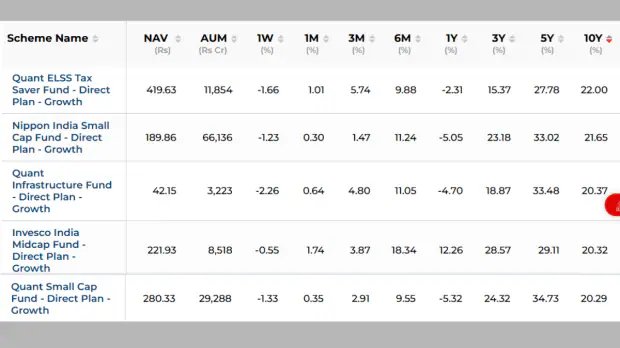
Based on data from the Financial Express Mutual Fund Screener (financialexpress.com), five actively managed schemes have delivered higher ten-year compounded growth than the Nifty 50, which registered a compound annual growth rate (CAGR) of 13.75%. The list includes Quant ELSS Tax Saver Fund – Direct Plan, Nippon India Small Cap Fund – Direct Plan, Quant Infrastructure Fund – Direct Plan, Invesco India Midcap Fund – Direct Plan, and Quant Small Cap Fund – Direct Plan.
All returns are on a CAGR basis and represent regular growth options. Only open-ended schemes with a ten-year track record and published CAGR figures were considered. Each fund lists its category, NAV, AUM, expense ratio, portfolio turnover ratio, and risk-o-meter rating. All figures represent compounded annual growth rates unless specified.
Top 5 mutual funds that beat the Nifty 50 over the last 10 years
#1 Quant ELSS Tax Saver Fund Direct Plan (Equity ELSS)
Quant ELSS has grown at a 22.00 percent CAGR over ten years, while the Nifty 50 TRI delivered 13.75 percent in the same period. The NAV is Rs 419.63, showing how much the fund’s unit value has grown since launch. With an AUM of Rs 11,854 crore, it’s among the bigger players in the tax-saving space, backed by steady inflows. The expense ratio of 0.58 percent keeps costs low for investors. A portfolio turnover of 132.14 percent shows the manager actively rebalances holdings to stay ahead of market shifts.
Nearly 99 percent of the fund is in equities, mainly Adani Power, Reliance Industries, and Larsen & Toubro. It carries a very high risk tag, which fits its aggressive growth style. The five-year CAGR of 27.78 percent shows it hasn’t just kept up with markets, it’s stayed well ahead.
#2 Nippon India Small Cap Fund Direct Plan (Equity Small Cap)
Nippon India Small Cap Fund Direct Plan (Equity Small Cap) has returned a 21.65 percent CAGR over ten years, topping the Nifty 50 TRI’s 13.75 percent. Its NAV is Rs 189.86, and the AUM stands at Rs 66,136 crore, making it one of the largest small-cap schemes in India. The expense ratio of 0.64 percent is fair for an actively managed portfolio, while the 17.92 percent turnover shows a patient, long-term approach.
Holdings include Multi Commodity Exchange of India and Kirloskar Brothers, along with other mid- and small-cap names. The fund’s five-year CAGR of 33.02 percent shows consistent outperformance through different cycles. The very high risk rating is justified given its exposure to small-cap volatility.
#3 Quant Infrastructure Fund Direct Plan (Equity Sectoral / Thematic)
Over ten years, Quant Infrastructure Fund Direct Plan (Equity Sectoral / Thematic) has posted a CAGR of 20.37 percent, well above the Nifty 50 TRI’s 13.75 percent. Its NAV is Rs 42.15, and the AUM totals Rs 3,223 crore, a size that allows flexibility within a focused theme. The expense ratio of 0.66 percent sits in the middle range, while the turnover ratio of 79 percent suggests a strategy that adapts quickly within the infrastructure space. Top holdings include Larsen & Toubro, Adani Power, and Tata Power, key names in India’s capex revival. The five-year CAGR of 33.48 percent shows how this sector has rewarded timing and conviction. The fund is tagged very high risk, as expected for a concentrated theme.
#4 Invesco India Midcap Fund Direct Plan (Equity Mid Cap)
Invesco India Midcap Fund Direct Plan is a mid-cap fund and has grown at a CAGR of 20.32 percent over ten years, about six percentage points above the Nifty 50 TRI. Its NAV is Rs 221.93, showing steady value creation over time. The AUM stands at Rs 8,518 crore, a solid base for a focused mid-cap strategy. With an expense ratio of 0.54 percent, it’s relatively affordable, and the 48.24 percent turnover indicates selective changes rather than constant churn. Key holdings include Swiggy, AU Small Finance Bank, and L&T Finance. It carries a very high risk tag, typical for the mid-cap category. The five-year CAGR of 29.11 percent shows that the fund’s approach has worked across several market cycles.
#5 Quant Small Cap Fund Direct Plan (Equity Small Cap)
Over ten years, Quant Small Cap Fund Direct Plan has compounded at a 20.29 percent CAGR, ahead of the Nifty 50 TRI’s 13.75 percent. Its NAV is Rs 280.33, while the AUM stands at Rs 29,288 crore, placing it among the larger small-cap funds. The expense ratio of 0.71 percent is typical for an actively managed small-cap portfolio, and the 68.36 percent turnover shows the fund frequently adjusts positions to ride short-term momentum. Core holdings include Reliance Industries, Jio Financial Services, and RBL Bank. The very high risk label fits its strategy. A five-year CAGR of 34.73 percent shows the fund has captured the full force of the small-cap rally.
Here’s a snapshot from the Screener:
Factors behind long-term outperformance
Across these five schemes, three drivers stand out: strategic allocation to smaller companies during long up-cycles; concentrated sectoral bets in energy, infrastructure and financials and disciplined yet differentiated portfolio churn. Expense ratios are generally moderate, helping preserve alpha. Higher turnover in some Quant schemes indicates tactical rotation rather than excessive trading.
Each fund’s ability to sustain CAGRs well above the index over ten years suggests robust stock-selection and risk management frameworks.
Should you invest in these funds now?
Past performance offers useful evidence but no guarantee. These funds carry very high risk ratings and have thrived in phases when mid and small-caps led markets. A long-term investor (ten years or more) could consider them as part of a diversified equity core, paired with large-cap or index exposure to balance volatility. Those with shorter horizons or low risk tolerance should avoid narrow sector and small-cap schemes and stay with broader diversified options.
The investor’s takeaway
Based on data from the Financial Express Mutual Fund Screener, all five schemes above have recorded ten-year CAGRs well above the Nifty 50. Their NAVs, expense ratios, and turnover levels show that long-term outperformance is possible with active management and disciplined execution.
For investors planning a ten-year SIP, these funds demonstrate how consistent alpha generation can compound meaningfully beyond index returns provided the risk is understood and staying invested through volatility remains non-negotiable.
In conclusion, it’s important to reemphasize a point we at FinancialExpress.com constantly express. A typical investor’s portfolio should probably be concentrated in a diversified fund like a Flexicap or Focused. This gives the fund manager ample flexibility to move money in order to profit from upcoming opportunities. Sectoral or thematic funds cannot do that indefinitely. And that’s why such funds should have little, if at all, allocation in a portfolio.
Disclaimer: The above content is for informational purposes only. Mutual Fund investments are subject to market risks. Please consult your financial advisor before investing.