
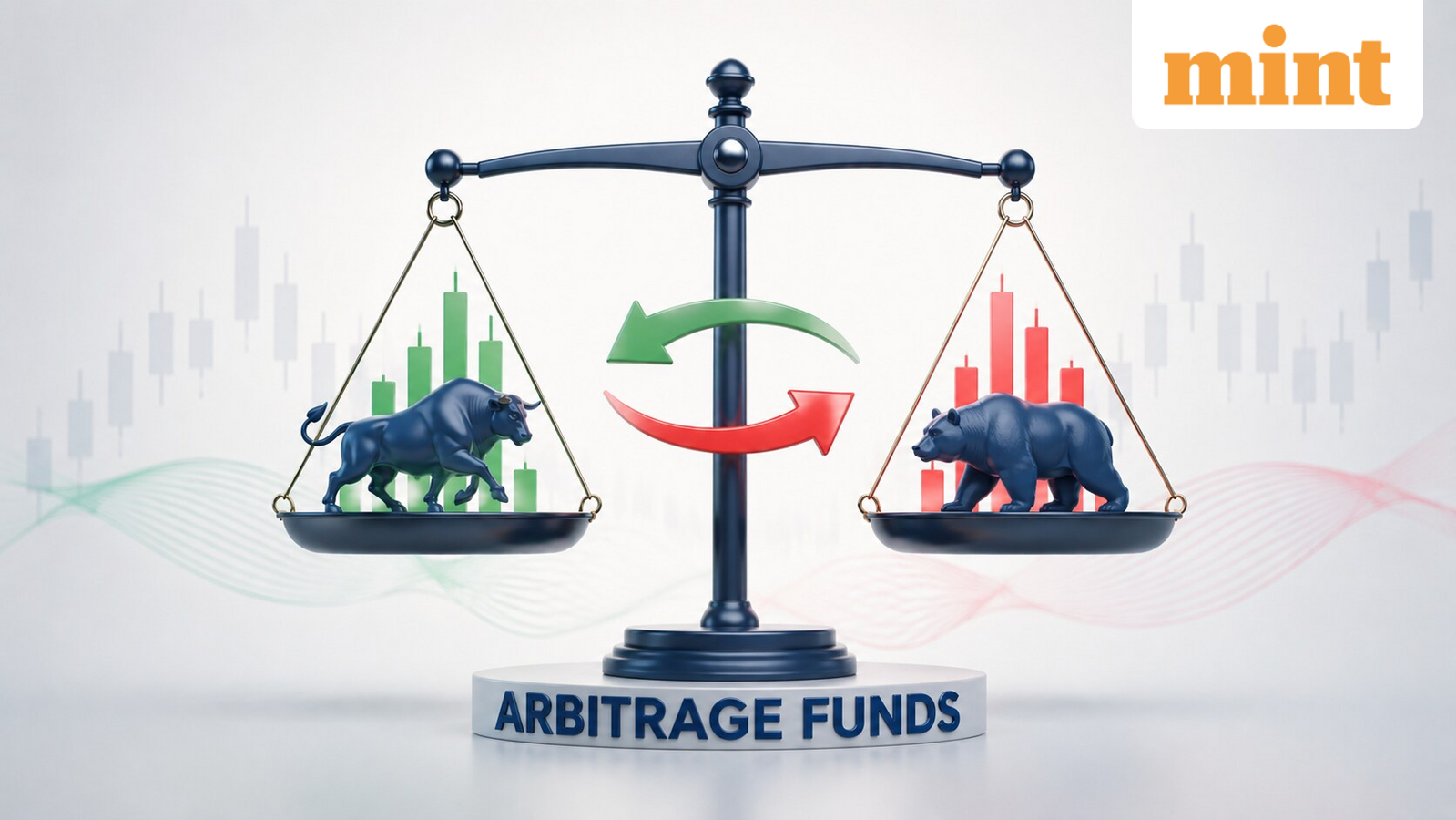
Arbitrage funds are a type of hybrid mutual fund that aims to generate returns by taking advantage of price differences in the cash and futures markets. The strategy involves buying a stock in the cash market and simultaneously selling the same stock in the futures market when it is trading at a higher price, thereby locking in the price difference.
Since the fund takes equal and opposite positions in both markets, its returns are less dependent on the direction of the stock market and more on the availability of arbitrage opportunities.
So, let’s take a closer look at what arbitrage funds are, how they work, the key factors investors should consider before investing, and the benefits and risks associated with these funds.
What are arbitrage funds?
Under SEBI regulations, arbitrage funds must invest at least 65% of their assets in equities and equity-related instruments while following an arbitrage-based investment strategy.
Arbitrage refers to the practice of simultaneously buying and selling the same asset in different markets to benefit from a price mismatch. The objective is to earn returns from the gap between the two prices while minimizing exposure to market movements.
Under SEBI’s revised regulations effective April 1, 2026, arbitrage funds are no longer permitted to invest in Infrastructure Investment Trusts (InvITs).
Additionally, the debt portion of the portfolio is restricted to relatively low-risk instruments such as Certificates of Deposit (CDs), government securities with residual maturity of up to one year, units of liquid mutual fund schemes, units of money market mutual fund schemes, and other mutual fund schemes with a macaulay duration of less than one year.
These changes are aimed at ensuring that the debt allocation within arbitrage funds remains highly liquid and conservative.
How do arbitrage funds work?
Arbitrage funds seek to generate returns through the price differences between the cash market and the futures market for the same stock.
The fund manager buys a stock in the cash market and simultaneously sells an equivalent quantity of the same stock in the futures market, where it is usually trading at a premium. By taking equal and opposite positions in the two markets, the fund locks in the price difference, known as the arbitrage spread.
These positions are typically held until the futures contract expires. As expiry approaches, the futures price and the cash market price generally converge. The fund then closes both positions and captures the spread as its return, after deducting trading and other related costs.
For example, if a stock is trading at ₹1,000 in the cash market and ₹1,020 in the futures market, the fund can buy the stock at ₹1,000 and sell the futures contract at ₹1,020. When the two prices converge at expiry, the fund earns the locked-in spread.
Because gains in one market are usually offset by losses in the other, the strategy is largely insulated from broad market movements. Whether stock prices rise or fall, the return depends primarily on the initial gap between the cash and futures prices rather than on the direction of the market.
Arbitrage funds continuously identify and execute such opportunities across multiple stocks. Any surplus cash is generally invested in short-term debt and money market instruments to maintain liquidity and meet operational requirements.
Factors to consider while investing in arbitrage funds
Here are a few factors you need to consider in arbitrage funds:
Availability of arbitrage opportunities
Returns are largely determined by the gap between cash and futures prices. When these spreads are wide, funds can lock in higher yields. When spreads shrink, return potential declines irrespective of market performance.
Returns may fluctuate across market cycles
Arbitrage opportunities are not available in equal measure at all times. Investors should understand that returns can vary from one period to another depending on liquidity, volatility, and pricing inefficiencies in the market.
Investment horizon should match the strategy
Arbitrage gains accrue over multiple futures expiry cycles. Investors with a holding period of at least three to six months are generally better positioned to benefit from the strategy than those seeking returns over a few weeks.
Asset allocation
The mix between equity arbitrage positions and debt instruments can vary across schemes. Investors should ensure that the fund’s allocation aligns with their risk tolerance, liquidity needs, and investment objectives.
Expense ratio and costs
Since arbitrage strategies typically involve buying and selling of securities to capture arbitrage opportunities, the expenses can have a meaningful impact on returns. Comparing expense ratios across schemes can help investors identify more cost-efficient options.
Fund manager’s execution capability
Arbitrage is a low-margin strategy where efficient trade execution, cost control, and access to liquidity can significantly influence returns. Even small differences in execution by the fund manager can affect returns over time.
Check rolling returns instead of recent performance
Rather than focusing only on the latest one-year return, investors should examine the fund’s rolling returns over the years. This provides a better picture of how consistently the fund has delivered returns over time.
Benefits of investing in arbitrage funds
- Unlike equity funds, arbitrage funds do not require stock prices to rise to earn returns. The strategy focuses on capturing pricing inefficiencies rather than betting on market bullishness.
- Market uncertainty often widens cash-futures spreads, creating more opportunities for arbitrage trades. As a result, periods that may not work for equity funds can sometimes improve return prospects for arbitrage funds.
- For investors who do not need immediate access to their money but are uncomfortable with taking significant equity risk, arbitrage funds can serve as a middle ground between equity and traditional short-term debt products.
- The category combines the tax treatment of equity-oriented funds with a strategy that is generally less sensitive to day-to-day stock market movements, which can improve risk-adjusted outcomes for investors.
Drawbacks of arbitrage funds
- Strong returns in one period do not guarantee similar performance in the next. In stable markets, there is a lack of arbitrage opportunities, thereby reducing the fund’s earning potential.
- During periods of market stress, lower liquidity, wider bid-ask spreads, or tighter margin requirements can make trades more difficult to execute, which may affect returns and lead to temporary fluctuations in the fund’s NAV.
- During periods of low volatility and tight spreads, arbitrage funds can even underperform certain debt fund categories.
Disclaimer: This is purely for educational/ informational purposes and should not be taken as any sort of investment advice. Always consult a SEBI-registered advisor before making any investment decisions.